





When 35Wx7 rope improves fatigue life on high-cycle cranes
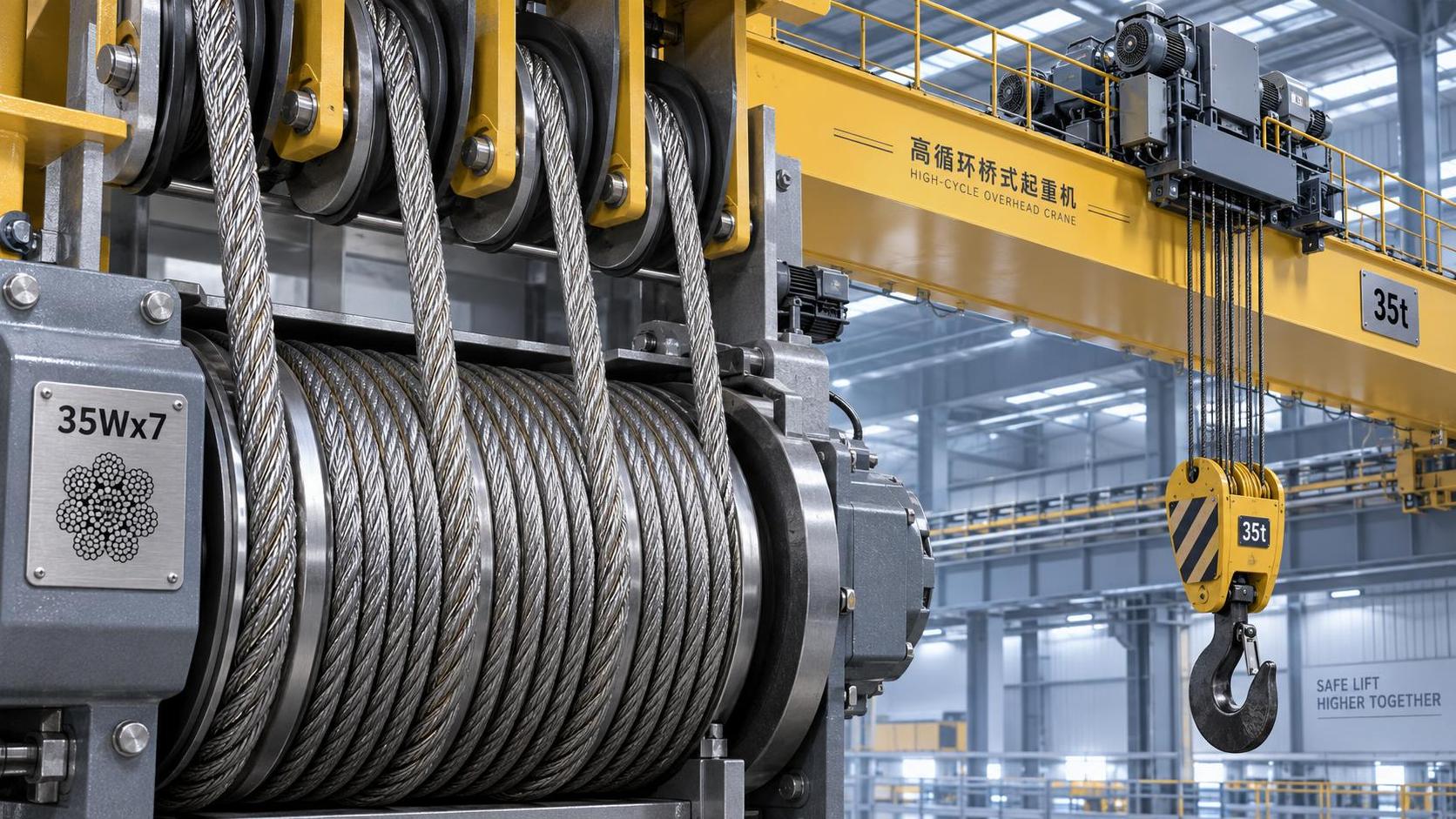
A 35Wx7 rope improves fatigue life on a high-cycle crane when the rope spends much of its service life repeatedly bending over sheaves and through drum grooves under meaningful tension. Its construction uses 35 outer strands arranged around a seven-strand core, creating many relatively small wires. That flexibility allows the rope to conform to curved surfaces with lower localized bending stress than a less flexible construction of the same diameter.
This advantage is most visible on cranes with frequent short lifts, rapid duty cycles, multiple reeving passes, or compact sheave arrangements. A rope that has adequate breaking strength but poor bending endurance can still become the maintenance-limiting component. Outer-wire breaks, localized flattening, loss of metallic area, and premature retirement often begin at the points where the rope repeatedly changes direction.
Where the 35Wx7 construction earns its place
Wire-rope fatigue develops from cyclic stress. Every time a loaded rope bends over a sheave or wraps onto a drum, wires on the outside of the bend are stretched while wires on the inside are compressed. Repeated cycles gradually initiate small cracks, often first in individual wires near strand crowns. The large number of wires in a 35Wx7 construction distributes this bending action across finer elements, reducing the severity of strain in each wire when the rope is properly matched to the crane.
A 35Wx7 rope is therefore a strong candidate where bending fatigue, rather than simple static load capacity, drives replacement intervals. Typical conditions include:
- Overhead process cranes making frequent, repetitive lifts over the same travel path.
- Container, port, and production-handling cranes where the hoist line passes over several sheaves during every cycle.
- Equipment with relatively small sheave or drum diameters for the selected rope size, provided the crane design permits the construction.
- Hoists where smooth running and stable layer formation affect availability as much as nominal lifting capacity.
The construction should not be selected solely because the crane has a high number of operating cycles. A large sheave diameter, low working load, and uncomplicated reeving can allow other rope designs to perform satisfactorily. Conversely, a moderate-cycle crane can be demanding when side pull, poor fleet angle, abrasive contamination, or repeated shock loading is present. Cycle count describes only part of the fatigue environment.
Flexibility changes the bending response, not every failure mode
The principal tradeoff is that flexible multi-strand ropes are often less tolerant of rough handling, severe crushing, and some forms of external damage than coarser-stranded alternatives. More wires create better bending behavior, but individual outer wires are smaller. A 35Wx7 rope may extend service life on correctly aligned sheaves while showing rapid deterioration if it is dragged across sharp edges, squeezed in a damaged drum groove, or subjected to persistent cross-over pressure between rope layers.
This distinction matters when diagnosing a short rope life. Wire breaks concentrated at sheave contact zones point toward bending fatigue, undersized sheaves, misalignment, or inadequate lubrication. Flattened areas and crushed strands near the drum suggest compression or poor spooling. A narrow band of damage recurring at one location can indicate a defective sheave groove or a local obstruction. Replacing the rope with a more flexible construction without correcting the mechanical cause can simply move the failure to a different form.
Sheave and drum geometry set the practical result
The ratio between sheave diameter and rope diameter has a direct effect on bending severity. Smaller sheaves force a tighter bend, increasing cyclic stress in the wires. A 35Wx7 construction can improve resilience under this condition, but it does not make an unsuitable sheave diameter acceptable. The rope manufacturer and crane documentation should be reviewed together for the permitted construction, diameter tolerance, minimum sheave dimensions, and groove profile.
Grooves require equal attention. A groove that is too narrow pinches the rope and raises contact pressure; one that is too wide reduces lateral support and can allow flattening. Worn grooves may appear smooth while no longer matching the rope diameter. On multi-layer drums, the first layer establishes the foundation for all layers above it. Loose wraps, uneven tension, or damaged anchoring can cause upper layers to bite into lower layers, which is a crushing problem rather than a fatigue-life benefit that rope construction alone can solve.
Selection data that should travel with the rope order
A request for “35Wx7 rope” is incomplete unless it also identifies the working arrangement. The relevant information includes rope diameter, nominal strength grade, core type, lay direction, whether rotation resistance is required, number of falls, drum type, sheave diameters, and the expected load range. The line is often lightly loaded for much of the shift, then exposed to occasional heavier lifts. Both conditions matter: very low tension can impair spooling, while higher tension increases bending and contact stresses.
Core selection deserves particular care. A steel core can offer support and resistance to crushing in some applications, while a fiber core may provide different flexibility and lubrication characteristics. Neither is automatically better for high-cycle operation. The correct choice follows the crane design, the drum pressure, the reeving arrangement, and the specified rope category.
Rotation behavior must also be separated from fatigue performance. A rope chosen for bending endurance is not automatically appropriate for a single-part line, a long free-hanging lift, or a load that is highly sensitive to rotation. If the hook block or load turns during operation, the reeving geometry, rope category, and end termination require a full system review. Adding a swivel without confirming its suitability can worsen rotation in certain rope arrangements.
Installation can preserve or erase the advantage
Even a suitable rope loses fatigue life when installed with twist, kinks, or uneven initial tension. The replacement rope should be unreeled from a rotating payoff device rather than pulled sideways from a stationary coil. During installation, the rope needs to enter the drum under controlled back tension so the first layer is firm and evenly packed. A loose foundation layer commonly produces irregular upper layers and local crushing later in service.
Lubrication is not cosmetic. The lubricant must reach the contact zones between wires and strands while remaining compatible with the rope, environment, and nearby equipment. A dry-looking rope may have lost internal lubrication even when its exterior appears clean. Excessive external lubricant can attract abrasive material, so the objective is a maintained lubricating film rather than indiscriminate application.
Inspection records become more useful when they identify the location and pattern of deterioration instead of recording only the number of broken wires. Marking the affected rope length, noting whether damage occurs at a sheave, drum crossover, termination, or idle section, and comparing the pattern after replacement creates a basis for correcting the underlying condition. Removal criteria should follow the applicable crane, rope, and site requirements rather than a visual judgment alone.
Auxiliary restraint, towing, or fixed securing work should be kept separate from the hoist-rope decision. Where a chain assembly is specified for those functions, the configuration and intended use need their own evaluation, such as DIN763 DIN764 DIN766 Standard Carbon Steel Electric Galvanized Welded Link Chain. Chain selection does not replace the required assessment of the crane’s running rope, sheaves, drum, and reeving system.
A 35Wx7 rope delivers its clearest fatigue-life benefit when repeated bending is the dominant service demand and the crane provides proper support, alignment, lubrication, and spooling. Where crushing, corrosion, side loading, or rotation control governs rope life, those conditions must be resolved alongside construction selection.
Navigation
Send Us A Message



Shandong Faster Technology Co., Ltd. is a professional manufacturer of steel wire ropes.
Get in Touch
*We respect your confidentiality and all information are protected.