





Wire Rope Specifications That Often Get Overlooked in RFQs
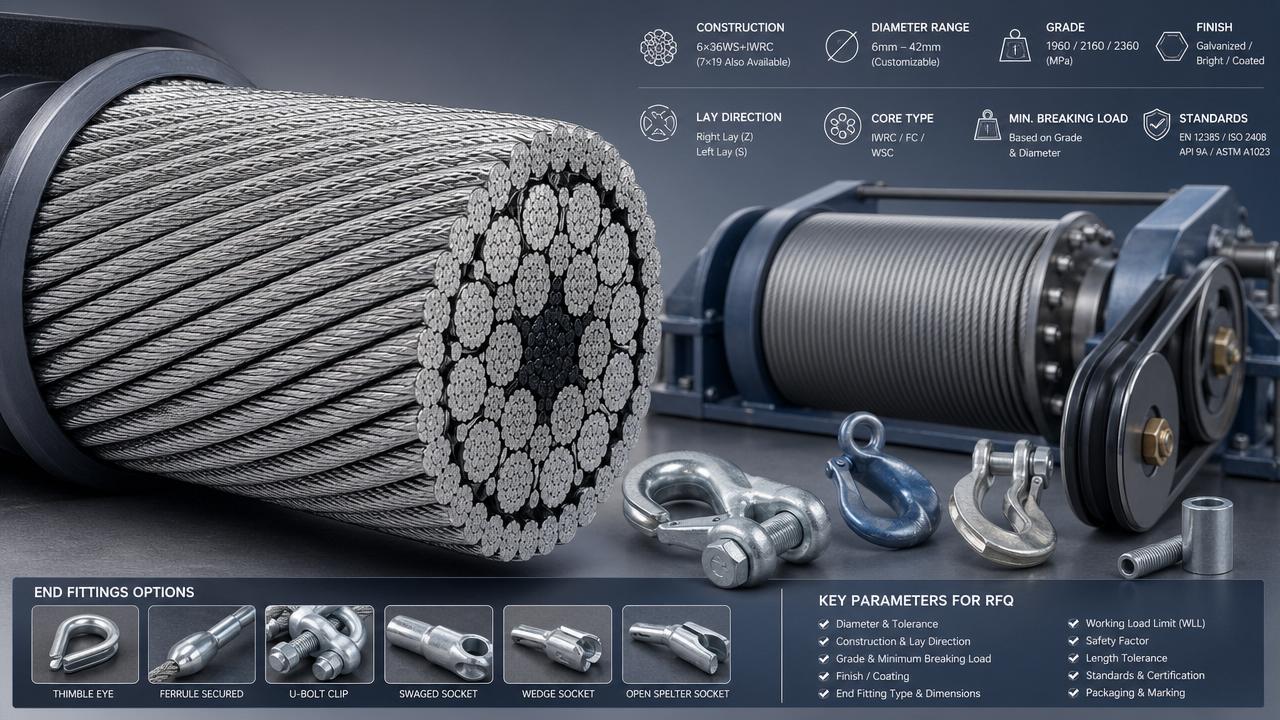
When procurement teams prepare an RFQ for Wire Rope, small specification gaps can lead to costly delays, unsuitable selections, or supplier misunderstandings. Beyond diameter and construction, overlooked details such as core type, lay direction, surface finish, tensile grade, and compliance standards often determine performance and total lifecycle value. This article highlights the Wire Rope specifications buyers frequently miss and explains how clearer RFQs help improve sourcing accuracy, safety, and long-term reliability.
Why overlooked Wire Rope details matter more in today’s sourcing environment
A noticeable shift is taking place in industrial procurement: buyers are being asked to deliver both cost control and higher operational certainty. In that environment, a Wire Rope RFQ can no longer be treated as a basic request listing only diameter, length, and breaking load. The market has become less forgiving of incomplete technical descriptions because applications are more specialized, compliance scrutiny is tighter, and downtime costs are more visible than before.
This change affects procurement teams directly. When a sourcing document for Wire Rope lacks details such as lubrication type, preforming, tolerance expectations, or end termination requirements, suppliers must make assumptions. Those assumptions may not match the real working condition. The result is not just quotation inconsistency; it can also create inspection failures, shortened service life, or installation delays.
Another trend is the growing expectation that purchasing staff understand the operating context behind the product. Buyers are increasingly evaluated not only on price negotiation, but on whether the supplied Wire Rope performs safely in cranes, hoists, winches, marine systems, elevators, mining equipment, or heavy-duty material handling lines. That is why overlooked specifications now have strategic importance.
Signals driving this change
- Greater equipment specialization and application-specific performance demands
- Stronger focus on safety documentation and traceability
- Pressure to reduce total lifecycle cost rather than only unit price
- More global sourcing, which increases the risk of interpretation gaps
- Longer approval cycles when RFQ specifications are incomplete
For procurement personnel, the practical takeaway is clear: a better Wire Rope RFQ is no longer an administrative formality. It is a risk-control tool that shapes supplier response quality, technical comparability, and long-term asset reliability.
The specification gaps that suppliers see most often
In many RFQs, the most commonly stated items are rope diameter, rope construction, and approximate quantity. Those are essential, but they are rarely enough. As industrial applications become more demanding, the missing details are often the ones that determine bending fatigue, crush resistance, corrosion behavior, or compatibility with sheaves and drums.
The issue is not that buyers ignore technical quality. Rather, many specifications remain undocumented because they are inherited from old templates, copied from past orders, or assumed to be standard. In reality, there is no universal “standard Wire Rope” suitable for all lifting or pulling conditions.
Below is a practical view of the Wire Rope specifications that are often overlooked and why they matter during quotation and selection.
Frequently missed RFQ details
Core type is no longer a minor detail
Fiber core and steel core options can produce very different performance outcomes. In applications with high loads, drum pressure, or multi-layer winding, steel core Wire Rope may offer better structural support. In applications that require more flexibility, another construction may be preferable. If the RFQ does not specify core type, quotations may not be technically comparable.
Lay direction affects installation and service behavior
Right regular lay, left regular lay, lang lay, and non-rotating designs are not interchangeable from a usage perspective. Buyers who leave lay direction unspecified may receive a Wire Rope that fits catalog language but performs poorly on the actual drum or sheave arrangement. This is especially relevant in lifting systems where rotation, abrasion, and spooling consistency are critical.
What is pushing procurement teams to specify Wire Rope more precisely
The growing need for precision in Wire Rope RFQs is not random. It comes from several converging forces in the industrial equipment and components sector. Procurement teams are now operating at the intersection of engineering expectations, operational uptime targets, and audit-ready purchasing controls.
One major driver is the cost of failure. A low-clarity RFQ can save a few minutes at the sourcing stage but create weeks of delay if the selected Wire Rope fails compatibility checks, requires re-approval, or performs below expected life. As downtime becomes more expensive, buyers are under pressure to define “fit for purpose” more carefully.
Another driver is the internationalization of supply. More sourcing teams compare multiple regions and vendors. That increases commercial options, but it also raises the likelihood that one supplier interprets a request differently from another. More detailed RFQs help standardize interpretation and reduce hidden variation.
Key drivers behind tighter Wire Rope specifications
- Higher expectations for safety and quality traceability
- More application-specific design requirements in cranes, offshore systems, and heavy machinery
- Broader use of lifecycle cost evaluation in sourcing decisions
- Greater reliance on cross-border quotations and technical equivalence reviews
- Need to reduce ambiguity between engineering, maintenance, and procurement teams
Why standards and documentation are becoming central
More buyers now request not only the Wire Rope itself, but also mill certificates, inspection reports, standard references, and testing details. This reflects a larger market movement toward documented assurance. A supplier may offer a competitive price, but if the RFQ does not define required standards or acceptance criteria, the approval process can still stall.
For that reason, procurement teams should increasingly treat standards, tolerance expectations, and certification requirements as part of the commercial specification package, not as post-order clarifications. This simple shift often improves sourcing accuracy more than another round of price negotiation.
How these changes affect procurement, engineering, and supplier alignment
The impact of incomplete Wire Rope specifications is not limited to the buyer. It creates friction across the entire procurement chain. Engineering may need to revalidate the selected construction, maintenance may reject the delivered rope based on field experience, and suppliers may defend their quotation by saying the RFQ did not define a key requirement.
That is why the current trend is toward stronger internal alignment before RFQ release. The more critical the application, the more important it becomes to collect information from operations, maintenance, safety, and engineering before asking for supplier offers. This reduces rework and improves supplier response quality.
For purchasing personnel, the value is practical: a better-defined Wire Rope requirement makes quotes easier to compare and supplier recommendations easier to verify. Instead of sorting through inconsistent assumptions, teams can focus on lead time, service support, and long-term reliability.
Who feels the impact most
A sourcing trend worth noting
More companies are moving away from “brand-or-equal” purchasing language without technical boundaries. In the case of Wire Rope, equivalent supply only works when equivalence is defined by construction, standard, tensile grade, finish, lubrication, and application suitability. Otherwise, price comparison becomes misleading.
What buyers should now include in a stronger Wire Rope RFQ
The practical response to these market changes is not to make RFQs unnecessarily long. It is to make them more decision-useful. Buyers should include the specification points that materially affect selection, installation, compliance, and service life. A concise but complete Wire Rope RFQ usually performs better than a short one filled with assumptions.
A good approach is to organize requirements into four groups: technical design, operating environment, compliance needs, and commercial/inspection conditions. This helps suppliers respond with fewer assumptions and helps internal teams review quotations faster.
The goal is not to turn procurement staff into design engineers. The goal is to ask the right clarifying questions before releasing the RFQ, so that supplier responses are relevant, comparable, and lower risk.
Suggested RFQ checklist for Wire Rope
- Diameter, length, and construction
- Core type and lay direction
- Tensile grade or required minimum breaking force
- Surface finish such as bright, galvanized, or other corrosion-resistant option
- Lubrication condition and contamination sensitivity
- Application details: crane, winch, hoist, marine, mining, or other use
- Drum and sheave information where relevant
- End terminations, if required
- Applicable standards, inspection level, and certificates
- Packaging, marking, storage, and delivery conditions
Questions that improve supplier response quality
If a team is unsure whether its Wire Rope RFQ is complete, a useful test is to ask: Can two suppliers quote the same product without making different assumptions? If the answer is no, the document likely needs more clarity. Buyers should also ask whether the stated specification reflects actual operating conditions rather than legacy purchasing habits.
In current sourcing practice, clarity often creates better commercial outcomes. Suppliers can quote more accurately, internal reviewers can approve more confidently, and buyers can reduce the hidden cost of correction, return, or premature replacement.
How to judge future Wire Rope sourcing requirements more effectively
Looking ahead, the direction is clear: Wire Rope sourcing is becoming more specification-driven, more application-aware, and more documentation-sensitive. Procurement teams that adapt early will be better positioned to manage supplier choices, technical risk, and lifecycle cost. Those that continue to rely on minimal RFQs may face more approval delays and less reliable quotation comparisons.
The most useful mindset is to monitor change signals rather than react only when a supply issue occurs. If equipment loads are increasing, if environmental exposure is changing, if maintenance teams are reporting early wear, or if compliance checks are becoming stricter, then the Wire Rope specification should be reviewed before the next RFQ is issued.
For companies that want to improve sourcing quality, the next step is straightforward: review current RFQ templates and identify where assumptions still exist. If your team wants to judge how these trends affect your own procurement process, focus on a few practical questions: Are core type, lay direction, finish, grade, and standards clearly defined? Are operating conditions documented well enough for suppliers to recommend the right Wire Rope? And can your internal stakeholders agree that the RFQ describes not just what to buy, but what performance the rope must deliver over time?
Navigation
Send Us A Message



Shandong Faster Technology Co., Ltd. is a professional manufacturer of steel wire ropes.
Get in Touch
*We respect your confidentiality and all information are protected.