





Wire Rope Size Selection: How Diameter and Construction Affect Safe Working Load
Wire Rope Size Selection: How Diameter and Construction Affect Safe Working Load
Selecting the correct wire rope size is not simply a matter of choosing the largest diameter that fits the budget or the smallest rope that appears to meet a calculated load. In lifting, traction, and securement work, diameter is closely tied to breaking force, but the final safe working load also depends on rope construction, core type, termination efficiency, sling geometry, equipment compatibility, and the safety requirements governing the job.
For technical evaluators, the key question is therefore not “What diameter can carry this load?” It is “What complete rope assembly can carry this load safely throughout its intended service life?” A rope that performs well on a static pull test may still be unsuitable if it bends repeatedly over undersized sheaves, is exposed to saltwater corrosion, or is used in a multi-leg sling at an unfavorable angle.
Diameter Sets the Starting Point, Not the Final Answer
Wire rope diameter determines the metallic cross-sectional area available to resist tension. All else being equal, a larger diameter normally provides a higher minimum breaking force. That relationship makes diameter the first screening parameter when comparing rope options, especially for hoisting lines, crane slings, marine mooring-related equipment, and mining applications.
However, safe working load is not the same as minimum breaking force. Working load is established by applying the appropriate design factor and then accounting for the actual assembly and use conditions. A wire rope can lose usable capacity through poorly selected fittings, damaged strands, sharp-edge contact, side loading, crushing on a drum, or an altered sling angle. For this reason, a supplier’s rated capacity chart should always be read together with the stated rope grade, construction, core, end termination, and applicable standard.
Diameter measurement also needs discipline. A nominal 10 mm rope should be measured across the widest points of opposing strands, not across the valleys between them. Measurements taken after a rope has been flattened, worn, or loaded under distortion can create a misleading impression of its original size. Inspection records should distinguish between manufacturing tolerance and in-service diameter loss.
Construction Changes the Trade-Off Between Strength, Flexibility, and Wear
Two ropes of the same diameter can behave very differently. Construction describes the number of strands, the number of wires in each strand, the lay arrangement, and the core. A construction with fewer, larger outer wires generally offers better resistance to abrasion and rough handling. A construction with more, finer wires is usually more flexible and better suited to repeated bending around sheaves or drums, though its smaller outer wires may be more vulnerable to abrasive wear.
Common selections illustrate this balance. A 6x19-type rope is often considered where abrasion resistance and general lifting duty are important. A 6x37-type rope has more individual wires and is commonly considered where flexibility and fatigue performance are priorities. Multi-strand constructions such as 19x7 may be selected for particular rotation-resistant applications, but they require proper handling and should not be substituted casually for a conventional rope. Their behavior under load, installation requirements, and compatibility with the lifting system must be checked as a complete package.
Core selection matters as well. A fiber core can support flexibility and lubricant retention in suitable applications. An independent wire rope core (IWRC) generally provides higher resistance to crushing and lower structural stretch, making it relevant where ropes are subject to high line pull, multilayer spooling, or demanding sling service. Neither core is universally better; the duty cycle and equipment geometry decide the practical choice.
The Sling Arrangement Can Reduce Available Capacity
When wire rope is made into a sling, the assembly must be evaluated rather than the rope alone. Eye splices, ferrules, sockets, thimbles, master links, hooks, and mechanical connections all influence the rated working load. A correctly sized rope paired with an underspecified hook or unsuitable ferrule does not create a safe lifting system.
Multi-leg bridle slings deserve particular attention. As the angle between the sling leg and vertical becomes wider, tension in each leg rises. Load sharing may also be uneven because of load shape, center-of-gravity variation, hook position, and differences in leg length. Four-leg assemblies can provide valuable load stability, but it is unsafe to assume that all four legs will always carry an equal share. The rated capacity must be based on the relevant sling configuration and the conditions defined by the applicable lifting practice or project requirement.
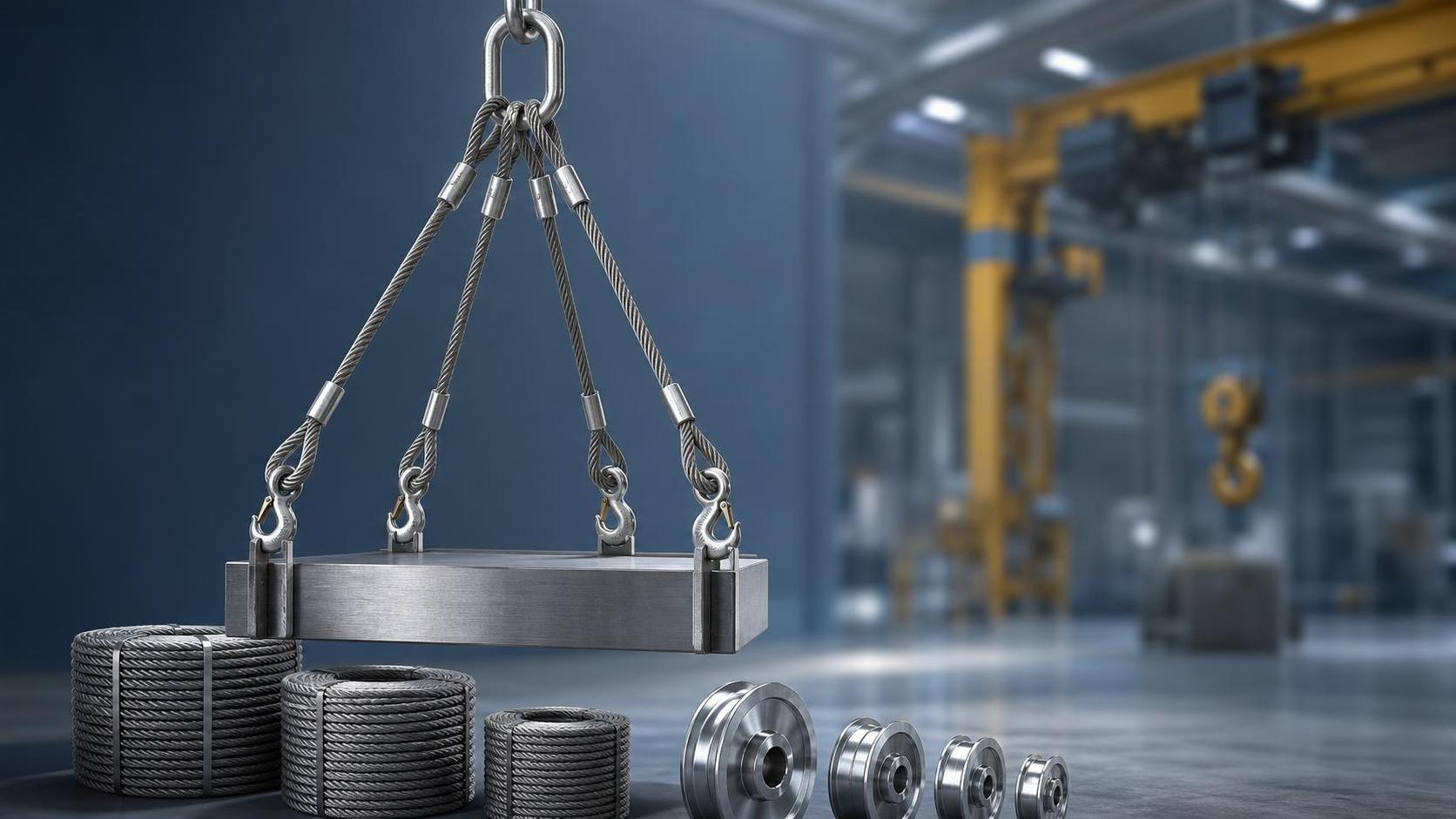
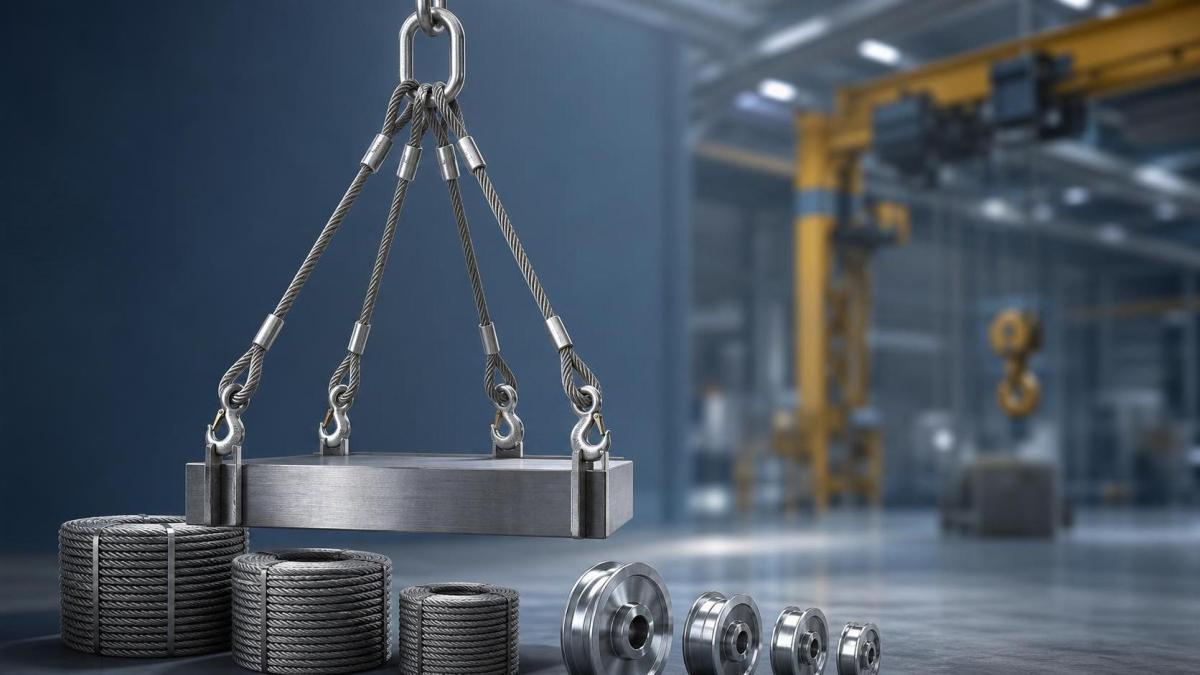
For example, a 4 Leg Wire Rope Sling Carbon Steel With Latched Eye Sling Hook for Heavy Lifting combines four rope legs, mechanically formed thimble eyes, an oblong master link, and latched hooks. Such an arrangement can be appropriate for balanced loads in construction, ports, mining, or marine handling, but selection still requires the actual load dimensions, lifting points, headroom, leg angle, and attachment compatibility. The master link must fit the crane hook correctly, and each hook must be suitable for its intended connection and loading direction.
Material and Surface Finish Must Match the Exposure
A technically correct wire rope size can still fail early if corrosion conditions are underestimated. Bright rope may be practical for controlled indoor environments where lubrication and inspection are well managed. Galvanized rope is commonly considered where atmospheric moisture is a concern. Stainless steel may be specified where corrosion resistance is more critical, although the required mechanical properties and the actual chemical environment must be reviewed rather than assumed. Plastic-coated rope can protect surfaces and improve handling in some securement or general-purpose applications, but the coating does not remove the need to inspect the underlying rope.
In ports, fishery operations, and ocean-facing projects, corrosion resistance should be evaluated alongside abrasion, bend fatigue, and maintenance access. In a dusty mine or construction site, external wear and crushing may be the dominant concerns. The right selection is often a compromise based on the failure mode most likely to limit service life.
A Practical Evaluation Sequence
A reliable specification process begins with the maximum load, but should not end there. Technical teams should confirm the following before releasing a purchase specification:
- Maximum working load, including any foreseeable dynamic effects from lifting, acceleration, or shock loading.
- Application type: static securement, repeated hoisting, crane line, traction, marine use, or a fabricated sling assembly.
- Required safety factor, rated capacity basis, and any project, customer, or local compliance requirements.
- Rope construction, tensile grade, core type, and compatibility with sheaves, drums, and reeving arrangements.
- Environmental exposure, including moisture, salt, chemicals, abrasive particles, and temperature.
- Termination type, sling angle, fitting dimensions, inspection expectations, and replacement criteria.
This process avoids a common procurement error: requesting only diameter and length. Those two details are necessary, but they do not define a complete rope. A more usable request includes construction, finish, tensile strength class where applicable, core preference, end preparation, quantity, and the service description. Drawings or samples are especially useful when a sling must interface with existing lifting points or machinery.
From Rope Selection to a Complete Supply Decision
For projects that involve several lifting and securement components, it is often more efficient to review rope, sling, and chain requirements together. Shandong Faster Technology Co., Ltd. manufactures steel wire rope, slings, and chains for industrial applications including lifting, ships, ports, construction, mining, and elevators. Its production capability covers single- and multi-strand wire ropes from 1 to 20 mm in galvanized, stainless steel, and plastic-coated series, alongside customized pressed sling assemblies and chain grades from G30 through G100.
For a technical evaluation, the useful point is traceability of the specification: the rope must be matched to the assembly, and the assembly to the job. Production controls from wire drawing through twisting and rope closing can support consistency, but the final decision should still be verified against the project’s required load rating, fitting configuration, certification documentation, and inspection plan.
The best wire rope size is therefore rarely the one with the highest nominal capacity alone. It is the diameter and construction that preserve an adequate working-load margin while fitting the equipment, surviving the environment, and allowing the rope or sling to be inspected and used as intended.
Navigation
Send Us A Message



Shandong Faster Technology Co., Ltd. is a professional manufacturer of steel wire ropes.
Get in Touch
*We respect your confidentiality and all information are protected.