





Why 19x7 rope is chosen for rotation-resistant lifting
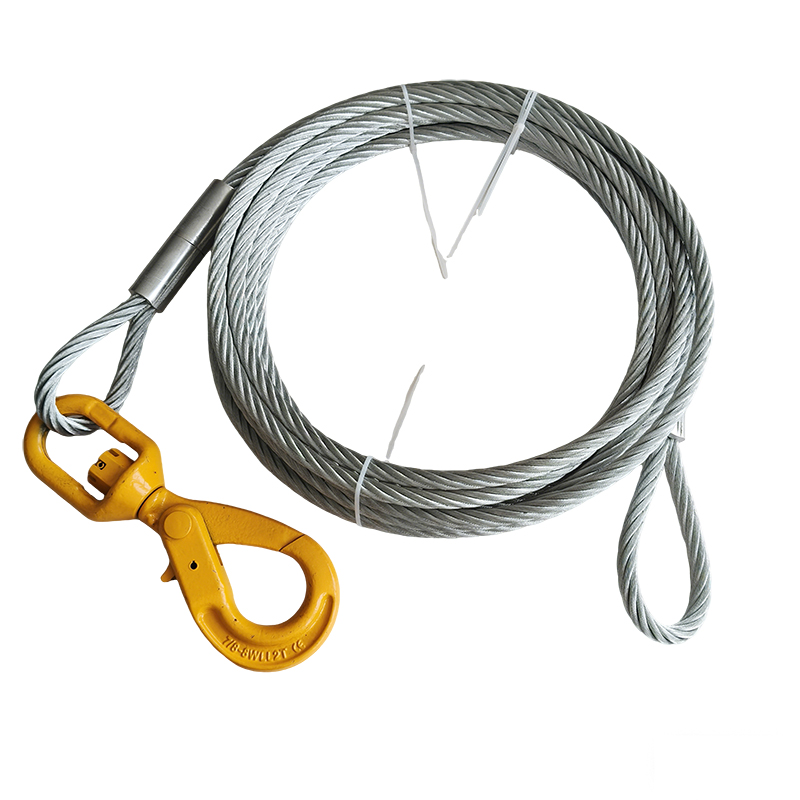
A 19x7 rope is chosen for rotation-resistant lifting when a suspended load must remain reasonably stable instead of turning as it travels. This matters on multi-part crane falls, long lifts, single-line hoists, and jobs involving guided loads, personnel-sensitive areas, or components that must be positioned accurately. Its value is not simply higher strength. The main reason is its strand geometry, which counteracts a large part of the torque generated under load.
For buyers, the practical question is whether the lifting system creates enough tendency for the hook block or load to spin that a conventional rope becomes difficult to control. When it does, a 19x7 construction is often a more appropriate specification than a standard 6-strand general-purpose rope.
How the 19x7 construction reduces load rotation
The designation 19x7 describes a rope built from 19 strands, with each strand containing 7 wires. These strands are arranged in layers around the rope center. During loading, wire rope naturally develops torque because its wires and strands follow helical paths. In a conventional rope, that torque can be transmitted to the hook and suspended load, causing rotation.
In a 19x7 rope, the opposing strand layers are arranged so that their torsional effects partially balance each other. This does not mean the rope is completely non-rotating. No wire rope should be assumed to eliminate rotation under every condition. It means that, compared with ordinary 6x19 or 6x37 constructions, the rope is designed to transmit substantially less turning force to the load in normal lifting use.
That distinction is important. A rotation-resistant rope improves control, but it does not correct poor reeving, an unbalanced load, a freely swiveling hook, or a lifting arrangement with excessive side pull. Procurement specifications should treat the rope construction as one part of the lifting system, not as a substitute for proper rigging practice.
Where rotation resistance makes a real operational difference
19x7 rope is commonly considered for crane hoist lines, tower crane applications, port handling equipment, mining hoists, and construction lifts where the hook block works at height or the load has a long free-hanging distance. The longer the suspended length and the fewer the parts of line, the more visible load rotation can become.
It is particularly useful when lifting long fabricated sections, structural members, pipe assemblies, machinery, or loads with an uneven shape. A rotating load can strike nearby structures, twist sling legs, make tag-line control difficult, and delay accurate placement. On repeated duty cycles, reducing this instability can also make lifting operations more predictable for the operator and rigging crew.
However, 19x7 rope is not automatically the right choice for every hoist. A short, well-guided lift on a small workshop hoist may gain little from a rotation-resistant construction. In that situation, a flexible general-purpose rope may offer a more economical and serviceable option, provided it meets the equipment manufacturer's requirement and the intended duty.
Do not select by construction alone
A common purchasing error is to request “19x7” without defining the operating conditions. Construction identifies the rope family, but it does not complete the specification. Diameter, nominal strength grade, finish, core, lay direction, lubrication, rope length, and end termination can all affect suitability and service life.
The crane or hoist manufacturer's rope recommendation should remain the starting point. A rope that is suitable in principle can still perform poorly if its diameter, construction, or lay does not match the reeving system.
Rotation-resistant rope needs more careful handling
The internal design that reduces torque also makes this rope category less tolerant of incorrect installation and handling than many general-purpose ropes. Improper unreeling can introduce twist before the rope is even installed. A rope should be paid off from a correctly supported reel so it leaves straight, without being pulled sideways from a stationary coil.
Cutting, socketing, or applying grips without controlling the rope ends can allow strands to move. During installation, the rope must be wound evenly on the drum under appropriate tension. Loose, crossed, or crushed wraps can damage the rope internally and undermine the performance that justified selecting 19x7 in the first place.
Inspection also needs to look beyond visible broken wires. Flattening, localized diameter changes, birdcaging, strand displacement, corrosion, and unusual rope behavior near the termination are all meaningful findings. Rotation-resistant constructions can retain damage inside the rope before the exterior condition appears severe, so inspection intervals and discard criteria should follow the equipment and applicable lifting requirements.
Why a stronger rope is not necessarily a better answer
Increasing diameter or tensile grade may address capacity, but it does not necessarily reduce load rotation. A larger conventional rope can still transfer torque to the hook. Conversely, selecting a 19x7 rope solely because it is rotation-resistant can be excessive where the load is constrained, the lift is short, and the equipment is designed around a different construction.
Capacity, rotation behavior, fatigue resistance, abrasion resistance, and corrosion protection are separate selection factors. They interact, but none should be used as a shortcut for the others. The right request to a supplier is therefore not “send the strongest rope,” but “supply a rope compatible with this hoist, reeving arrangement, duty cycle, environment, and required load control.”
Separate hoist rope selection from sling selection
A 19x7 rope used as a running hoist line and a wire rope sling perform different jobs. The hoist rope must work repeatedly over sheaves and drums; the sling connects the load to the hook and must suit the load shape, sling angle, connection hardware, and handling method. It is possible to have a well-chosen rotation-resistant hoist line and still create load instability through unsuitable sling geometry.
For smaller rigging or bundling tasks, an eye-to-eye sling may be more relevant than a rotation-resistant running rope. For example, 8mm galvanized steel wire rope Sling soft eye 3tons Eye to Eye for Rigging & Hoisting can be considered where its stated working arrangement, end configuration, and compatibility with hooks, shackles, or rings suit the actual lift. The sling selection must still account for hitch type, sling angle, edge protection, and the capacity reduction that can arise when the load is not lifted vertically.
What to include in a procurement enquiry
A useful enquiry for 19x7 rope should state the equipment type, drum and sheave arrangement, required rope diameter, lifting duty, expected lift height, number of parts of line, environmental exposure, and preferred termination. Include whether load spin has already occurred and under what lift conditions. This gives the supplier enough context to distinguish a rope-construction issue from a reeving, hook, or rigging issue.
Shandong Faster Technology Co., Ltd. supplies wire ropes, slings, and chains for lifting, port, construction, mining, marine, and related applications, with options across galvanized, stainless steel, bright, and plastic-coated rope ranges. Where a project needs both a hoist rope and finished lifting accessories, aligning the rope construction, sling assembly, and connection hardware at the specification stage reduces the risk of mismatched components arriving on site.
The decision to use 19x7 rope is justified when controlling load rotation is a real operational requirement and the lifting equipment is suitable for this rope class. Specify the complete system, install it correctly, and inspect it as a rotation-resistant construction rather than treating it as an ordinary substitute rope.
Navigation
Send Us A Message



Shandong Faster Technology Co., Ltd. is a professional manufacturer of steel wire ropes.
Get in Touch
*We respect your confidentiality and all information are protected.