





When wire rope with IWRC is safer than fiber core rope
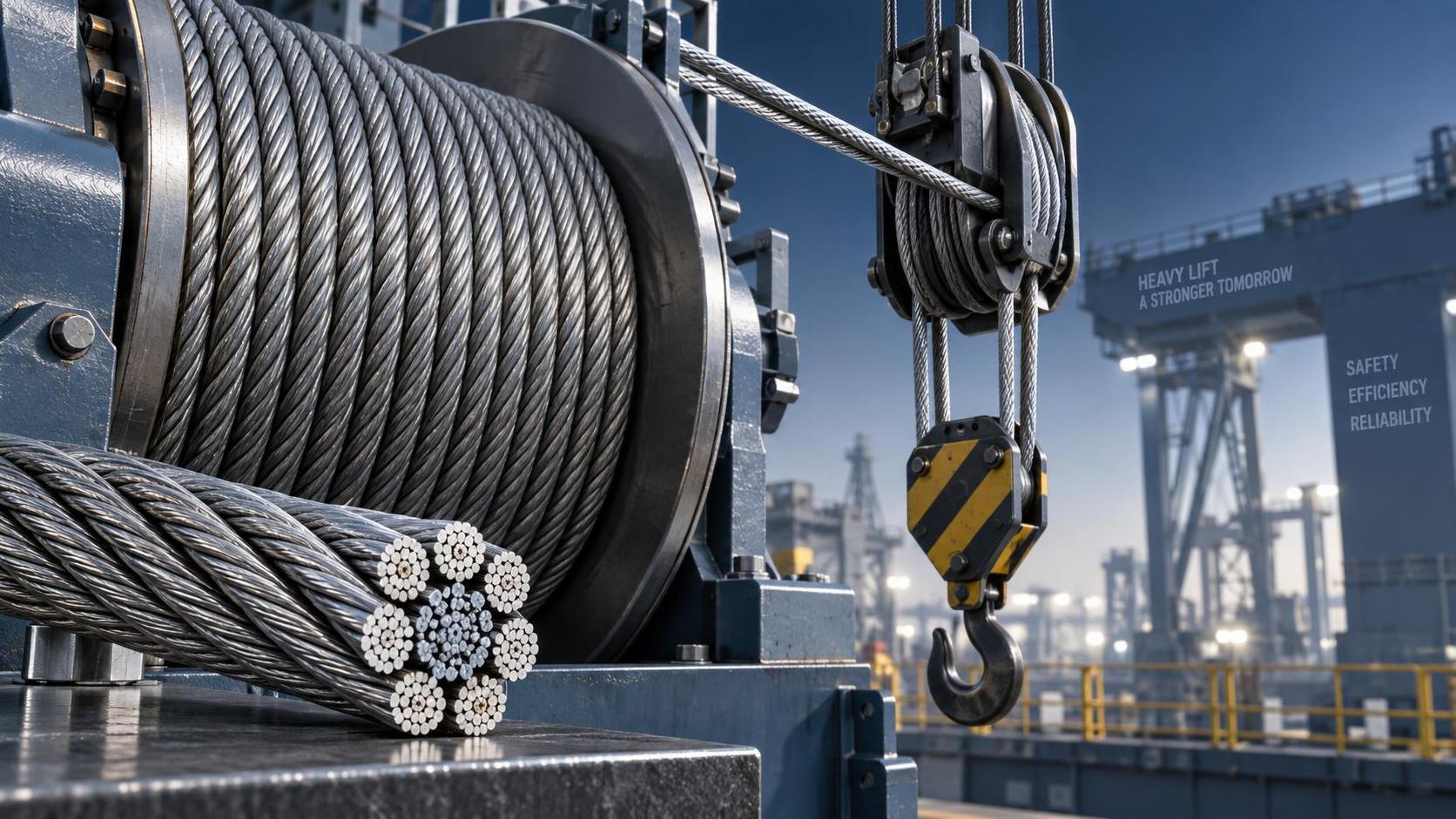
A rope core becomes a safety issue when the rope is exposed to high loads, multiple drum layers, fleet-angle pressure, shock loading, or repeated bending over sheaves. In those conditions, a wire rope with IWRC is usually safer than a fiber core rope because its independent wire rope core supports the outer strands, resists crushing, and preserves more of the rope’s metallic strength.
The decision should not be based on strength alone. A fiber core rope can work well in lower-pressure, well-lubricated applications where flexibility is the main priority. But when rope failure would interrupt lifting, material handling, vessel operations, hoisting, or personnel-related equipment, the core must be evaluated as part of the entire load path. A rope that looks acceptable externally may already have internal strand distortion or loss of support if its core is not suited to the drum and loading conditions.
Where IWRC provides a clear safety advantage
IWRC means Independent Wire Rope Core. Instead of using a natural or synthetic fiber center, the rope contains a separate steel wire rope core beneath its outer strands. This construction generally gives the finished rope greater resistance to radial pressure, a higher minimum breaking force than a comparable fiber-core construction, and better structural stability under demanding service.
It is often the safer specification in the following situations:
- Multi-layer drum winding: Lower wraps are compressed by upper layers, especially near crossover points. An IWRC better resists flattening and strand displacement caused by this pressure.
- High line pull or near-capacity lifting: When load levels are substantial and operational margins are limited, the added metallic support helps the rope maintain its geometry.
- Frequent starts, stops, and shock loading: Sudden tension changes can compact a softer core and create uneven load sharing among strands.
- Small-diameter drums or sheaves within the equipment’s permitted range: Repeated bending already creates fatigue demand. A stable core helps reduce additional deformation from crushing.
- High-temperature surroundings: Fiber cores may lose lubricant, harden, degrade, or lose support when exposed to heat beyond their intended service capability.
- Applications where rotation resistance and structural stability matter: Depending on rope design, an IWRC can offer better internal support under torque and tension.
Typical examples include crane hoist ropes, winch ropes, port handling equipment, mine hoists, construction lifting systems, and other installations where rope runs repeatedly over sheaves and winds under pressure. The exact rope construction still matters: an IWRC does not automatically make every rope suitable for every hoist, drum, or reeving arrangement.
The failure pattern that is easy to miss with fiber cores
Fiber-core ropes are not inherently unsafe. Their flexibility can be useful, and a properly lubricated fiber core may help retain lubricant within the rope. The problem appears when the application imposes more compression than the core can support.
On a multi-layer drum, for example, the rope may begin to flatten where wraps cross. Outer strands can be forced inward, local valleys can deepen, and the rope may no longer sit consistently in its intended position. The visible symptom is sometimes an irregular rope profile, but internal deterioration can begin before obvious external damage appears.
Once the core compresses, outer strands may carry load less evenly. This can accelerate abrasion, produce localized wire breaks, reduce bending performance, and increase the risk of crushing damage. Replacing the rope based only on visible broken-wire counts may then be too late, because a distorted rope may no longer perform as designed even when wire breaks appear limited.
IWRC construction does not eliminate inspection requirements, but it reduces the likelihood that the rope will lose its internal support under severe radial pressure. That distinction is especially relevant where the drum is not grooved, where spooling is imperfect, or where crossover zones cannot be avoided.
Use operating conditions, not a single feature, to make the decision
A practical selection review starts with the equipment rather than the catalog description. Review how the rope is actually loaded, wound, and maintained. The following comparison can help identify whether a fiber core is becoming a weak point.
Do not treat “higher strength” as permission to increase the working load limit. The equipment rating, rope diameter, termination efficiency, sheave and drum design, reeving arrangement, safety factor, and applicable operating rules remain controlling factors. An IWRC rope must be selected to the equipment manufacturer’s requirements and installed with correct tension and spooling practices.
Inspection findings that should trigger a core review
When evaluating an existing fiber-core rope, inspect the areas that experience the highest compressive and bending stress rather than only the most accessible free-hanging section. Drum crossover zones, first-layer wraps, sheave contact points, and termination-adjacent sections often reveal the condition of the rope sooner.
- Flattened areas or a rope diameter that changes noticeably along its length
- Outer strands that appear loose, raised, displaced, or unusually embedded
- Local birdcaging, waviness, or a tendency for the rope to rotate unexpectedly
- Concentrated wire breaks near crossover points or at repeated bend locations
- Dry rope interiors, lubricant loss, or contamination that prevents effective lubrication
- Damaged drum grooves, poor fleet angle, uneven spooling, or wraps cutting into lower layers
These observations do not automatically prove that the core type is wrong. They may point to a drum, sheave, alignment, lubrication, or installation problem. Still, where crushing and deformation recur after those conditions are corrected, changing from fiber core to an appropriate wire rope with IWRC is a reasonable engineering direction to assess.
IWRC is not automatically the right answer
An IWRC rope is generally stiffer than a comparable fiber-core rope. That can affect handling, bending behavior, and suitability for small sheaves or equipment designed around a more flexible construction. A replacement rope should never be selected only because it is labeled IWRC. Confirm the rope class, strand pattern, lay direction, nominal diameter, grade, finish, lubrication, rotational characteristics, and manufacturer-recommended minimum drum and sheave diameters.
Lubrication also needs attention. A fiber core can act as a lubricant reservoir, while an IWRC rope may require a more deliberate external and penetrating lubrication program to protect internal wires. In wet, abrasive, or corrosive environments, core selection must be considered alongside wire finish and the condition of guards, drums, sheaves, and rope cleaners.
For securing, bundling, or non-lifting auxiliary restraint tasks, the selection logic is different from hoist-rope selection. For example, ASTM A413-80 Standard G30 Proof Coil Chain Galvanized Link Chain Q235 Carbon Steel Chain is intended for light-duty uses such as bundling, hanging, fence protection, and non-lifting fixation within its stated working-load limits. It should not be substituted for a lifting chain or used to solve a wire-rope hoisting requirement merely because it is galvanized or available in a convenient size.
A safer specification process before ordering
Start by recording the current rope construction and the equipment’s original requirement. Then document the actual drum layers, reeving path, duty cycle, load spectrum, observed damage, and environmental exposure. Compare those findings with the rope supplier’s technical data rather than comparing only diameter and nominal breaking force.
Where the duty includes severe crushing, high line pull, repeated lifting cycles, or heat exposure, specify an IWRC construction that is compatible with the equipment. Before commissioning, verify rope direction, anchoring method, dead-wrap requirement, groove condition, initial tension, and correct spooling. After installation, inspect early in service: poor winding can damage even a correctly selected IWRC rope before it has accumulated normal operating wear.
The safest choice is therefore not “IWRC for every application.” It is IWRC where the operational evidence shows that a fiber core cannot reliably maintain rope shape, internal support, and load distribution throughout the required service interval.
Navigation
Send Us A Message



Shandong Faster Technology Co., Ltd. is a professional manufacturer of steel wire ropes.
Get in Touch
*We respect your confidentiality and all information are protected.