





When to Replace 7x7 Nylon Coated Stainless Steel 304 316 Wire Rope
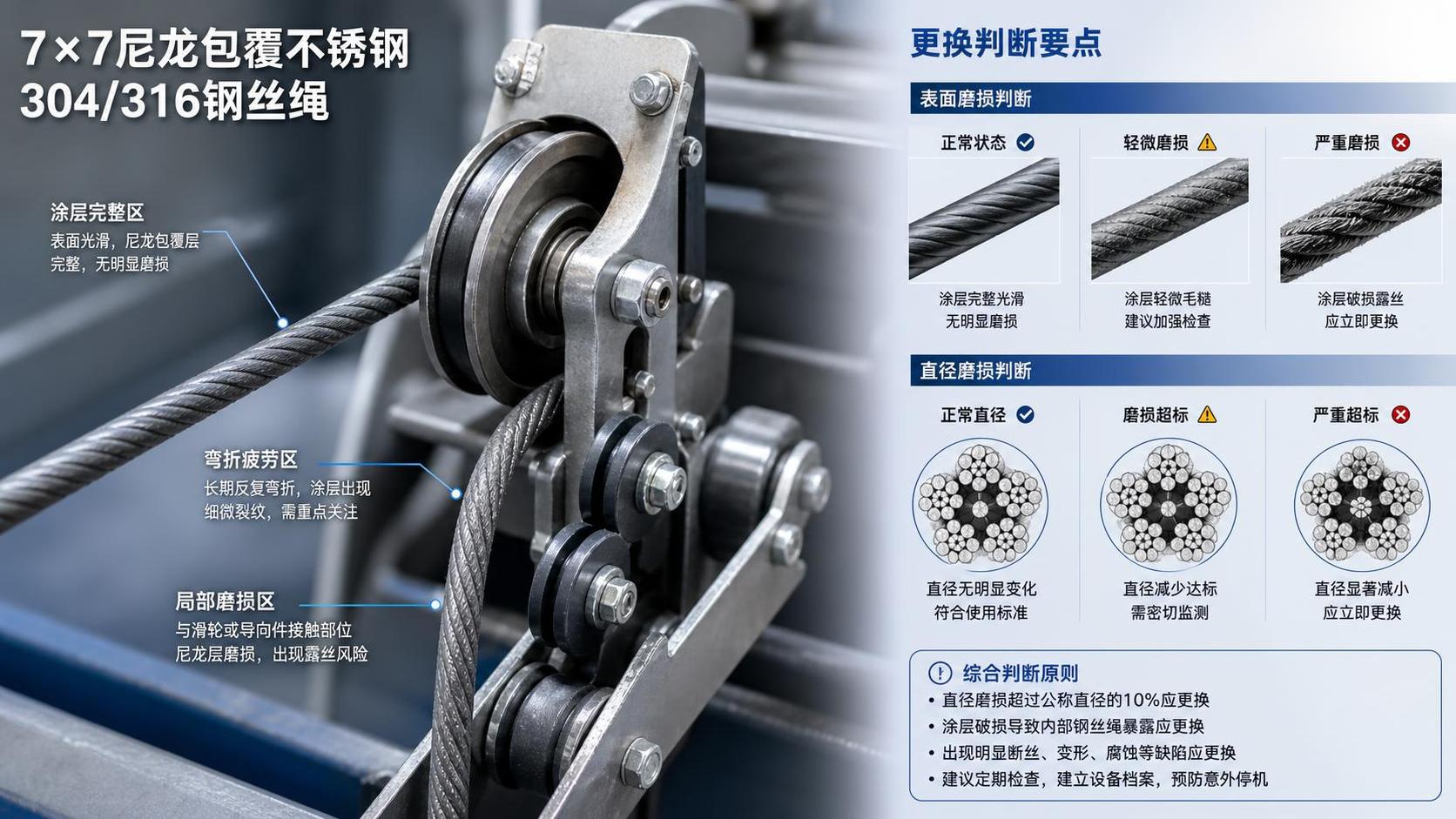
For maintenance teams, knowing when to replace 7x7 Nylon coated stainless steel 304 316 wire rope is critical to preventing unexpected downtime, safety risks, and equipment damage. Even with strong corrosion resistance and flexibility, this wire rope can still degrade under repeated bending, abrasion, overload, or harsh environments. Understanding the warning signs helps ensure reliable operation and supports smarter inspection and replacement decisions.
What Maintenance Teams Really Need to Know First
The core search intent behind 7x7 Nylon coated stainless steel 304 316 wire rope is practical replacement judgment, not basic product definition. Maintenance staff usually want to know when the rope is no longer safe.
In most cases, replacement should be based on visible damage, loss of flexibility, coating breakdown, wire fatigue, corrosion under the nylon layer, and changes in operating performance. Waiting for complete failure is not an acceptable maintenance strategy.
For after-sales maintenance personnel, the main concern is straightforward: how to identify early warning signs before rope failure affects equipment, operator safety, or service schedules. They need inspection standards they can apply in real work.
Why This Rope Still Wears Out Despite Good Corrosion Resistance
7x7 Nylon coated stainless steel 304 316 wire rope is chosen because it combines flexibility, corrosion resistance, and surface protection. The 7x7 construction gives better bending performance than stiffer structures in many control and support applications.
The nylon coating helps reduce surface abrasion, isolate the metal from moisture and contaminants, and improve handling. Stainless steel 304 is widely used in general corrosive environments, while 316 performs better in marine, chemical, and chloride-rich conditions.
However, none of these advantages make the rope permanent. Repeated bending over pulleys, vibration, side loading, shock loading, poor alignment, and environmental contamination gradually weaken both the coating and the wire strands inside.
In maintenance work, a common mistake is assuming that a smooth outer coating means the rope is still healthy. In reality, internal fatigue and hidden corrosion may already be progressing beneath the nylon jacket.
Clear Signs It Is Time to Replace the Wire Rope
The most reliable replacement decision comes from combining visual inspection with operational symptoms. If one serious defect appears, or several smaller defects appear together, replacement should be scheduled immediately.
One of the first signs is broken filaments or protruding wires. Even a nylon coated rope can reveal local bulging, sharp points, or uneven surface texture that indicates internal strand damage.
Another strong warning sign is cracked, split, or worn coating. When the nylon layer peels away, wears thin, or opens at repeated bend points, the stainless steel loses part of its environmental protection.
If the rope becomes stiffer than before, develops permanent kinks, or no longer tracks smoothly through guides and sheaves, internal structure damage may already be affecting performance. Flexibility loss is a meaningful service-life indicator.
Flattened sections, local crushing, birdcaging, or diameter reduction also require attention. These defects often result from overload, improper installation, poor drum spooling, or sudden shock loads during operation.
Rust staining, discoloration, or trapped moisture around damaged coating areas should never be ignored. Even stainless steel 304 and 316 can suffer corrosion, especially when deposits, chemicals, or salt remain on the surface over time.
If the rope starts producing abnormal noise, dragging resistance, or inconsistent travel under load, that can point to internal wire breakage or distortion. Functional change is often as important as visible external wear.
How to Judge Replacement in Daily Inspection Work
Maintenance teams need a repeatable inspection routine rather than subjective judgment. A practical approach is to inspect the rope by location, movement pattern, load history, and environmental exposure.
Start with the highest-stress areas. These usually include end terminations, sections that bend repeatedly over pulleys, contact points with guides, and locations exposed to edge rubbing or compression.
Run a slow visual and hand inspection where safe and permitted. Look for coating cuts, swelling, hard spots, soft spots, deformation, and any place where the rope profile is no longer uniform.
Compare the current rope condition with its original diameter, flexibility, and surface appearance. If available, use maintenance records to identify accelerated wear trends instead of looking at a single inspection in isolation.
Inspection frequency should increase in marine, port, mining, construction, and wet process environments. In these conditions, contamination and cyclic loading often shorten replacement intervals significantly.
It is also important to record the cause of damage, not only the damage itself. If a rope is repeatedly failing in the same section, the root problem may be misalignment, undersized sheaves, overload events, or poor routing.
304 or 316: Does the Material Change Replacement Timing?
Yes, but only to a degree. Stainless steel 316 generally lasts longer than 304 in chloride-heavy or marine conditions because of its improved corrosion resistance. That can slow visible deterioration in aggressive environments.
Still, 316 does not eliminate fatigue, abrasion, or mechanical distortion. If the application involves frequent bending cycles or contact wear, mechanical damage may control service life more than corrosion resistance.
For inland equipment, light industrial systems, and less aggressive environments, 304 may provide sufficient performance if inspections are consistent. For ships, ports, fishery, and ocean exposure, 316 is often the more reliable long-term choice.
Maintenance personnel should avoid making replacement decisions based only on material grade. The actual service condition always matters more than the catalog specification.
What Shortens Service Life Faster Than Expected
Unexpected early replacement often comes from application mismatch rather than product defect. The most common issue is using a rope selected for corrosion resistance in a system that mainly causes bending fatigue or crushing damage.
Improper pulley diameter is another major factor. If the rope is forced over overly tight bend radii, internal wires fatigue much faster, even when the outside coating still looks acceptable.
Overload and shock loading are equally damaging. A sudden dynamic load can deform strands, damage core balance, and create internal weak points that continue growing during later use.
Poor cleaning practices also matter. Dirt, salt, slurry, or chemical residue trapped on the rope surface can work into damaged coating sections and create a corrosive pocket under the nylon layer.
In lifting and rigging environments, the condition of connected components also affects rope life. Hooks, sleeves, thimbles, guides, and anchor points that are worn or poorly matched can create concentrated stress.
For example, teams working across construction, port, or mining sites often use rope assemblies together with slings suited to heavier handling tasks. In those broader lifting systems, products like 3 Leg bright oil steel Wire Rope Sling Hook and Loop 3tons Lifting Slings are typically selected for stable multi-point load distribution where a different rigging configuration is required.
Should You Replace Immediately or Monitor for a Short Period?
That depends on the type of defect. Broken wires, structural deformation, crushing, severe coating failure with metal exposure, or abnormal operation under load usually justify immediate replacement.
Minor cosmetic wear may be monitored for a short period if the rope still meets operational requirements and no internal damage is suspected. But monitoring only makes sense when inspection intervals are tightened and records are updated.
When the rope is used in safety-sensitive systems, conservative judgment is better than extending use for marginal savings. The cost of unplanned downtime or incident response is usually far higher than the rope replacement cost.
After replacement, it is worth reviewing whether the installed rope type still matches the application. Sometimes a different material, coating option, or rope structure improves life-cycle performance more effectively than simply repeating the same specification.
How Better Supply and Product Matching Support Maintenance Results
For industrial users, replacement decisions are easier when the supplier can provide consistent quality, stable dimensions, and traceable material options. That reduces uncertainty during maintenance planning and field installation.
Shandong Faster Technology Co., Ltd. supports multiple industries including lifting, ships, ports, construction, mining, and elevators, with annual steel wire rope production capacity above 70,000 tons and diameter coverage from 1mm to 20mm.
The company offers galvanized, stainless steel, and plastic coated wire rope products, along with customized sling processing and full-specification chain supply. This integrated rope-sling-chain capability helps maintenance teams source matching components more efficiently.
Where lifting applications extend beyond coated control rope use, broader rigging solutions may also be needed. That is why some buyers combine wire rope maintenance planning with related lifting products such as 3 Leg bright oil steel Wire Rope Sling Hook and Loop 3tons Lifting Slings for specific heavy handling scenarios.
Conclusion
The right time to replace 7x7 Nylon coated stainless steel 304 316 wire rope is when inspection shows clear evidence of damage, performance change, or growing risk, not when failure becomes obvious.
For after-sales maintenance personnel, the most useful rule is simple: evaluate coating condition, internal structure warning signs, flexibility, deformation, corrosion exposure, and operating behavior together. No single indicator should be judged alone.
With regular inspection, proper application matching, and timely replacement, maintenance teams can reduce service interruptions, improve equipment reliability, and prevent avoidable safety problems in demanding industrial environments.
Navigation
Send Us A Message



Shandong Faster Technology Co., Ltd. is a professional manufacturer of steel wire ropes.
Get in Touch
*We respect your confidentiality and all information are protected.