





When should stainless steel wire rope be replaced?
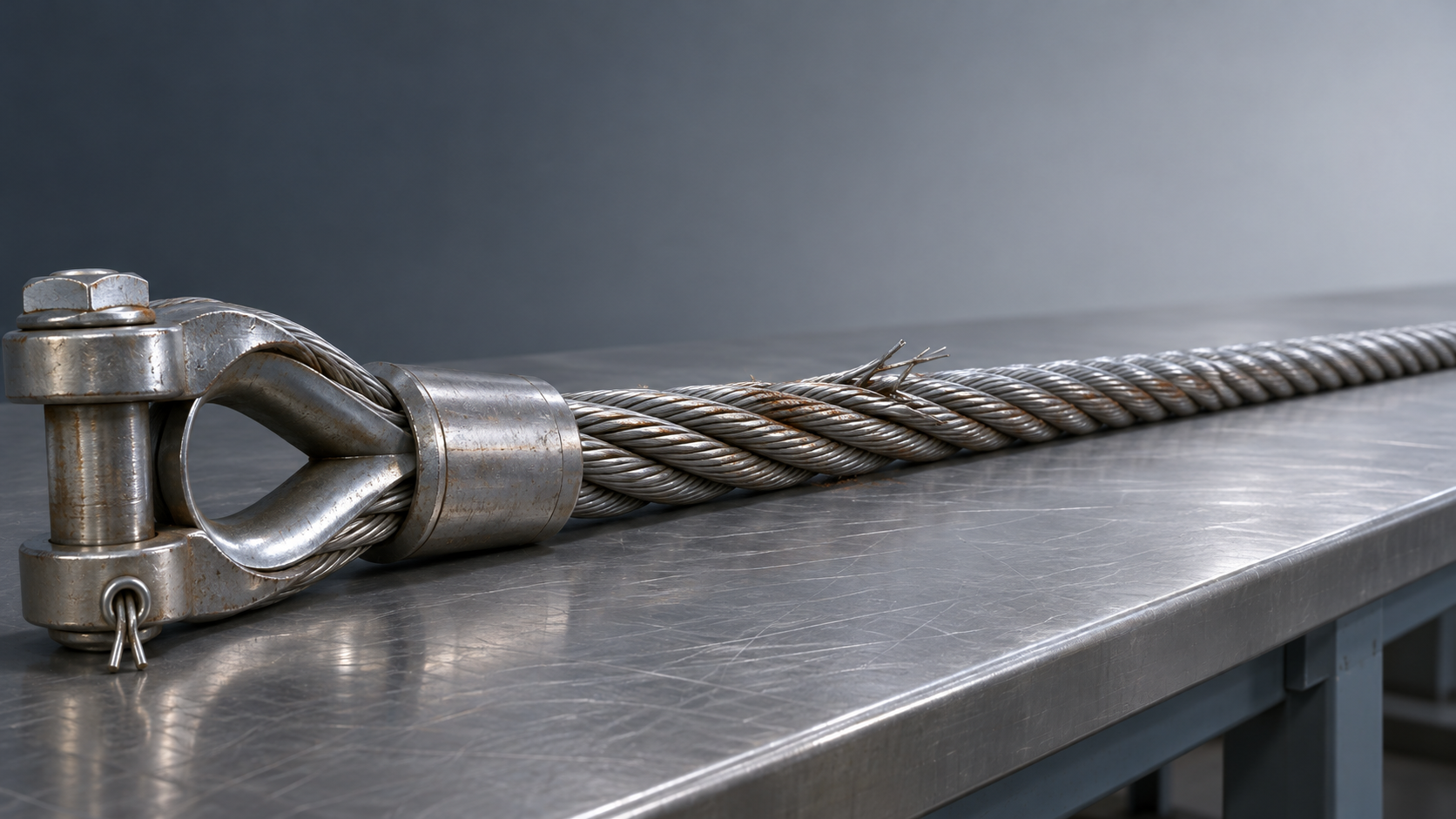
Replace stainless steel wire rope when it meets the applicable discard criteria, or when damage makes its condition unsafe to judge. Broken wires, significant corrosion, distortion and damaged terminations can each justify removal from service. A rope does not need to reach a predetermined age before it is replaced.
For quality and safety teams, the first decision is whether the rope can remain in use while its condition is assessed. If there is evidence of a kink, birdcaging, severe corrosion, a failed fitting or damage after an overload, stop using the assembly and have a competent person evaluate it. The replacement decision should follow the rules for the equipment and application, together with the rope and equipment manufacturers’ instructions.
Damage that calls for immediate attention
Some defects are difficult to assess from a wire count alone. They can indicate that the rope’s structure or load path has changed, even where much of the surface still looks sound.
- Kinks, crushing and birdcaging: A permanent bend, flattened section or strands that have opened into a cage shape can disrupt load sharing. Remove the rope from service for assessment; a kinked rope should not be straightened and returned to duty.
- Damage at terminations: Inspect sockets, swages, clips, thimbles and the rope immediately beside them. Cracks, slippage, distortion, broken wires or evidence that a termination has moved can make the assembly unfit for use.
- Heat or electrical damage: Contact with a welding arc, electrical current or excessive heat can alter rope properties. Isolate the rope and follow the equipment and rope manufacturers’ criteria for evaluation and replacement.
- Suspected overload or shock loading: A rope may have internal damage even if the outside appears serviceable. Remove it from service until a competent person has assessed it under the applicable requirements.
Do not treat a local repair, a new fitting or a clean surface as proof that the remaining rope is sound. Any repair or return to service must be permitted by the applicable rules and the manufacturer’s instructions.
How to assess broken wires and wear
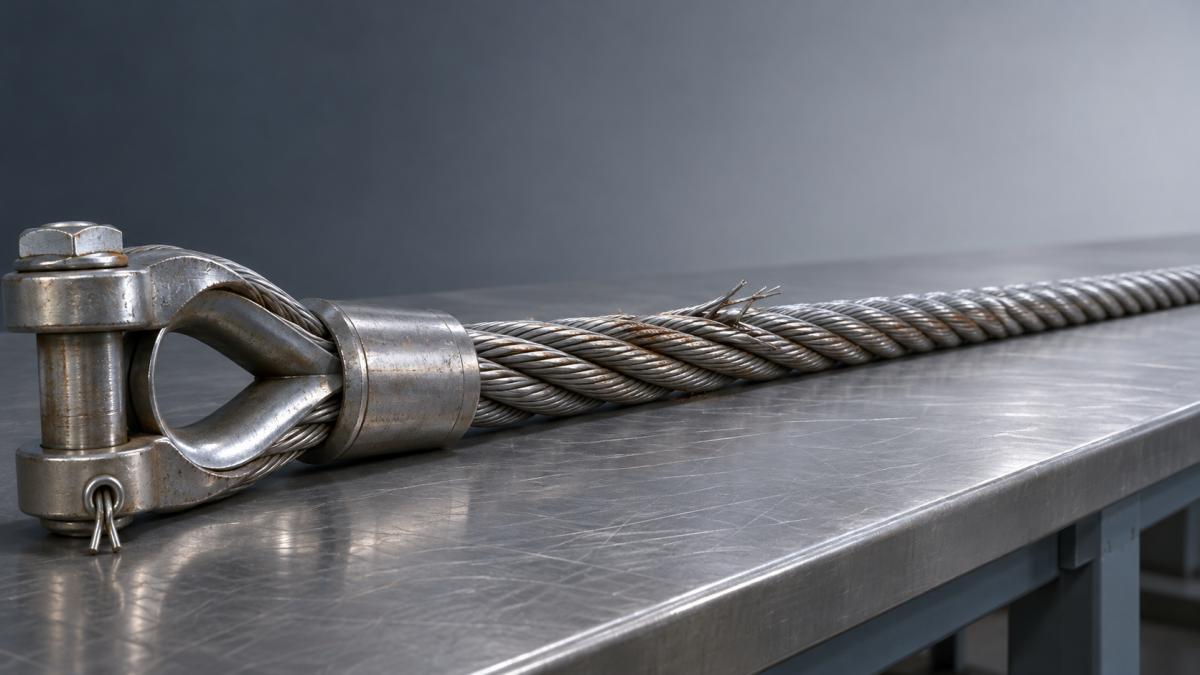
Broken wires are a direct sign of deterioration, but the number that triggers discard depends on the application, rope construction, location of the breaks and the governing standard. A count suitable for one crane rope or wire rope sling should not be transferred to another assembly.
Record where the breaks occur and how they are distributed. A cluster near a termination, over a sheave or at a recurring bend point can be more concerning than the same number spread across a longer length. Check valleys between strands as well as the exposed crown wires: fatigue breaks may appear where they are harder to see. Follow the relevant counting length and discard limits rather than estimating from a quick visual scan.
Wear also changes the rope’s condition before wires visibly break. Abrasion can flatten outer wires, while repeated bending can produce fatigue. Measure diameter using the method specified for the rope and compare the result with an appropriate baseline and the applicable discard criteria. Take readings at several locations, especially where the rope travels over sheaves or drums. A localized reduction can be missed by measuring only an accessible, lightly used section.
Diameter alone is not a complete test. A rope can have internal damage without an obvious overall reduction, and a change in diameter needs to be interpreted in context. Rope construction, loading history and the condition of the core all matter.
Corrosion resistance is not immunity
Stainless steel can be a useful choice in wet or corrosive environments, but its performance depends on the grade and exposure. Salt deposits, trapped moisture, chemicals and contamination can attack the rope, particularly in crevices between wires and beneath fittings. A bright outer surface does not establish that the interior is free of corrosion.
Look for pitting, discoloration, roughness, stiffness and corrosion products around strand contacts and terminations. Pay particular attention to sections that remain wet, collect deposits or are difficult to inspect. Cleaning may make damage easier to see, but it cannot restore metal lost to pitting.
Coated or covered rope deserves the same caution. A coating can conceal wire breaks or corrosion and may prevent a meaningful inspection of the underlying rope. Follow the assembly manufacturer’s instructions for inspecting covered sections; where the required condition cannot be established, remove the assembly from service pending a decision under the applicable criteria.
Which standard governs replacement?
Start with the equipment and use, not the rope material. Requirements for a crane hoist rope, a wire rope sling, an elevator rope and a marine application may differ. Identify the applicable legislation and equipment-specific standard in the operating jurisdiction, then use the relevant edition together with the equipment and rope manufacturers’ instructions.
For example, ISO 4309 addresses care, maintenance, inspection and discard of steel wire ropes used on cranes. In the United States, OSHA requirements for wire rope slings include removal-from-service criteria; crane requirements are addressed separately. These references are not interchangeable, and neither should be applied automatically to every stainless steel rope assembly.
Establish the inspection frequency from those requirements and the actual duty. Inspection before use and more detailed periodic inspection serve different purposes. Heavy cycling, repeated bending, marine exposure, abrasive contact or a history of damage may justify closer monitoring, subject to the governing requirements. Inspection records should identify the rope, its location, observed defects, measurements, the decision taken and the person responsible.
Replace the assembly with the right specification
Before ordering a replacement, confirm more than nominal diameter. The rope construction, stainless steel grade, strength, lay, flexibility, length and termination design must suit the equipment and duty. Check compatibility with sheaves, drums and fittings, and retain identification and relevant documentation for the replacement assembly. A higher stated strength or better corrosion resistance does not by itself make a different rope an acceptable substitute.
The same distinction applies when a job also uses chain to restrain equipment in transport. A separate product such as the G80 Alloy Steel Welded Marine Lashing Link Chain Hot Dip Galvanized with Double Eye Grab Hooks 8mm 10mm addresses a lashing application; it is not an automatic replacement for a wire rope lifting assembly. Chain, hooks, connections and the complete arrangement need their own suitability checks and ratings for the intended use.
When the inspection result falls short of a clear discard limit but the rope’s internal condition remains uncertain, keep it out of service while the competent person determines what further examination or replacement is required. The useful outcome is a documented decision tied to the specific rope and duty, not an assumed service life based on the word “stainless.”
Navigation
Send Us A Message



Shandong Faster Technology Co., Ltd. is a professional manufacturer of steel wire ropes.
Get in Touch
*We respect your confidentiality and all information are protected.