





When should you choose 7x7 cable over 7x19 cable?
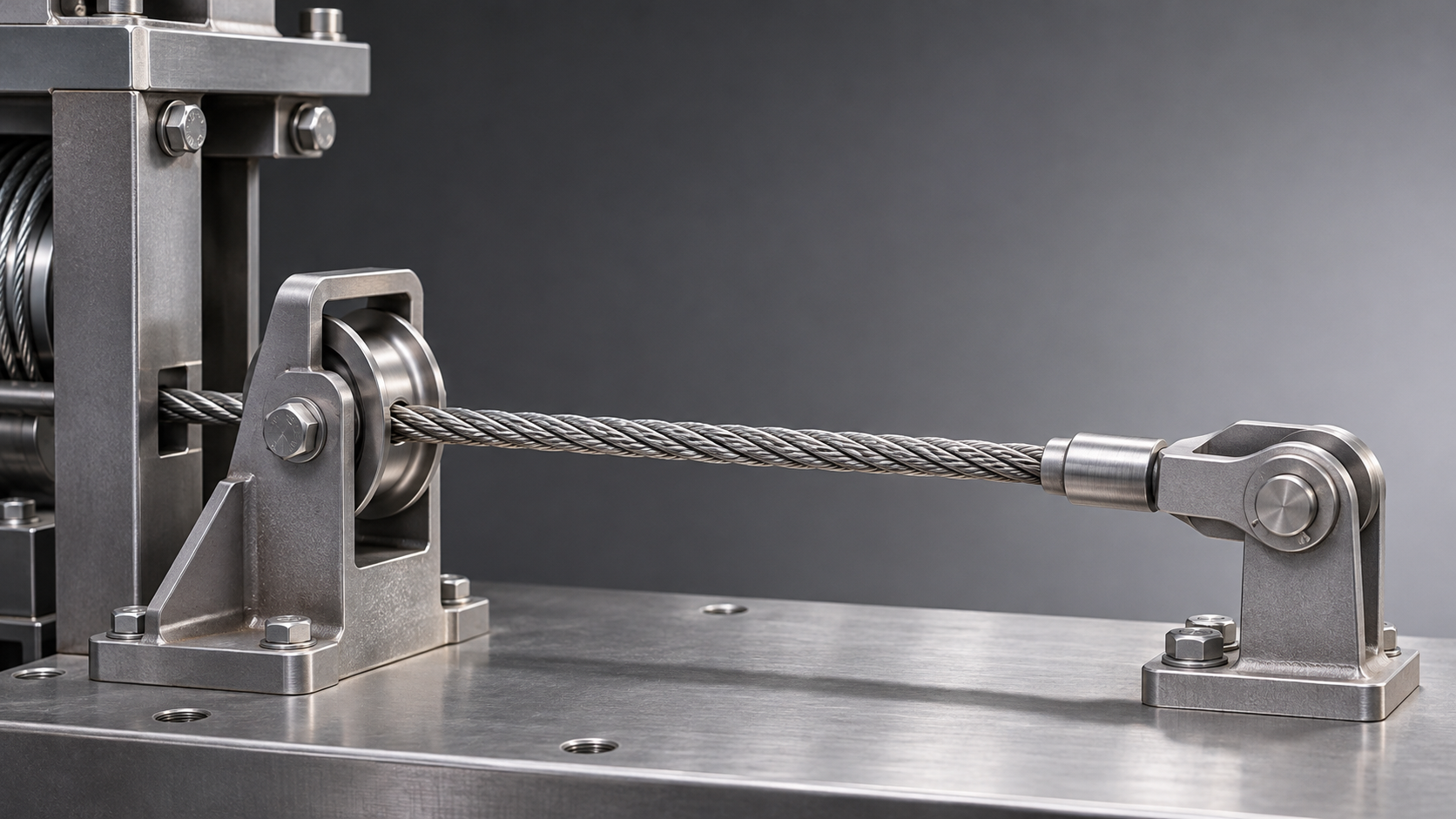
Choose 7x7 cable over 7x19 when the cable runs mostly straight or bends only occasionally, and a firmer construction helps with positioning, feeding, or maintaining a clean line. Choose 7x19 when the cable must repeatedly pass around sheaves, negotiate tighter routing, or remain easy to handle during installation.
The distinction matters in equipment such as guards, control mechanisms, and tensioned supports: a cable that is too stiff can load small sheaves and terminations unfavorably, while one that is more flexible than necessary may be harder to push into position or keep aligned. Neither construction should be selected on flexibility alone; rated strength, bending geometry, environment, and end fittings still have to match the duty.
Start with the way the cable moves
A 7x7 cable consists nominally of seven strands, each containing seven wires. A 7x19 cable has seven strands of 19 wires. At the same nominal cable diameter, the individual wires in a 7x19 construction are generally finer, which makes the rope more flexible. A 7x7 construction generally has larger individual wires and a firmer feel.
That difference is most useful when the motion is understood. A stationary tension member can still see small movements from vibration or thermal expansion, but it does not experience the same bending cycle as a cable traveling over a sheave. Conversely, a cable that appears straight at rest may bend repeatedly at a guide or termination whenever the machine operates.
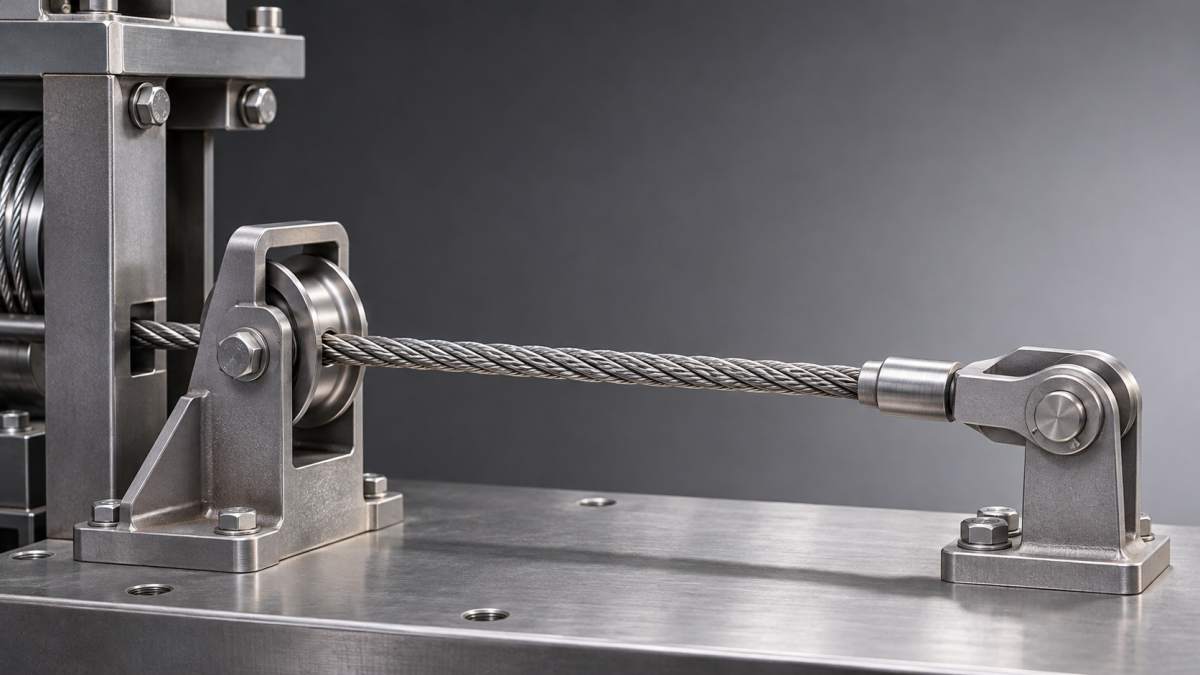
These are general construction tendencies, not guaranteed values for every product. Wire grade, material, lay, manufacturing method, and any coating can change the properties of a specific cable.
Where the firmer construction is useful
Consider 7x7 for a tensioned restraint, support line, or guard cable with long straight sections and few changes of direction. Its relative stiffness can make it easier to guide through fittings and maintain the intended alignment during assembly. It may also be suitable for a lightly articulated control cable where movement is limited and the equipment manufacturer permits the construction.
The larger outer wires can be advantageous where surface contact or abrasion is a concern. That is not a blanket guarantee of longer life: contact pressure, surface finish, vibration, corrosion, and the direction of movement all affect wear. Inspect the actual contact points rather than assuming that construction alone controls the outcome.
Stiffness can also be a disadvantage. A cable forced into a short bend at a fitting may concentrate movement near the termination. If that location flexes every cycle, a seemingly minor detail can govern service life. Check the complete installed path, including the transition into swaged ends, clips, thimbles, and guides.
When the balance shifts toward 7x19
Repeated travel over sheaves or around drums is a strong reason to evaluate 7x19 first. Its greater flexibility generally makes it better suited to cyclic bending than a comparable 7x7 cable. It can also be easier to route through a machine with several changes of direction, provided the bends and fittings are designed for the cable.
Flexibility does not make a small sheave automatically acceptable. Record the sheave’s tread diameter and groove profile, the rope diameter, the wrap angle, the operating load, and the expected number of cycles. Check the resulting sheave-to-rope diameter ratio against the equipment and rope manufacturer’s requirements. A sheave with a worn or incorrectly sized groove can damage either construction.
Also distinguish between movement over a sheave and movement caused by vibration at an otherwise fixed anchor. The latter may create localized fatigue even when the overall cable path is straight. Improve alignment or support where appropriate, and assess the fitting and cable together rather than changing construction without addressing the source of movement.
Compare complete specifications, not strand counts alone
Two cables with the same nominal diameter and construction can have different minimum breaking forces. Compare manufacturer data for the exact diameter, material, finish, and grade. Use the load and design factor required for the application; minimum breaking force is not a working load limit. Include shock loading, acceleration, uneven loading, and any reduction associated with the selected termination in the assessment.
Corrosion protection is a separate choice. Galvanized and stainless steel cables can both be supplied in different constructions, but their suitability depends on exposure and maintenance. A plastic coating can change the outside diameter used for routing and may obscure the underlying rope during inspection. Confirm whether fittings are designed to grip the bare rope or the coated assembly, and follow their installation instructions.
Construction is not a reliable shortcut for predicting elongation. Initial bedding-in and elastic stretch depend on the rope design, load, length, and fittings. Where positioning accuracy or tension retention matters, request the relevant data for the proposed assembly and account for adjustment or retensioning in the design.
Check the assembly before substituting a cable
A replacement must fit more than the nominal hole size. Confirm compatibility with the existing sheaves, drum, end fittings, and installation method. Swaging dies and termination procedures are specific to the fitting and rope combination; a satisfactory-looking pressed end is not proof of its rated capacity.
For a two-point lifting application, the Double Leg Swaged Wire Rope Sling with Safety Hook Galvanized High-Strength is an example of a finished assembly listed with 7x19 among its available rope constructions. It is not listed as a 7x7 product. Its suitability depends on the specified sling configuration, rated capacity, leg angle, hooks, and load attachment points; cable construction alone does not establish the assembly’s lifting rating.
Before releasing a specification, document whether the cable is static or cyclic, the smallest bend it encounters, the required load rating, the exposure conditions, and the termination details. If a proposed 7x7 replacement changes a moving cable path or a lifting assembly, obtain confirmation for that complete configuration rather than treating the two constructions as interchangeable.
Navigation
Send Us A Message



Shandong Faster Technology Co., Ltd. is a professional manufacturer of steel wire ropes.
Get in Touch
*We respect your confidentiality and all information are protected.