





When is bright wire rope a practical choice indoors?
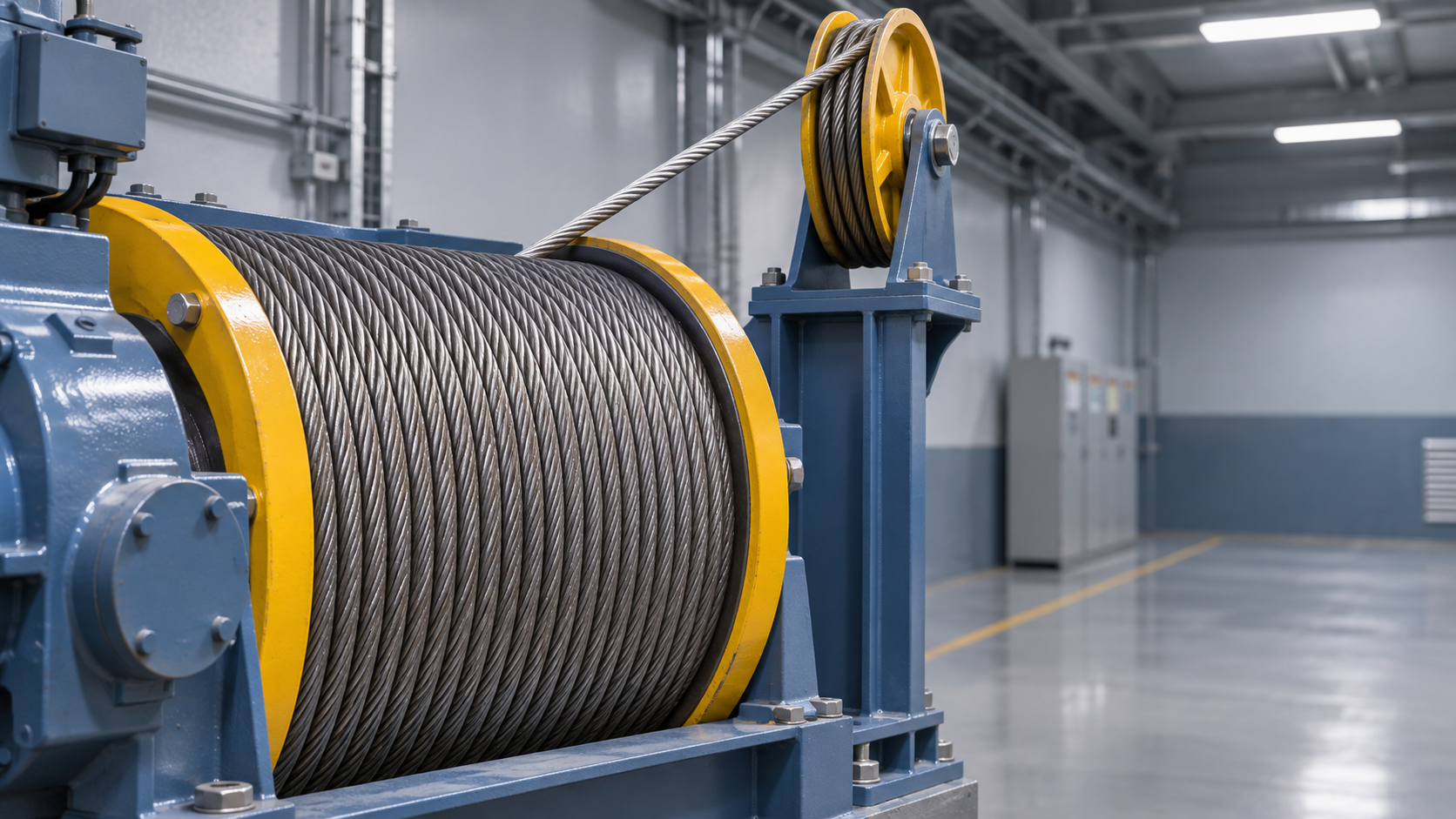
Bright wire rope is a practical indoor choice when the operating area is consistently dry, corrosion exposure is limited, and the equipment’s load and fatigue requirements are met. Its uncoated steel surface can make it an economical alternative to corrosion-resistant rope, but being indoors alone does not establish that it will remain dry or perform safely.
A warehouse hoist near an open loading door, for example, may experience condensation and airborne moisture even though the machinery is under a roof. In that setting, surface corrosion can complicate inspection and shorten service life. The decision should therefore begin with the rope’s actual exposure and duty, not simply the building classification.
Start with the environment around the rope
Bright wire rope has no protective zinc coating. Lubrication can help limit corrosion, but it is not equivalent to galvanizing or stainless steel. A clean, temperature-controlled machinery room is generally a better candidate than an indoor washdown area, a humid basement, or a space where process chemicals are present.
Follow the entire rope path when assessing exposure. The visible running length may be dry while rope stored on a drum sits near a cold wall, below a leaking pipe, or in a poorly ventilated enclosure. Temperature changes can also cause condensation on steel surfaces. Check whether the rope will encounter cleaning liquids, salt carried in from outside, corrosive vapors, or water tracked through loading bays.
Occasional moisture does not automatically rule out bright rope, but it changes the maintenance decision. Determine how quickly the rope can dry, whether lubricant can be maintained, and whether inspection points are accessible. Persistent dampness or chemical exposure may justify a galvanized or stainless-steel alternative, subject to compatibility with the equipment and the specific chemicals involved.
Match the rope to the equipment, not just the load
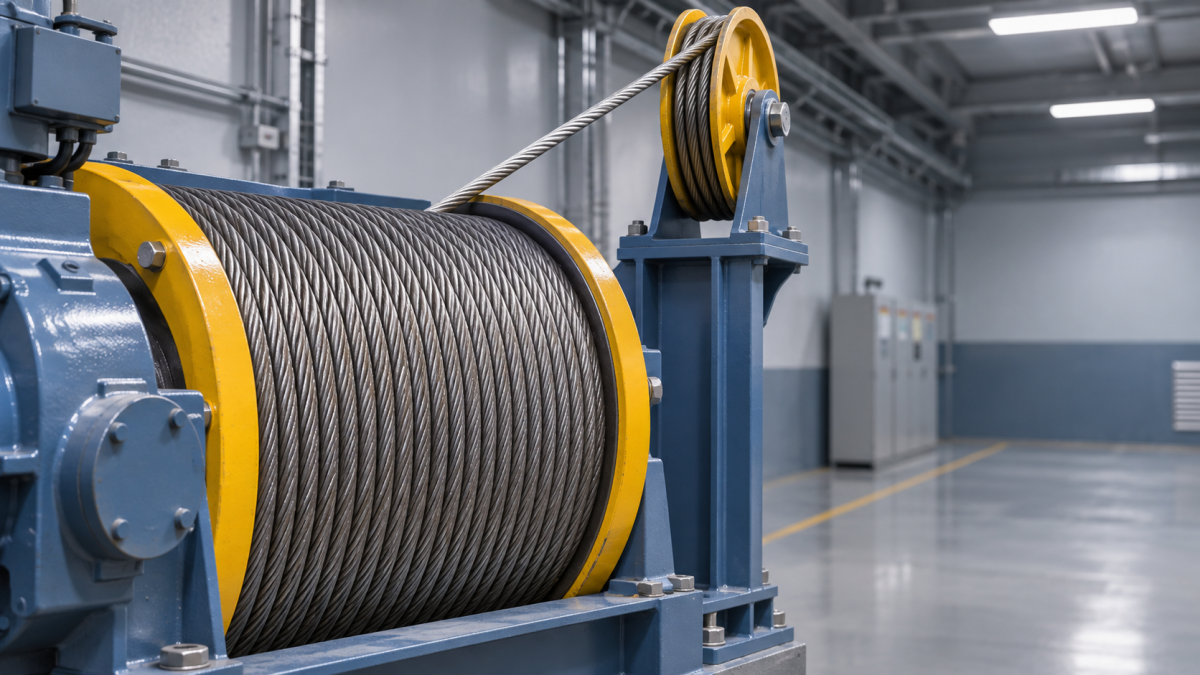
A suitable breaking force is only one part of the selection. Start with the equipment manufacturer’s rope specification and the applicable requirements for the installation. Confirm the required minimum breaking force, diameter, construction, core, lay, and any rotation-resistant characteristics. A rope of the same nominal diameter is not necessarily an acceptable replacement.
Duty has a substantial effect on service life. A rope that holds a static load may be exposed mainly to sustained tension and local contact, while a frequently cycled hoist rope repeatedly bends over sheaves and drums. Rope construction and sheave dimensions influence bending fatigue; the equipment manufacturer’s specified drum and sheave dimensions should be respected rather than adjusted to accommodate a convenient rope.
Before approving an indoor installation, review these operating conditions:
- Loading: Establish the maximum working load, acceleration, shock loading, and required design factor. Do not treat the rope’s breaking force as its permissible working load.
- Rope path: Check sheave groove condition, drum winding, fleet angle, and possible contact with guards or structural edges. Poor alignment and damaged grooves can cause wear regardless of the rope finish.
- Cycle pattern: Record travel length, frequency, dwell periods, and whether the same section repeatedly bends or rests on a sheave.
- Termination: Verify compatibility between rope construction and the specified socket, pressed fitting, or other termination. The assembly’s capacity depends on the complete termination, not the rope alone.
For personnel lifting or other critical duties, use only a rope and assembly explicitly specified for that equipment and application. A general-purpose rope should not be substituted solely because its stated breaking force appears sufficient.
Compare the alternatives at the exposed points
Compare alternatives using the specified rope construction and supplier data, not surface finish alone. Coatings and materials can affect available dimensions and mechanical properties; changing the finish may require a fresh compatibility check. Initial purchase cost should also be weighed against inspection access, relubrication, downtime, and expected replacement conditions.
Maintenance is part of the selection decision
Indoor machinery can collect dust, abrasive particles, and old lubricant. These deposits may conceal broken wires or hold moisture against the rope. Choose a lubricant compatible with the rope, equipment, and surrounding process, and follow the rope and equipment manufacturers’ instructions for application. Excess lubricant can attract contamination or create an unacceptable hazard near certain processes.
Inspection access matters as much as lubrication access. Examine working sections and areas near terminations, equalizer sheaves, and drum anchorages in accordance with the equipment’s inspection procedure. Look for broken wires, corrosion, abrasion, diameter reduction, distortion, and damage to fittings. Internal deterioration may not be apparent from a casual surface check; suspected internal corrosion warrants further assessment under the applicable inspection procedure.
Use the equipment manufacturer’s criteria and applicable standards to determine inspection intervals and discard limits. If the rope shows kinking, crushing, birdcaging, severe corrosion, or other serious damage, remove the equipment from service until the rope has been assessed and any required replacement is completed. Do not rely on lubrication to repair damaged wires.
Separate rope selection from nearby chain duties
An indoor installation may use rope for machine movement and chain for a separate, non-heavy-load task such as restricting access to equipment or securing an item on a shelf. For those ancillary duties, DIN5685 A/C Short or Long Link Chain is available in short-link and long-link forms, including carbon-steel and stainless-steel options. Link dimensions and the supplier’s proof-load and breaking-load information should be checked against the intended use.
That chain is not a direct replacement for a specified hoist rope or a lifting-grade chain assembly. For any load-bearing application, confirm the product’s permitted use and rated capacity; proof load or breaking load alone does not establish a working load limit.
Bright rope remains a defensible choice when the dry condition can be maintained over the full rope path, the specified construction suits the machine, and inspection and lubrication are practical. If any of those conditions cannot be established before installation, resolve that uncertainty before using the uncoated option.
Navigation
Send Us A Message



Shandong Faster Technology Co., Ltd. is a professional manufacturer of steel wire ropes.
Get in Touch
*We respect your confidentiality and all information are protected.