





When Does Galvanized Steel Wire Rope Need Replacement Outdoors?
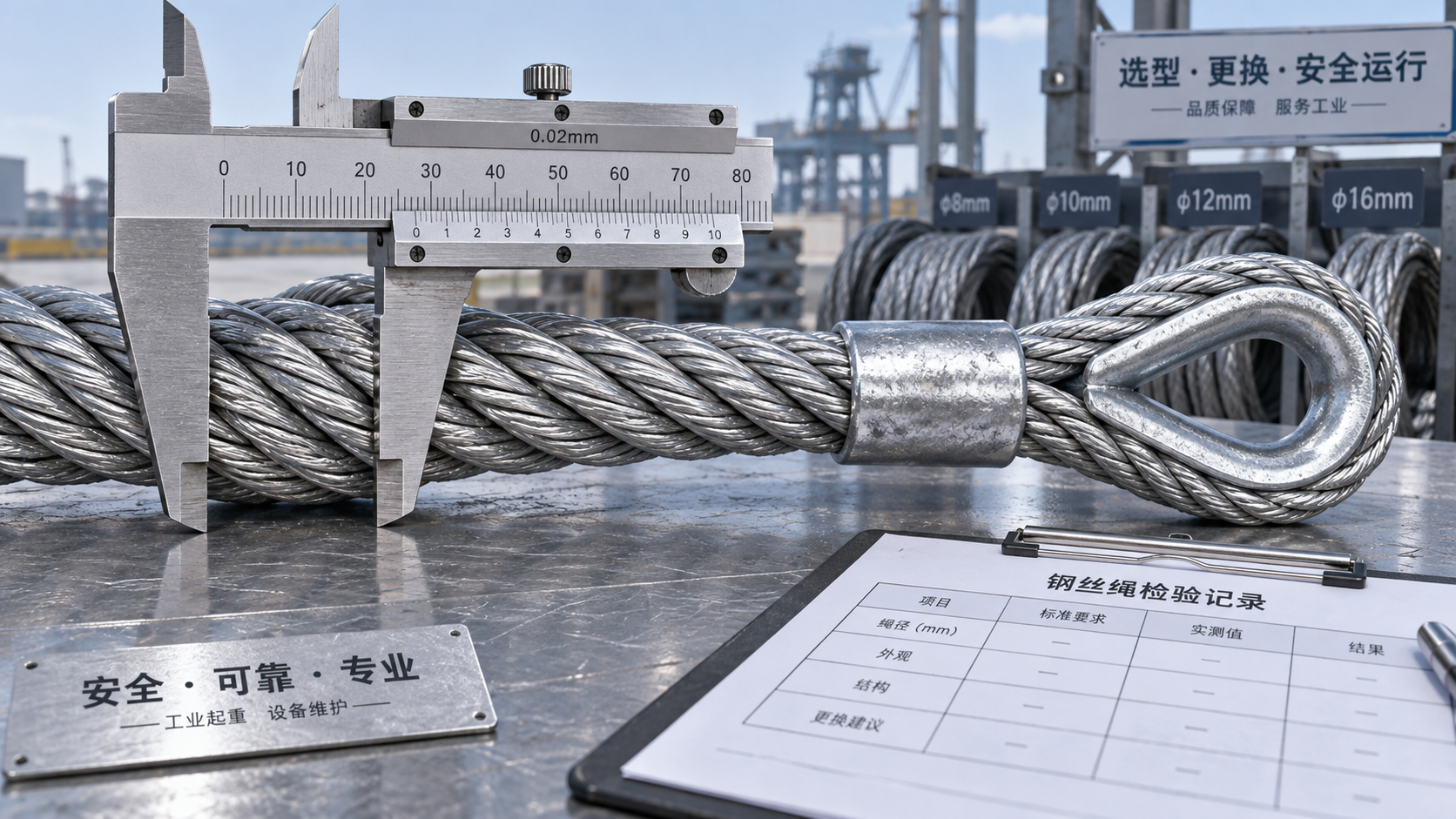
When Does Galvanized Steel Wire Rope Need Replacement Outdoors?
Outdoor exposure can shorten the service life of galvanized steel wire rope, but age alone is not a reliable replacement trigger. The real question is whether weathering, wear, or mechanical damage has compromised safe operation. Broken wires, corrosion, diameter loss, and deformation must be assessed against the equipment manufacturer’s instructions and applicable inspection standards—not against a general lifespan estimate.
Replace the rope when it reaches an applicable discard criterion. If serious damage is suspected but cannot be assessed confidently, remove it from service pending competent inspection. A bright surface does not prove that a rope is sound, and a dull surface does not automatically mean it has failed.
Separate coating weathering from structural damage
Galvanizing provides sacrificial corrosion protection for the steel wires. Outdoors, that protection gradually changes as the rope encounters moisture, salt, abrasion, and pollutants. A gray appearance or white zinc corrosion products may indicate coating weathering rather than significant steel loss. However, deposits can obscure the surface and should not be dismissed without inspection.
Red rust deserves closer attention because it can indicate that steel is exposed. Inspect for pitting, roughened wires, reduced wire sections, and corrosion emerging from strand valleys. Rust concentrated around a socket, clamp, or sheltered contact point can be more concerning than uniform discoloration along an open span.
Internal condition matters too. Moisture can remain between wires or near the core even when the outside dries. Where internal deterioration is suspected, visual inspection alone may be insufficient; a competent inspector should determine whether additional examination is appropriate for the rope and equipment.
Warning signs that should change the maintenance decision
Broken wires: location matters as much as quantity
Record broken wires by location and by the reference length specified in the applicable inspection criteria. Scattered breaks, concentrated breaks in one strand, and breaks near terminations can require different decisions. Repeated bending over sheaves may produce fatigue damage, while dragging against rough surfaces can combine abrasion with wire breakage.
Do not apply a universal “allowed number” found online. For crane ropes, ISO 4309 provides care, inspection, and discard guidance, but its application depends on the rope and equipment. Sling, elevator, and stationary support applications require their own relevant criteria. A limit from one application is not permission to continue using another.
Diameter loss and wear
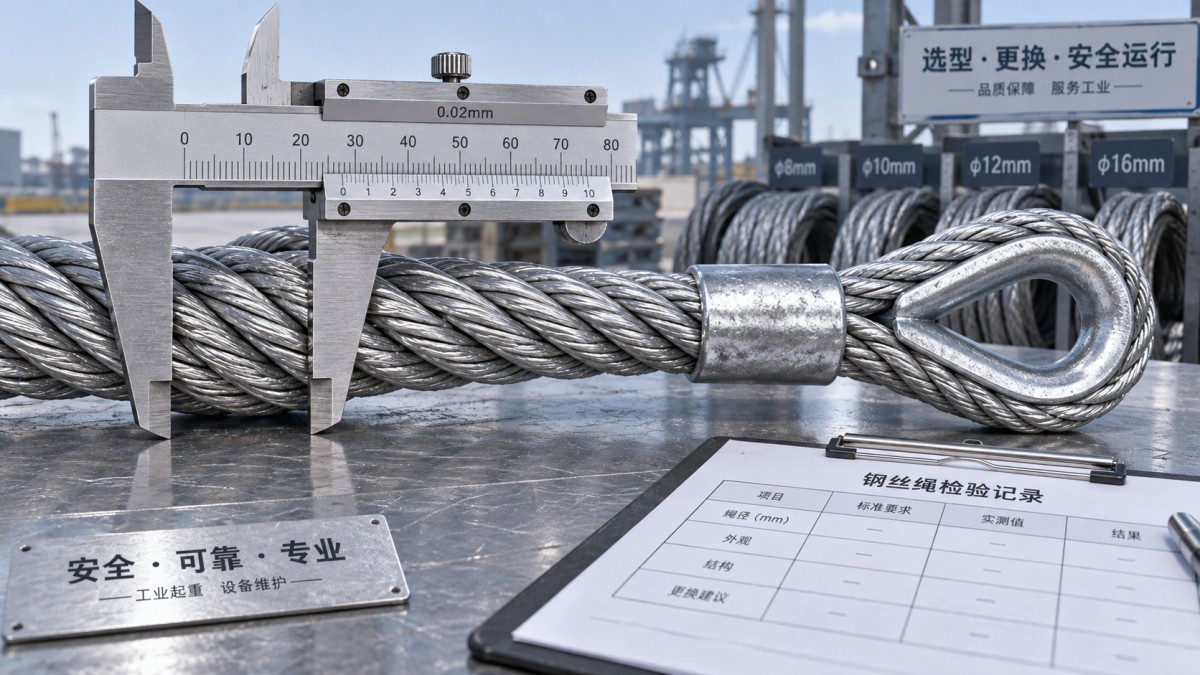
Measure rope diameter across opposite strand crowns, using the method required by the manufacturer or inspection procedure. Compare readings with the recorded baseline and applicable limits. Measuring across strand valleys can produce misleading results.
A smaller diameter may reflect external wear, internal deterioration, or core damage. Local flattening requires attention even if the average diameter appears acceptable. Document where measurements were taken so later inspections compare the same areas rather than unrelated sections.
Deformation and termination damage
Kinks, birdcaging, displaced strands, core protrusion, and severe crushing are structural warnings—not cosmetic defects to straighten out. Isolate equipment showing these conditions and arrange assessment before further operation. Heat damage or arcing also warrants immediate withdrawal pending evaluation.
Check the complete assembly. A rope can look acceptable along its length while a corroded socket, slipping termination, damaged thimble, or loose attachment makes the system unsafe. Where a termination needs replacement, verify whether the rope end can be re-terminated under an approved procedure or whether the entire assembly must be replaced.
Outdoor conditions should influence inspection frequency
There is no dependable rule that all outdoor galvanized ropes should be replaced after a fixed number of years. A stationary rope in a well-drained installation faces different deterioration mechanisms from a frequently operated port hoist exposed to salt spray and repeated bending.
Use the required inspection schedule as the starting point, then account for exposure and duty. Shorter intervals may be necessary where ropes encounter seawater, abrasive dust, chemical contamination, frequent loading, or persistent wetting. Inspect after exceptional events such as overload, impact, derailment, or prolonged shutdown before returning equipment to service.
Pay particular attention to sections passing over sheaves, drum crossover points, low spots that retain water, and areas concealed by protective covers. These locations often tell more about the rope’s condition than the easiest section to see.
Turn inspection findings into a practical replacement plan
Before examination, secure the equipment using the site’s isolation procedure. Never check moving wire rope by hand. Clean only as permitted by the rope manufacturer, and avoid methods that damage the zinc coating or remove necessary lubricant.
- Identify the rope: record construction, diameter, grade, core, lay, termination type, and service history.
- Map deterioration: photograph defects, mark their positions, and record measurements and broken-wire observations.
- Make the disposition explicit: document continued service, increased monitoring, or withdrawal against the relevant criteria.
- Investigate the cause: examine sheave grooves, alignment, drum spooling, lubrication, and drainage before installing a replacement.
Monitoring is appropriate only while the rope remains within permitted limits. It must not become a way to postpone replacement after a discard criterion has been reached. Lubrication may help control friction and moisture ingress when correctly specified, but it cannot restore lost steel or repair broken wires.
Specify the replacement, not just the diameter
A replacement galvanized steel wire rope should match the equipment’s requirements for construction, strength, flexibility, rotation behavior, and terminations. Changing to stainless steel or plastic-coated rope may alter operating characteristics and inspection access; neither is an automatic upgrade for an existing lifting system.
Shandong Faster Technology Co., Ltd. manufactures steel wire ropes, slings, and chains, with automated wire drawing, stranding, and rope closing supported by quality inspection equipment. Its stated rope range includes galvanized, stainless steel, and plastic-coated options in diameters from 1–20 mm, alongside customized pressed slings. For replacement planning, confirm the exact construction, dimensional tolerances, termination compatibility, and required documentation rather than relying on material names alone.
Separate outdoor binding or fixing tasks may also involve the DIN763 DIN764 DIN766 Standard Carbon Steel Electric Galvanized Welded Link Chain, offered in long-, medium-, and short-link configurations. These chain options should be evaluated as separate components, not interchangeable substitutes for wire rope. Link geometry and galvanizing alone do not establish lifting suitability; verify the rated capacity, grade, application approval, and supporting documentation.
Before ordering, retain the inspection findings and identify what caused the deterioration. Replacing a damaged rope without correcting a worn sheave, trapped moisture, or unsuitable termination leaves the next rope exposed to the same problem.
Navigation
Send Us A Message



Shandong Faster Technology Co., Ltd. is a professional manufacturer of steel wire ropes.
Get in Touch
*We respect your confidentiality and all information are protected.