





What Wire Rope Tension Testing Standards Are Commonly Used
What Wire Rope Tension Testing Standards Are Commonly Used
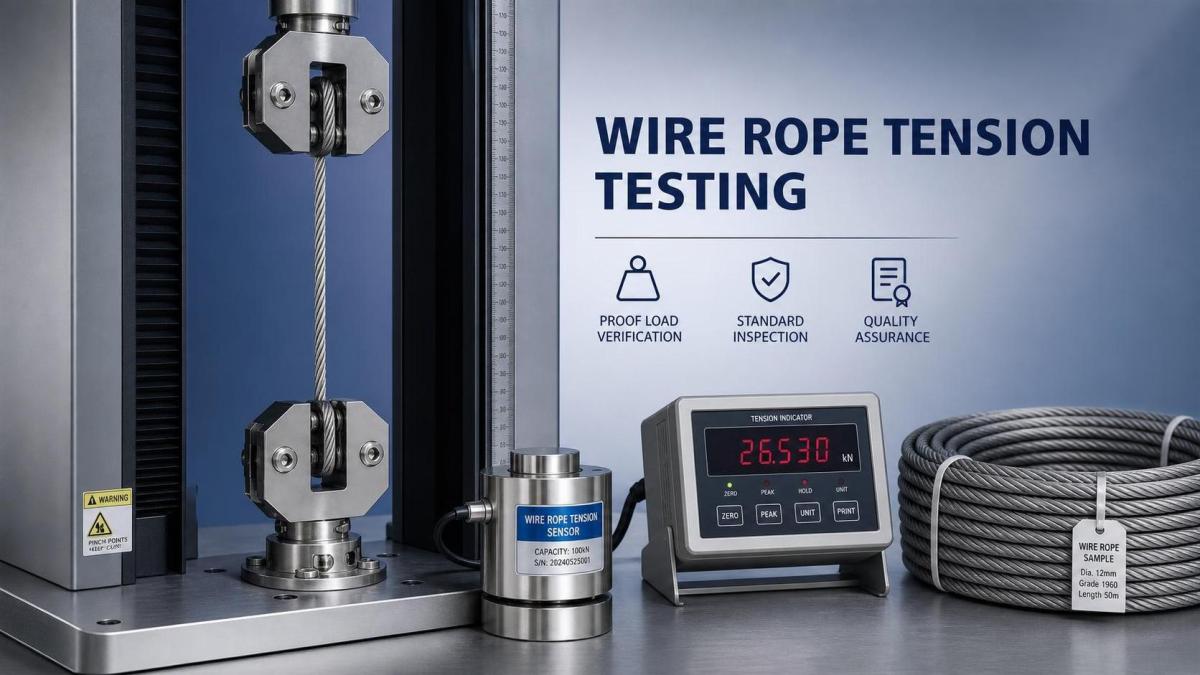
One of the easiest mistakes in wire rope inspection is to treat “tension testing” as a single, universal procedure. In practice, it covers several very different checks: proof loading, minimum breaking force verification, tensile testing of the wire itself, and in-service tension measurement used for balancing or condition control. The standard you use depends on which of those questions you are trying to answer. For quality control and safety management, that distinction matters more than the instrument brand or the test report format.
When people refer to wire rope tension, they may mean the force carried by a rope during operation, the load applied during factory acceptance, or the force level at which the rope or its termination fails. Those are not interchangeable. A rope that passes a production tensile test is not automatically suitable for a field tension reading procedure, and a correct in-service tension value does not replace proof load verification of a sling or assembly.
The most commonly cited standards therefore come from different systems: product manufacturing standards, test method standards, and application-specific safety standards. Reading them in the right context avoids a lot of confusion.
Where the Common Standards Actually Sit
For steel wire rope itself, widely used references include EN 12385, ISO 2408, ASTM A1023/A1023M, and application-linked rules such as those used in elevators, cranes, mining, or offshore lifting. These documents are not all “tension testing standards” in a narrow laboratory sense. Some define rope construction, nominal diameter tolerances, mechanical properties, and minimum breaking force. Others define how assemblies are tested or what level of proof loading is required before use.
A practical way to sort them is this:
That table is useful because many inspection disagreements come from mixing product standards with use standards. A purchasing document may call up ISO 2408, while a lifting contractor may ask for proof load records under a different sling-related requirement. Both can be reasonable, but they are checking different things.
The Standards Most QC Teams See in Real Work
In manufacturing and incoming inspection, ISO 2408 and EN 12385 are common reference points because they frame the rope in terms of construction, diameter, mass, and minimum breaking force. If the job is to confirm whether a rope matches the ordered specification and whether its declared performance is credible, these are usually more useful than a generic statement that “the rope was tension tested.”
ASTM A1023/A1023M appears frequently where customers buy to ASTM conventions. It is especially relevant when the procurement side needs a recognized U.S.-based specification for stranded carbon steel wire rope. For QC personnel, the value is not just the standard name itself; it is the fact that acceptance criteria, sampling expectations, and terminology become less ambiguous once the order is tied to a known specification.
Then there is proof loading. This is where safety managers often focus, because proof load testing tells you whether an assembly can sustain a prescribed load without permanent damage or functional failure. For a finished sling, socketed rope, or rope-and-fitting combination, proof loading is often more operationally meaningful than a bare minimum breaking force value. The exact requirement depends on the application standard and the end fitting design, so the rope cannot be judged in isolation.
What These Standards Do Not Tell You by Themselves
A standard may define strength or test procedure, but it does not remove the need to look at service conditions. Wire rope tension in a crane hoist, marine mooring support, mine haulage line, or elevator system behaves differently because bending cycles, shock loading, groove condition, corrosion, and lubrication all change the real stress state. Two ropes with the same nominal diameter and similar published breaking force can perform very differently in service if one is poorly matched to sheave geometry or exposed to aggressive corrosion.
This is also why experienced manufacturers keep emphasizing process control rather than only end-point testing. For a company such as Shandong Faster Technology, full-process control from wire drawing through twisting, closing, and inspection is not a marketing detail; it directly affects whether tensile values are stable from batch to batch. With annual wire rope output above 70,000 tons and supply across galvanized, stainless steel, and plastic-coated series in the 1-20 mm range, consistency becomes a manufacturing discipline, not a single laboratory event.
Common Misreadings in Inspection and Procurement
One common misunderstanding is to compare test results from wire, rope, and finished assemblies as though they should match numerically. They should not. Wire-level tensile properties, rope minimum breaking force, and assembly proof load are linked, but they answer different engineering questions.
Another is assuming that a higher measured tension always signals a stronger or safer setup. In field balancing work, especially on multi-line systems or elevators, uneven tension may actually indicate installation error, unequal stretch, or premature wear. The useful standard in that situation may be an equipment or maintenance rule rather than a rope manufacturing specification.
There is also a tendency to overlook adjacent components. In many industrial systems, the load path includes not only rope but chain, slings, hooks, and end fittings. If a site uses auxiliary restraint or non-lifting fixation hardware, the standard boundary changes. For example, a non-lifting chain product such as ASTM A413-80 Standard G30 Proof Coil Chain Galvanized Link Chain Q235 Carbon Steel Chain may be fully appropriate for bundling, hanging, shelf fixing, or light material traction within its rated working load range, but it should not be confused with a substitute for alloy lifting chain in overhead lifting service. That distinction matters during audits because the words “chain tested” or “galvanized chain” can sound reassuring while missing the actual service limit.
How to Choose the Right Testing Reference
A useful selection sequence is simple:
- Start with the product category: wire, finished rope, sling, or complete assembly.
- Identify whether the question is about material properties, minimum breaking force, proof loading, or field tension balance.
- Check the governing market or application requirement: ISO/EN, ASTM, ASME, or industry-specific rules.
- Confirm whether corrosion resistance, coating type, or termination method changes the acceptance method.
For safety managers, the key judgment is not choosing the “strictest” standard in the abstract. It is choosing the standard that matches the actual hazard and the actual component. For QC teams, the stronger habit is to insist that test certificates state the exact standard basis, specimen or assembly description, and acceptance criteria. Without that, “wire rope tension test passed” is often too vague to support a release decision.
If the application involves lifting, marine, construction, mining, or elevator systems, the right approach is usually a combination: product standard for the rope itself, process quality control during manufacturing, and application-specific proof or inspection requirements once the rope becomes part of a working system. That is the point where wire rope tension stops being a generic phrase and becomes a usable technical control item.
Navigation
Send Us A Message



Shandong Faster Technology Co., Ltd. is a professional manufacturer of steel wire ropes.
Get in Touch
*We respect your confidentiality and all information are protected.