





Marine Grade Stainless Wire: Where 316 Resists Corrosion—and Where It Can Fail
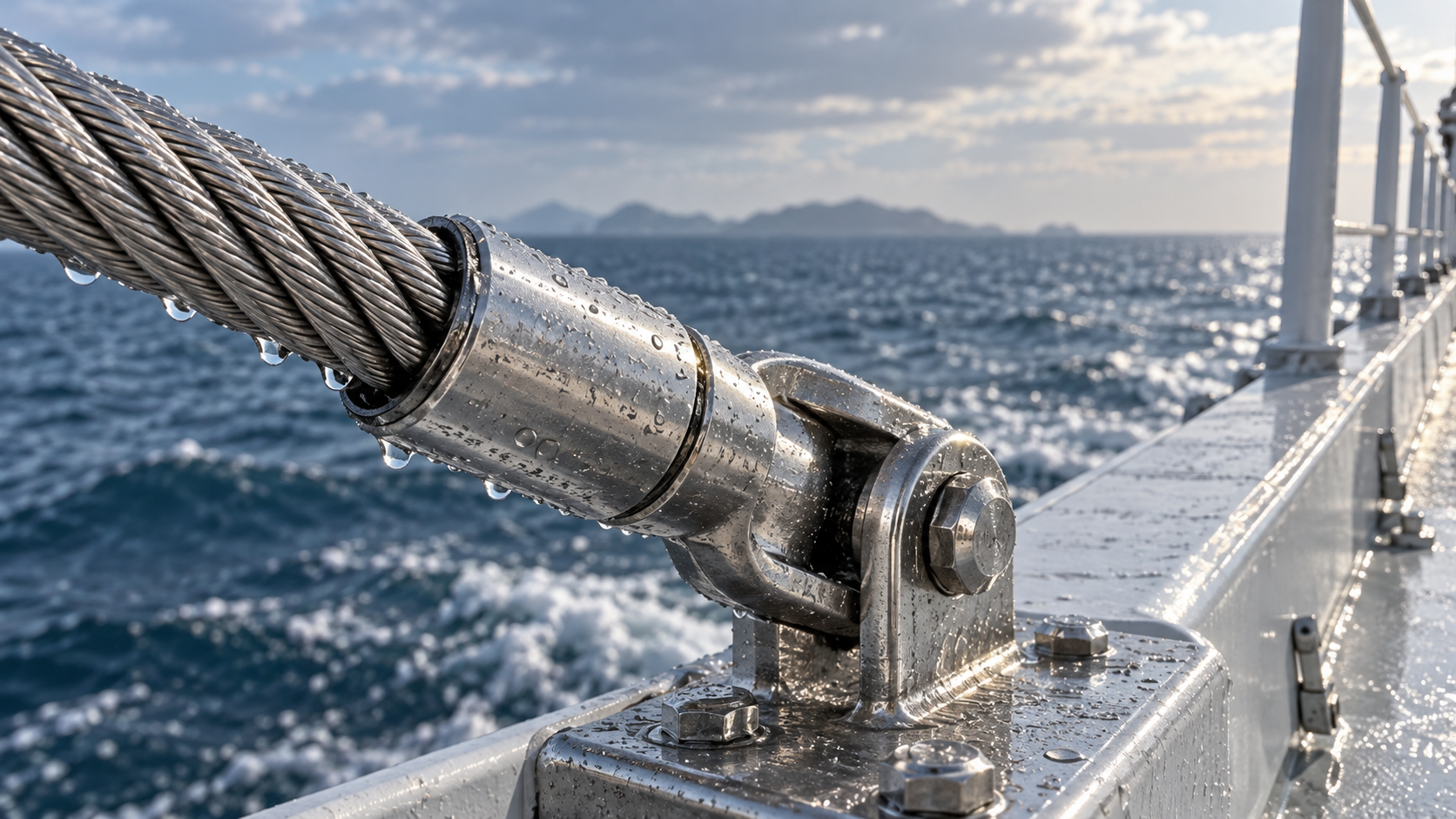
A stainless wire rope on a ship’s deck can remain serviceable while the same grade deteriorates inside a wet terminal or beneath a salt-filled coating. Marine grade stainless wire, usually specified as Type 316, resists chloride-induced pitting better than Type 304, but it is not immune to seawater corrosion. It is generally a reasonable candidate for exposed coastal equipment that drains, receives freshwater cleaning, and remains accessible for inspection.
The decision changes when seawater stays trapped between strands, under clamps, or inside fittings. Localized corrosion can remove metal without producing extensive visible rust, compromising small wires and load-bearing terminations. For ship, port, and lifting equipment, specify the exposure conditions and complete assembly—not simply “marine grade”—before accepting 316.
What the 316 designation actually establishes
Type 316 is an austenitic stainless steel containing chromium, nickel, and molybdenum. Chromium supports the passive surface film; molybdenum improves resistance to localized chloride attack compared with 304. That advantage is useful in coastal atmospheres and salt-spray exposure, but it does not establish an allowable load, fatigue life, or guaranteed seawater service life.
“Marine grade” is a commercial description, not a complete material specification. The purchase documents should identify the alloy, applicable product standard, wire or rope construction, diameter, mechanical requirements, and inspection documentation. A stainless wire material standard such as ASTM A580/A580M does not, by itself, qualify a finished rope assembly for lifting.
316L has lower carbon content, primarily reducing susceptibility to sensitization associated with welding or certain thermal histories. It is not a general upgrade that eliminates chloride pitting or crevice corrosion. For cold-drawn wire and mechanically assembled ropes, verify the actual grade and processing condition rather than assuming the “L” suffix resolves the exposure risk.
Match the material to the wetting pattern
There is no universal seawater temperature or chloride concentration below which every 316 rope assembly is safe. Surface condition, deposits, stress, wetting duration, and geometry interact. A freely exposed wire and a tightly packed rope made from the same alloy can therefore have different corrosion behavior.
The concealed locations where corrosion starts
Crevices are often the controlling weakness. Beneath clamps, inside swaged fittings, and between contacting wires, restricted fluid exchange can create an aggressive local environment. Oxygen depletion and changes in local chemistry destabilize passivity, allowing attack to progress while nearby exposed surfaces appear satisfactory.
Pitting can also begin where salt deposits remain after evaporation or where the surface is damaged or contaminated. On fine wire, a small pit can represent a significant reduction in effective cross-section and create a stress concentration. Repeated bending or vibration can then turn localized attack into a fatigue initiation site.
Chloride stress-corrosion cracking is a separate failure mechanism involving a susceptible material, tensile stress, and an aggressive environment. Elevated temperature generally increases concern, but assigning a single safe temperature without considering the actual chemistry and stress condition is unreliable.
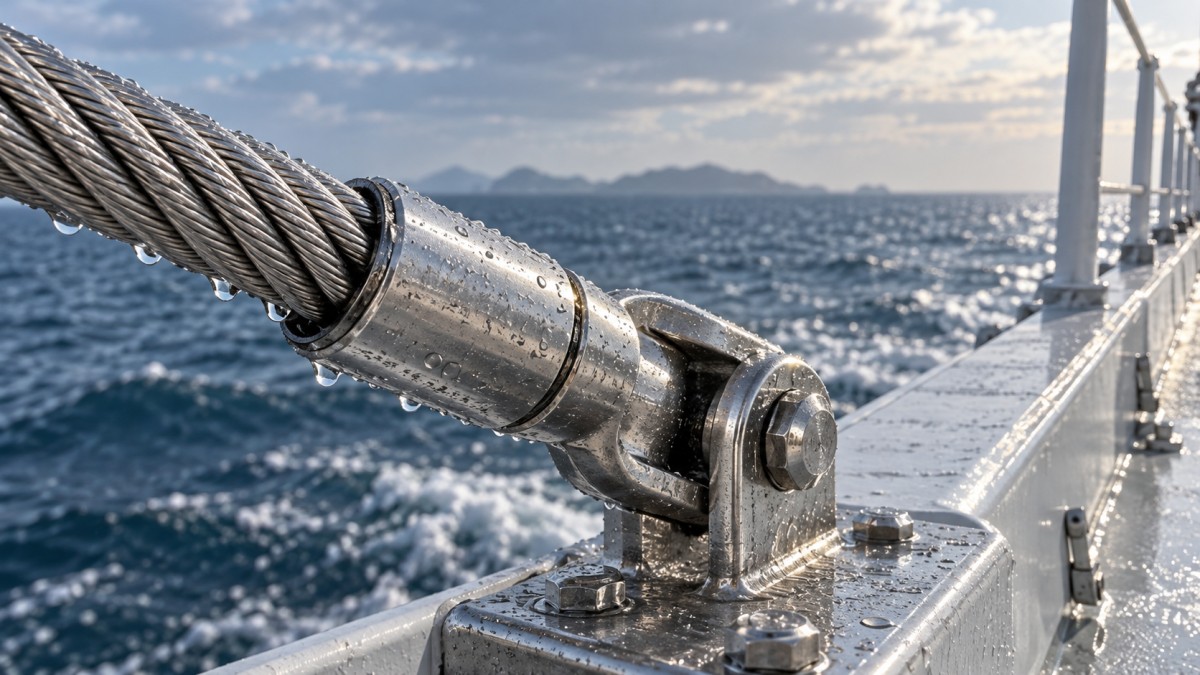
External brown staining should trigger investigation, not an automatic diagnosis. It may result from deposited carbon-steel particles, superficial staining, or corrosion of the stainless substrate. Cleaning reveals whether pits or other damage remain; appearance alone cannot establish residual strength.
Construction and surface treatment affect the result
Rope selection must balance corrosion exposure with mechanical duty. Flexible constructions suitable for repeated bending contain many wire contacts and internal spaces. More rigid constructions may suit static stays or restraints but can be unsuitable for the same sheave duty. Neither construction should be selected on corrosion resistance alone.
- Terminations: Specify compatible fittings, qualified assembly methods, and arrangements that limit water retention. A corrosion-resistant rope does not compensate for an unsuitable socket or clamp.
- Surface cleanliness: Prevent contamination from carbon-steel brushes, grinding debris, and shared handling equipment. Cleaning and appropriately specified pickling or passivation can improve surface condition, but do not change the alloy’s intrinsic limits.
- Lubrication: For running ropes, use a lubricant compatible with stainless steel, the environment, and the equipment. Effective penetration and renewal matter; an external film does not prove that internal wires are protected.
- Plastic coatings: Treat coatings as a separate engineered barrier. Damage, poorly sealed ends, and trapped water can conceal corrosion rather than prevent it.
Contact with other metals also needs review. Electrically connected stainless steel and carbon steel or galvanized components can form a galvanic couple in seawater. The less noble material may corrode faster, particularly where a small exposed area is coupled to a larger stainless surface.
Evidence to request before accepting the wire or rope
Start with traceable material documentation linking the supplied product to its alloy composition and production lot. Positive material identification can help distinguish molybdenum-bearing 316 from 304, but it does not establish tensile strength, rope construction, or assembly capacity. Common handheld X-ray fluorescence testing also cannot reliably verify the low-carbon distinction between 316 and 316L.
- Define the exposure: Record atmospheric, splash, or immersed service; temperature; cleaning access; deposits; and foreseeable chemical contamination.
- Verify mechanical suitability: Require the specified construction, diameter, minimum breaking force, termination details, and applicable test records. Derive working load limits through the relevant design requirements, not from alloy identity.
- Inspect the delivered condition: Look for damaged wires, contamination, rough surfaces, poorly finished fittings, and features that retain water.
- Establish an inspection baseline: Record critical locations and access limitations before service, especially where future internal inspection will be difficult.
Salt-spray test results may help compare controlled surface or coating conditions. They are not a direct prediction of service life in an immersed, loaded wire rope. Likewise, certificates for individual materials do not demonstrate compliance of the complete lifting assembly.
Separate corrosion selection from load-bearing approval
A port installation may use stainless wire for an exposed restraint and a different product for sheltered bundling or noncritical fastening. The Welded Steel Electric Galvanized Ordinary Short Medium Long Link Chain is offered in Q235 or Q195 carbon steel with electrogalvanized finishes and short-, medium-, and long-link options. It belongs to a different corrosion-protection system: zinc protects the underlying steel but can be consumed or damaged in service.
That chain is not an equivalent substitute for 316 in persistent seawater exposure. For lifting, neither its finish nor generic tensile or breaking-strength descriptions establish an approved working load limit. Require documentation for the specific chain, fittings, and intended duty before treating the assembly as lifting equipment.
During operation, prioritize inspections at terminations, strand valleys, splash-zone transitions, and locations where coatings are damaged. Follow the equipment manufacturer’s cleaning and lubrication instructions and the applicable inspection criteria. Pitting, cracking, broken wires, or unexplained deterioration in a load-bearing assembly warrants removal from service pending competent assessment; cleaning alone is not evidence that capacity has been restored.
Where stagnant immersion or inaccessible wet crevices cannot be removed, changing maintenance frequency may be insufficient. Evaluate drainage redesign, replaceable components, or higher-alloy alternatives with the mechanical and corrosion requirements considered together. The decisive question is whether the complete assembly remains inspectable and suitable under its actual exposure—not whether the wire carries a marine-grade label.
Navigation
Send Us A Message



Shandong Faster Technology Co., Ltd. is a professional manufacturer of steel wire ropes.
Get in Touch
*We respect your confidentiality and all information are protected.