





6–22mm G80 Chain Slings: Selecting 1–4 Legs, Hooks, and Rated Capacity
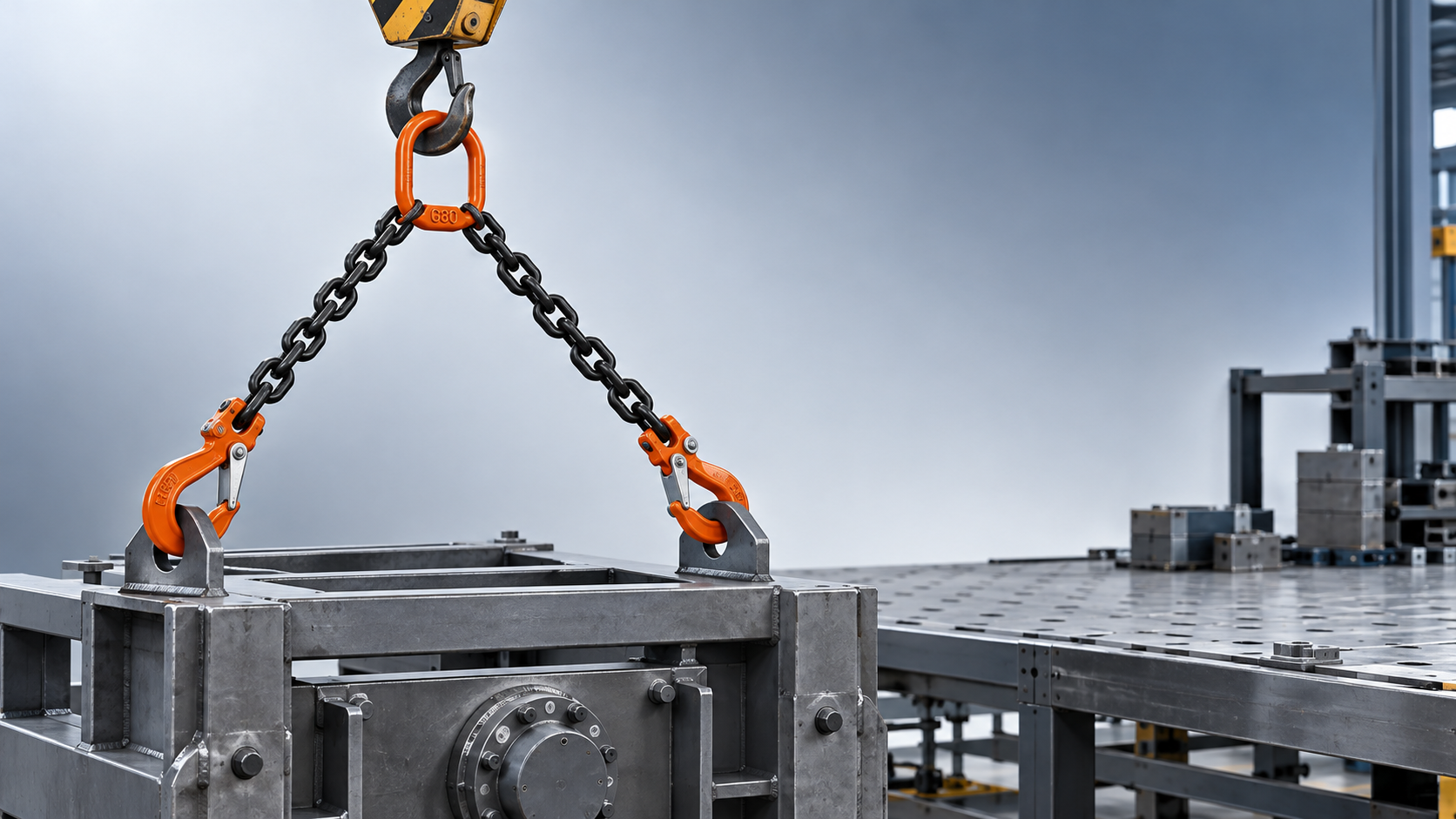
6–22mm G80 Chain Slings: Selecting 1–4 Legs, Hooks, and Rated Capacity
Selecting a G80 chain sling requires more than matching chain diameter to load weight. A listing such as “6-22mm Lifting Chain Sling 1 2 3 4 Legs G80 Welded Chain Sling With Hook” describes a product range, not a lifting capacity. The usable rating depends on the complete assembly, its configuration, the angle of its legs, and how the load actually reaches each attachment point.
For an equipment frame, fabricated skid, or irregular mining component, the difficult question is often not “Which chain is strong enough?” It is “Which legs will carry the load, and will the hooks remain correctly seated throughout the lift?” Start there before comparing prices or increasing chain diameter.
Choose the configuration around the load, not the number of lifting points
Record the load mass, center of gravity, lifting-point positions, and available headroom. Include attached equipment and retained contents where relevant. A frame that looks symmetrical may carry a motor or gearbox on one side; equal leg lengths do not make that load symmetrical.
Four hooks connected to four corners do not prove that each leg carries one-quarter of the weight. On a rigid skid, small differences in attachment height or chain length can leave one leg lightly loaded. Many rating systems group three- and four-leg slings together under specified conditions rather than assigning four times the single-leg capacity. Use the assembly manufacturer’s rating table and its stated assumptions.
Leg angle can change the selection more than diameter
Always establish how the angle is measured. An angle from vertical is not interchangeable with an angle from horizontal. A drawing showing “60°” without a reference can lead to the wrong capacity selection.
For an ideal, symmetrical two-leg lift, tension in each leg is T = W / (2 cos β), where W is the load force and β is the angle from vertical. At 45° from vertical, each leg carries approximately 0.707 times the load force. At 60°, each carries the full load force. These are static geometry calculations, not permission to select or rate an assembly independently.
Real lifts must also account for imbalance, operating restrictions, and the manufacturer’s rated angle bands. Where headroom forces the legs outward, a larger chain may not solve the whole problem: the lifting lugs also experience increased inward force. A suitably engineered lifting beam may be a better option than simply moving from a smaller chain to a larger one.
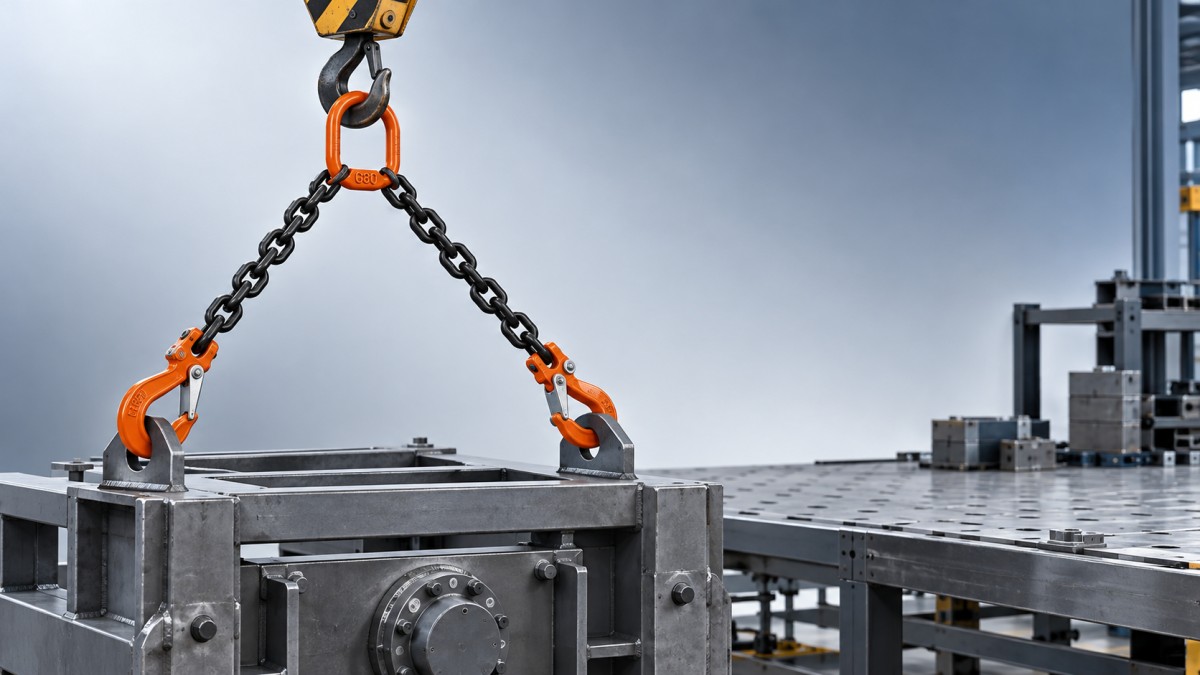
The useful comparison is therefore between complete arrangements: chain size, effective leg length, hook geometry, lifting-point spacing, and available hook height. A diameter-only quotation leaves too much unresolved.
Check capacity at assembly level
Within the 6–22mm range, there is no single universal capacity chart that should be applied without checking the product standard and manufacturer’s documentation. Request the working load limit, or WLL, for the exact diameter, leg count, hitch, and angle range being supplied.
The rating cannot exceed what the lowest-rated component permits, but component ratings alone are not enough. The master link must fit the crane hook correctly, connecting links must suit the chain and fittings, and the whole configuration must have an assigned assembly WLL. Breaking force and proof-test load are not working load limits.
Identify the applicable requirements early. EN 818-4 addresses Grade 8 chain slings, while ASME B30.9 covers slings in a different standards framework. Neither should be treated as a generic badge. Ask which requirements the supplied assembly meets and request supporting identification, instructions, and test documentation.
A larger chain also creates handling compromises
Moving toward 22mm increases assembly weight and fitting size. That matters when operators connect hooks in confined spaces or repeatedly reposition legs. Check lug openings and access before approving the larger size; a hook that cannot seat properly is not an acceptable trade-off for a higher nominal rating.
Select hooks for contact geometry and retention
A sling hook with a latch and a self-locking hook offer different retention arrangements. Neither compensates for a hook bearing on its tip, being side-loaded, or sitting against an unsuitable lug edge. The load should seat in the intended bearing area, with sufficient clearance for the retention mechanism to close.
Check throat opening, bowl dimensions, permitted loading direction, and clearance through the entire lift. If swivelling is required, confirm whether the selected swivel is rated to rotate under load; not every swivel has that function.
Shortening devices deserve equal attention. They must be approved for the chain size and arrangement, with any capacity restrictions stated. Do not shorten legs with improvised bolts, knots, or unapproved links. “Welded chain” describes chain construction, not permission to weld or repair a lifting assembly on site.
Keep non-lifting chain out of the specification
Suppliers offering several chain grades can support different jobs, but those products must remain clearly separated. For example, the ASTM A413-80 Standard G30 Proof Coil Chain Galvanized Link Chain Q235 Carbon Steel Chain is a low-carbon-steel option for non-lifting bundling and fixation applications, subject to its specific rating. It is not a substitute for G80 overhead-lifting chain.
Galvanizing does not turn G30 into a lifting grade. Likewise, specify only manufacturer-approved corrosion protection for G80 assemblies; do not assume an after-market coating or galvanizing process is harmless. Heat, chemicals, corrosion, and abrasive contact require application-specific review and may impose derating or prohibit use.
What to send with a customized sling enquiry
Shandong Faster Technology Co., Ltd. supplies steel wire rope, processed slings, and chain grades including G30, G80, and G100. That range is useful when comparing lifting and fixation solutions, but wire-rope production capability should not replace verification of the proposed chain sling.
For a meaningful technical proposal, send a lifting-point drawing, verified load mass and center of gravity, required leg lengths, headroom, hook preferences, and operating environment. Request the assembly drawing, WLL and angle limits, component compatibility details, traceability, test records, and inspection instructions.
Before release, confirm that the sling identification matches the delivered assembly and the approved lift plan. If the quotation gives only “G80, four legs, with hooks,” it is not yet a complete selection. Resolve the geometry and rating assumptions before the sling reaches the crane.
Navigation
Send Us A Message



Shandong Faster Technology Co., Ltd. is a professional manufacturer of steel wire ropes.
Get in Touch
*We respect your confidentiality and all information are protected.