





Is 7x19 galvanized wire cable flexible enough for winches?
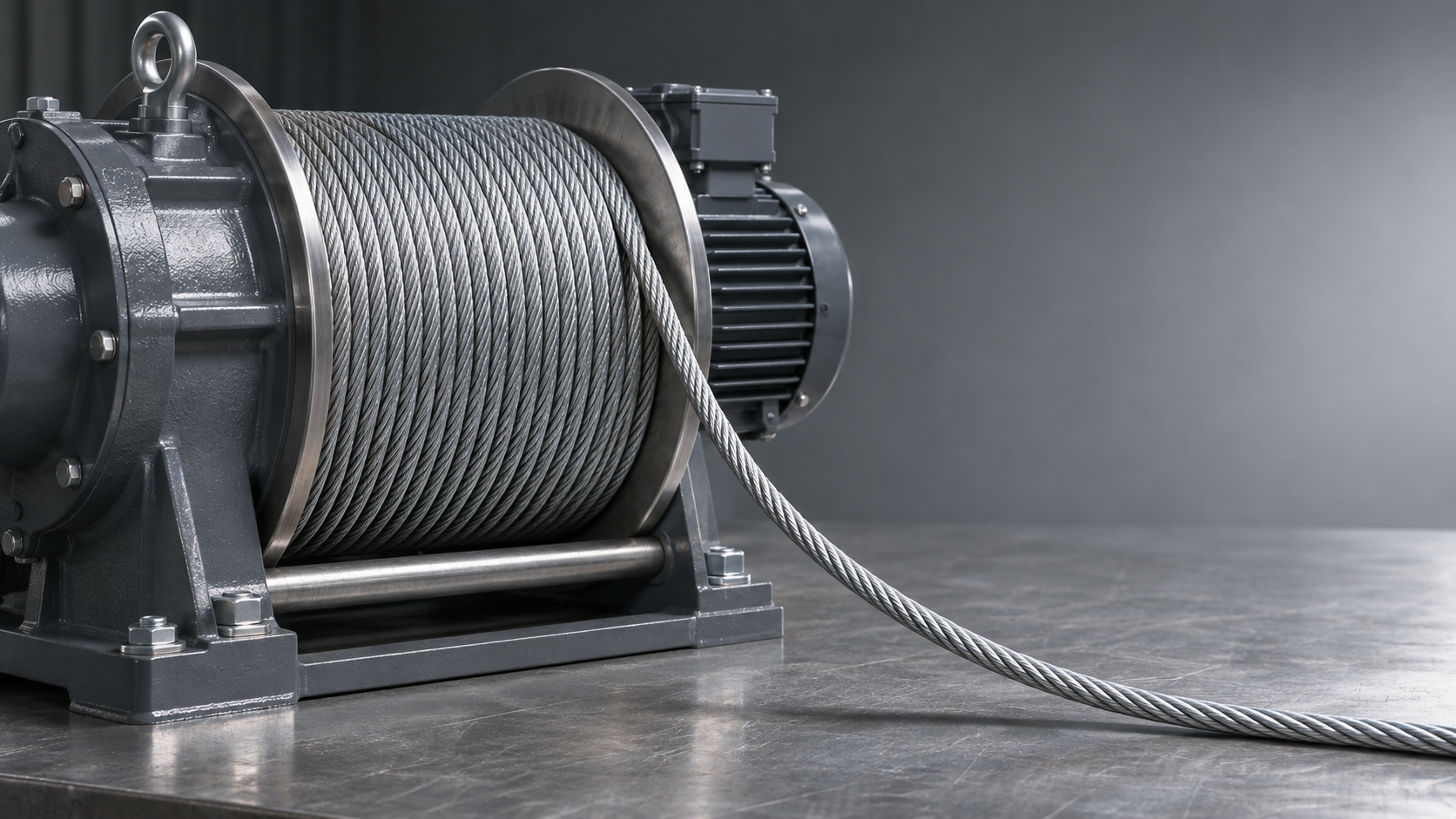
Yes. A 7x19 galvanized wire rope is flexible enough for many winches, provided its diameter, breaking strength, drum and sheave geometry, and construction meet the equipment requirements. Its numerous relatively fine wires allow it to bend more readily than a comparable rope made with fewer, thicker wires. That flexibility alone does not establish a suitable service life or make the rope interchangeable with the winch’s specified cable.
The answer changes with the duty. A rope used occasionally for straight-line pulling faces different demands from one cycling under load across several sheaves or winding repeatedly onto multiple drum layers. Evaluate the complete rope path and the highest expected line tension before selecting the construction.
What 7x19 construction tells you
A 7x19 rope consists of seven strands, each containing 19 wires. For a given diameter, its smaller individual wires generally bend more easily than the larger wires in a 7x7 construction. This makes 7x19 a common candidate where a cable must wind around a drum or pass over sheaves.
There is a trade-off: finer outer wires present less material at each exposed contact point and can be vulnerable to abrasion. A rope running over clean, correctly sized sheaves may benefit from the construction, while a rope dragged over rough ground or damaged drum flanges may wear on its outside before bending fatigue becomes the limiting factor. Compare ropes of the same nominal diameter and grade using their actual specifications; construction labels alone do not establish relative breaking strength.
Drum and sheave size set the bending demand
The relationship between the drum or sheave diameter and the rope diameter is often expressed as a D/d ratio. A smaller ratio forces the rope into a tighter bend, increasing bending strain in the wires. Repeated bending under tension can then cause fatigue, even when the rope is flexible enough to wrap around the drum during installation.
Use the relevant drum and sheave dimensions specified by the winch and rope manufacturers, including the basis on which those diameters are measured. Check every sheave in the rope path: a small redirecting sheave can govern fatigue exposure even when the main drum is relatively large. Reverse bends, where the rope curves in opposite directions over successive components, add to the bending duty.
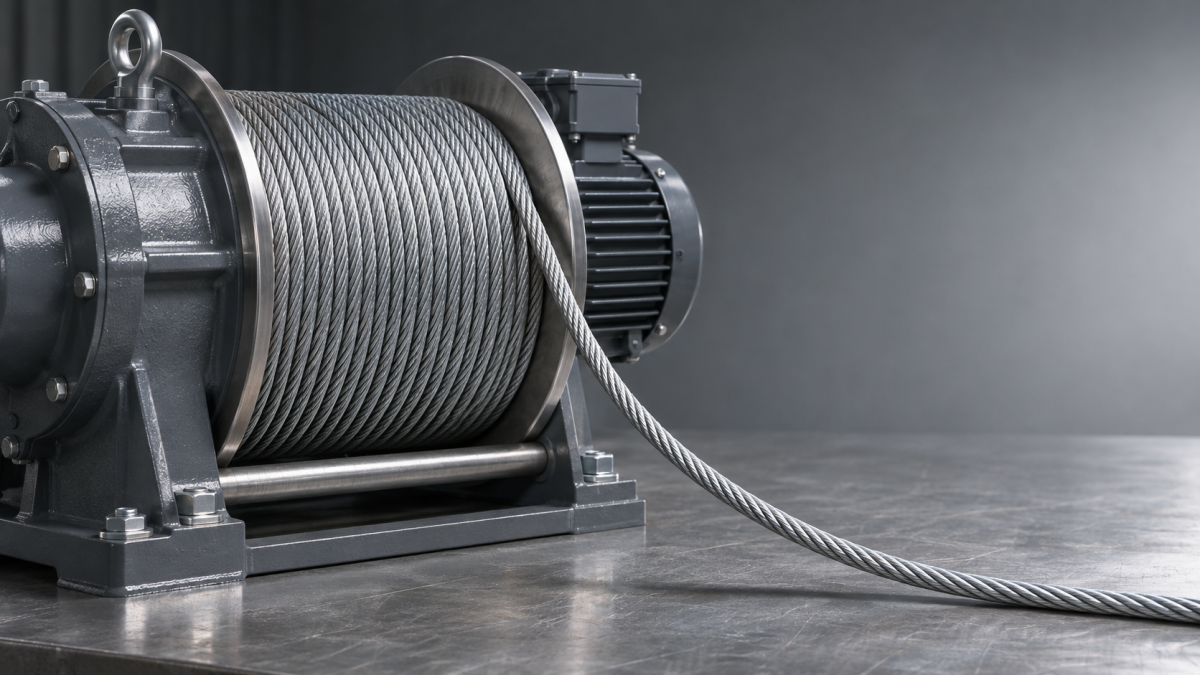
Do not select a smaller rope solely to improve the D/d ratio. A reduced diameter can also reduce breaking strength and may no longer fit the drum grooves, sheave grooves, anchor, or termination. A sheave groove that poorly supports the rope can create concentrated contact pressure; an excessively tight groove can pinch it. Groove condition and dimensions need to suit the actual rope diameter.
Flexibility does not establish load capacity
Determine the maximum line tension for the intended pull or lift, including the effect of the reeving arrangement, friction, acceleration, and any foreseeable shock loading. For a recovery or traction winch, the force needed to move a load can differ substantially from the load’s weight. For a lifting application, use the applicable equipment requirements and design factor rather than treating the rope’s minimum breaking force as an allowable working load.
Winch ratings also require careful interpretation. Line pull can vary with the layer of rope on the drum, and the equipment rating is not a substitute for the rope’s specified breaking force. Conversely, a high rope breaking force does not increase the rated capacity of the winch, anchor, hook, or other connecting components.
Obtain the minimum breaking force for the exact diameter, construction, grade, and finish being considered. Verify termination efficiency and compatibility separately: a fitting’s rating depends on its design and installation, and a rope-end assembly should not be assumed to retain the full strength of the bare rope.
7x19 and rotation-resistant rope serve different needs
For a guided pulling line with both ends restrained, conventional 7x19 rope can be a practical choice when the winch permits it. A freely suspended load introduces a different question: torque in a loaded rope can cause the load to rotate. Standard 7x19 construction should not be assumed to provide the rotational stability required for a particular lifting arrangement.
A separate construction such as 19x7 galvanized steel wire rope 4.0-18.0mm Anti rotation steel cable uses multiple layers of strands to resist rotation. Its listed diameter range is 4.0 to 18.0 mm. It is a distinct rope construction, not a 7x19 variant, and its suitability still depends on the winch, reeving, load, and specified handling requirements. Rotation-resistant ropes can require particular care during installation and may have restrictions on swivel use; follow the rope and equipment instructions for the exact product.
Low rotation does not automatically mean better bending fatigue, greater abrasion resistance, or higher allowable load. Where a winch was designed for a specific rope construction, changing to 19x7 requires confirmation of compatibility rather than a diameter-only substitution.
Galvanizing, spooling, and service life
The zinc coating provides corrosion protection, which is useful when a winch is exposed to moisture. It does not prevent mechanical damage or eliminate the need for appropriate lubrication. Salt exposure, trapped water, abrasive contamination, and inadequate drainage can still shorten service life. Confirm the coating type and lubrication requirements for the intended environment; galvanized finish alone is not a corrosion-life rating.
On a multilayer drum, lower wraps experience pressure from the layers above. Loose or uneven winding allows upper wraps to cut into lower layers, causing crushing, distortion, and erratic spooling. Maintain the winding tension and fleet angle specified for the equipment, and avoid dragging the rope across a flange or overwinding the drum. A flexible 7x19 rope is still susceptible to damage if the winding geometry is poor.
During service, inspect the rope along its length, with attention to sections that repeatedly pass over sheaves, enter the drum, or sit at layer crossovers. Broken wires concentrated around bend points can indicate fatigue; flattened strands or local deformation at crossover points suggest crushing. Corrosion, kinks, protruding wires, and damaged terminations also require assessment against the applicable equipment and rope discard criteria. Remove the rope from service when those criteria are met or when its condition cannot be established safely.
Before specifying 7x19 galvanized wire for a winch, establish the rope diameter and length, required breaking force, drum and smallest sheave dimensions, line path, duty cycle, and environmental exposure. If any of these conflict with the winch manufacturer’s rope requirements, the construction’s flexibility is not sufficient reason to use it.
Navigation
Send Us A Message



Shandong Faster Technology Co., Ltd. is a professional manufacturer of steel wire ropes.
Get in Touch
*We respect your confidentiality and all information are protected.