





How to verify a wire rope supplier's test certificates
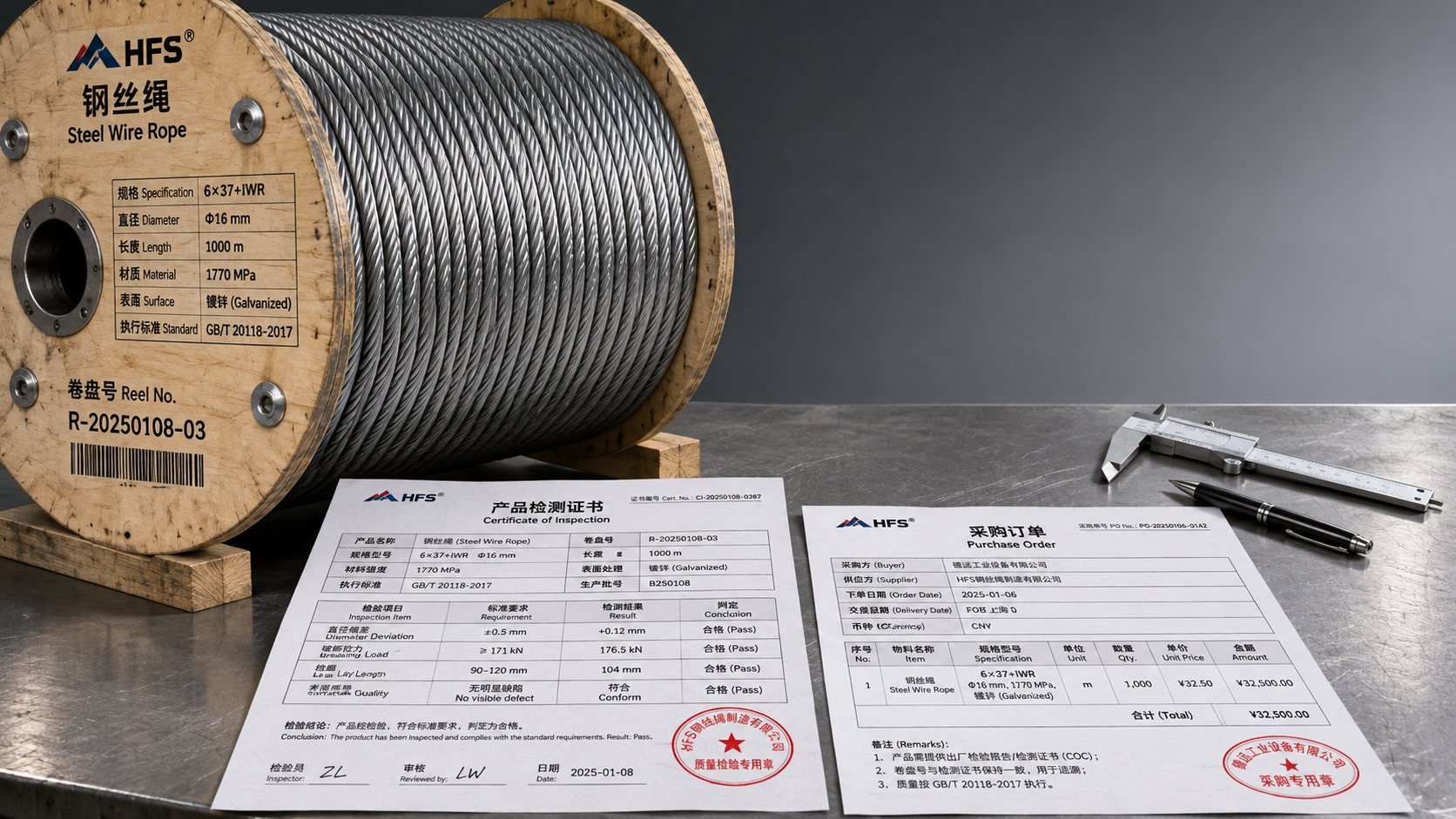
A wire rope supplier’s test certificate is useful only when it identifies the supplied product, records the relevant results, and can be traced to the rope being purchased. Check it against the purchase order and reel markings, compare each result with the agreed acceptance criteria, and verify the document with its issuer when its origin or scope is uncertain.
This matters when several rope constructions or production batches arrive under one order: a genuine report for a similar diameter may still describe the wrong material. Accepting it without checking can lead to delivery delays, replacement costs, or the installation of rope that has not been demonstrated to meet the application’s requirements.
Start with the order, not the certificate heading
Before reviewing test values, collect the purchase order, technical specification, approved drawing or data sheet, and any inspection requirements. These documents establish what the supplier agreed to provide. A certificate can accurately report a test and still be unsuitable if the tested product differs from the order.
Compare the following identifiers across the order, certificate, packing list, reel label, and product marking where applicable:
- Rope description: nominal diameter, construction, core type, lay direction and any required finish, such as galvanized or stainless steel.
- Material and performance: specified wire tensile grade, minimum breaking force, and other agreed properties. Check that the stated units and test basis are comparable.
- Quantity and traceability: reel numbers, batch or production identification, and the quantity covered by the document.
- Standard: the exact designation and edition specified in the order, including any agreed additional requirements.
A missing detail is not automatically proof of nonconformity. Ask for the manufacturer’s production record or a documented cross-reference if, for example, a reel number does not appear on the certificate. Do not rely on a verbal assurance that the document covers all reels.
Distinguish a product test from supporting material records
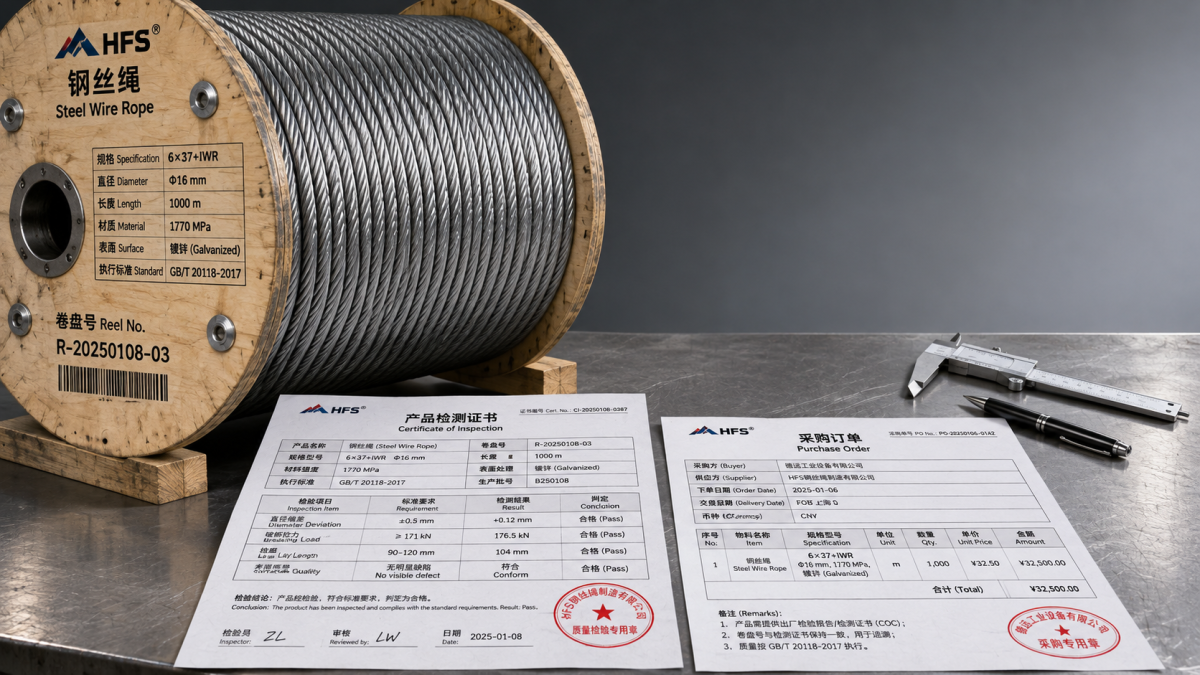
Wire rope is an assembled product. A wire rod certificate or an individual wire test can support material traceability, but neither automatically establishes the breaking force of the finished rope. Similarly, a laboratory report for a sample or a certificate of conformity may not contain actual results for the batch in the shipment.
Read the document’s scope and wording. Does it report measured values, or merely state that the product complies? Does it identify the finished rope, constituent wire, coating, or another item? Check the sampling location and test method where these are specified. A report describing a product type may be useful evidence of capability, but it is not a substitute for order-specific testing when the contract requires it.
Document designations also need context. For example, an EN 10204 inspection document type describes the nature of the inspection document and its validation; the designation alone does not establish which tests were performed or whether a particular reel was sampled. Agree on the required document type and inspection scope before ordering.
Read the results against the agreed limits
Locate the actual result for each required characteristic and compare it with the corresponding limit in the applicable specification. Confirm whether a value is a minimum requirement, a nominal property, or a measured result. A table of standard minimums should not be mistaken for evidence that the supplied rope was tested.
For breaking force, check the unit and whether the figure refers to the complete rope or to another calculated or component value. A result expressed in kilonewtons cannot be compared directly with a requirement in a different unit without conversion. Where the order specifies diameter tolerance, coating checks, or other tests, confirm the reported method and acceptance range rather than assuming a “pass” covers every requirement.
Do not infer a safe working load from a breaking-force result alone. Selection and use depend on the application, termination, applicable requirements, and other design factors. For lifting or other safety-critical service, resolve any mismatch with the responsible engineering or inspection function before release.
Check who issued the document
Identify the manufacturer, inspection representative, or laboratory named on each record and determine what that party actually attests. A laboratory may report only the sample submitted to it; that does not necessarily establish that every reel in the shipment is identical to the sample.
- Ask the supplier for the original certificate or a legible copy, including all pages, report number, issue date, test dates, and any attachments.
- For an independently issued report, contact the issuing organization through a contact channel obtained independently of the document. Ask it to confirm the report number, issue date, test scope, and whether the copy matches its record.
- Where accreditation is required, confirm the laboratory’s status and whether the relevant test was within its accredited scope at the time of testing. A laboratory’s accreditation does not by itself certify the product.
- Request written clarification for amendments, missing pages, inconsistent names, altered values, or a report that cannot be verified. Keep the response with the purchasing record.
Confidentiality rules may limit what an issuer will disclose. In that case, request authorization from the document holder or agree on another verification route. An unverified report should not be treated as confirmed solely because it contains a logo or stamp.
Handle discrepancies before accepting the delivery
Separate a documentation gap from a failed result. A missing batch reference may be resolved with traceability records; a measured result below an agreed minimum is a product nonconformity and cannot be corrected by reissuing the same certificate. Hold the affected reels from use while the discrepancy is assessed, and record which items are affected.
Ask the supplier to identify the cause, provide supporting production or inspection records, and propose a disposition. Depending on the contract and technical requirements, that may involve replacement, further traceability work, or additional testing. Any concession should be approved by the party authorized to accept it; procurement should not silently waive a safety-related requirement to avoid delay.
Retesting also needs a defined sampling plan. One new test may clarify a questionable result, but it does not automatically validate every reel or batch. Agree on who selects samples, which test method applies, how results will be evaluated, and who pays before arranging it.
Build verification costs into the purchase decision
Request a sample document with the quotation, then specify the final evidence required with delivery. State the applicable standard and edition, product identifiers, tests, document type, traceability level, and whether independent witnessing or verification is required. Ask which charges are included and which apply to additional tests, duplicate documents, or inspection attendance.
When comparing quotations, a lower unit price may carry extra cost if the offered documents do not satisfy the order. Conversely, paying for unnecessary third-party testing can add expense without resolving the actual traceability requirement. Match the evidence to the consequences of failure and the contract’s acceptance rules.
Keep records for related items separate. If an order also includes ASTM A413-80 Standard G30 Proof Coil Chain Galvanized Link Chain Q235 Carbon Steel Chain for non-lifting bundling or fixation, its chain documentation should be checked against the chain specification, not used as evidence for the wire rope. Confirm the required size, finish and load rating for the intended use; do not assume a general-purpose G30 chain is suitable for overhead lifting.
Navigation
Send Us A Message


Shandong Faster Technology Co., Ltd. is a professional manufacturer of steel wire ropes.
Get in Touch
*We respect your confidentiality and all information are protected.