





How wire rope core choice changes crushing resistance on drums
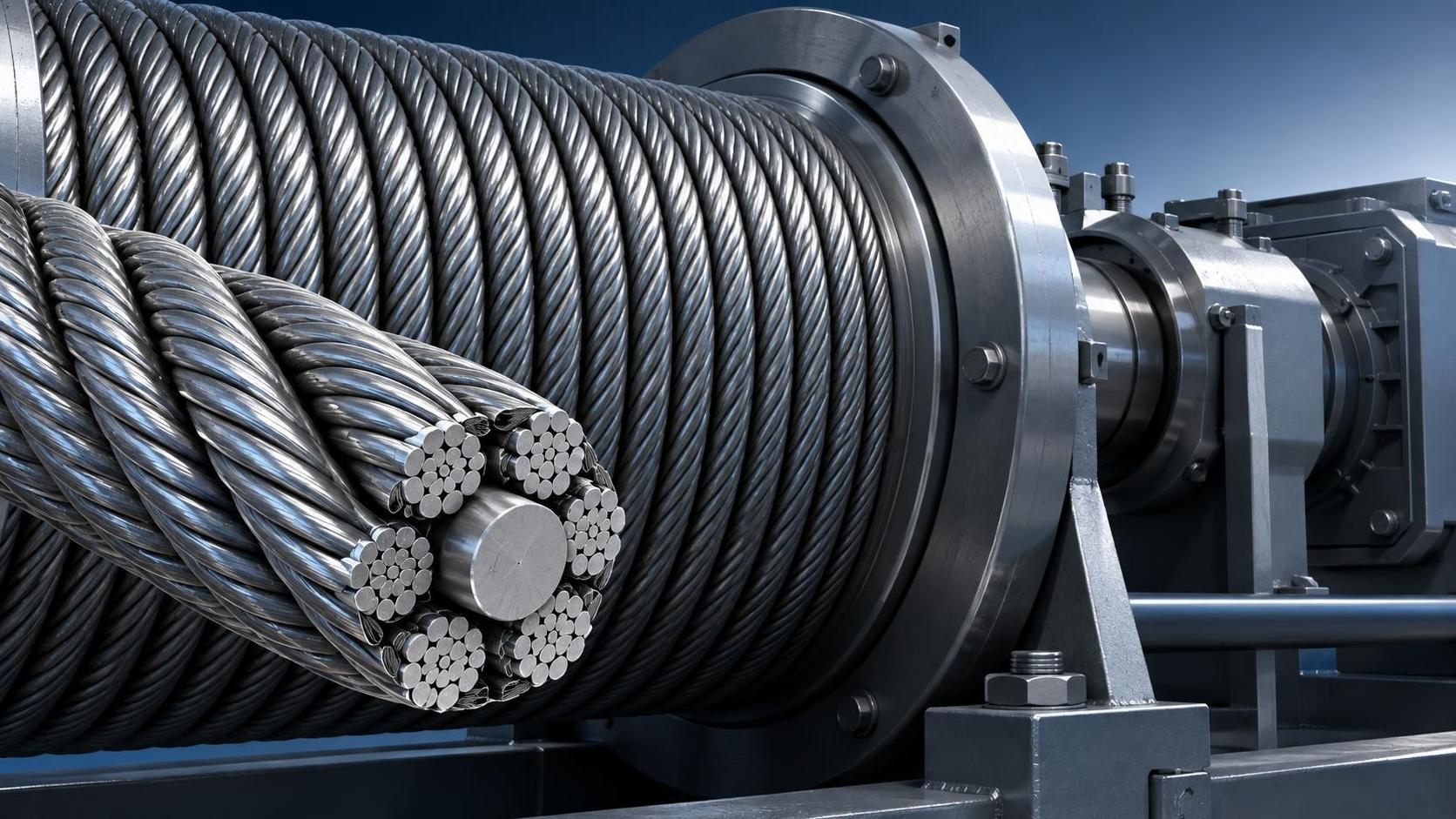
How Wire Rope Core Choice Changes Crushing Resistance on Drums
Wire rope core selection directly affects crushing resistance, dimensional stability, and service safety when ropes operate on drums under high load. For quality and safety teams, the issue is not simply whether a rope meets its nominal breaking-force requirement. A rope can have adequate strength on paper and still develop flattened sections, strand displacement, loss of diameter, or accelerated wire breakage after repeated multilayer winding. The core is central to that outcome.
Drum crushing occurs when pressure from upper wraps is transferred into lower wraps. The rope is compressed between adjacent turns, against the drum surface, and sometimes against crossed layers where spooling is imperfect. In a lifting, mining, port, or marine system, this pressure is compounded by tension, cyclic loading, fleet angle, drum geometry, and the number of rope layers. Selecting the right Wire rope core is therefore a practical risk-control decision rather than a minor construction detail.
Why the core determines how a rope holds its shape
The core supports the outer strands and helps maintain the rope’s round profile under load. It also affects flexibility, lubrication retention, weight, and resistance to internal movement. When a rope is wound under tension, the outer strands transfer radial pressure toward the center. A core that yields too easily allows the strands to move inward; once the geometry changes, load distribution between individual wires becomes less predictable.
This is why crushing damage should not be treated as a purely cosmetic defect. A locally flattened rope may no longer seat correctly in a groove, can generate uneven contact on sheaves, and may suffer concentrated stress in displaced strands. In severe cases, the rope’s running characteristics change before visible external wire breaks make the condition obvious.
Fiber core: flexible, but more vulnerable to high radial pressure
A fiber core, often identified as FC, gives a rope good flexibility and can act as a lubricant reservoir. This can be useful where the rope repeatedly bends over sheaves and where multilayer drum pressure is limited. Fiber-core ropes also tend to accommodate bending more readily than comparable steel-core constructions.
The trade-off is lower resistance to compression. Under sustained high tension or multiple layers on a drum, the fiber core may compact. That compaction can reduce rope diameter and permit outer strands to bed into the core. The risk increases when the rope is tightly wound, the drum has poor grooving, or the installation experiences shock loading. A fiber core is not automatically unsuitable for drum service, but it calls for closer alignment between rope design and actual winding conditions.
Steel core: stronger radial support, with a flexibility trade-off
A steel core, commonly an independent wire rope core (IWRC), provides a more rigid internal foundation. It supports the surrounding strands under compressive load and generally helps the rope retain its circular shape on a drum. For demanding multilayer hoist systems, high line pulls, mining equipment, cranes, and heavy-duty traction applications, this added resistance to crushing is often a major reason to specify a steel-core construction.
That does not mean a steel core solves every drum problem. A steel-core rope is normally less flexible than an equivalent fiber-core rope. If sheave diameters are too small, the reeving path is misaligned, or the drum fleet angle is excessive, bending fatigue and abrasion may still shorten rope life. The correct decision is a balance between radial stability and the bending demands of the full machine system.
Core selection cannot compensate for a poor drum system
Many premature crushing complaints trace back to system conditions rather than the core alone. A rope may be correctly specified but still be damaged by a worn drum groove, cross-over zones, uneven initial spooling, incorrect dead-end fixing, or excessive fleet angle. The first few wraps are particularly important: if they are not installed under controlled tension, later layers can settle unevenly and create high local contact pressure.
Quality inspections should look beyond overall diameter. Measure the rope in several orientations where permitted by the inspection procedure, especially in high-pressure zones and near cross-over points. Compare current observations with the rope’s documented nominal diameter and discard criteria applicable to the equipment and governing requirements. Flattening, ridges, gaps between strands, protruding core material, or a pattern of wire breaks at the same drum location deserve investigation before the rope returns to service.
It is also worth checking whether the drum was designed for single-layer or multilayer winding. A rope that performs adequately in a single-layer arrangement can behave very differently when upper layers impose compressive force on lower layers. The number of wraps, drum pitch, groove profile, rope lay direction, and winding sequence should be reviewed together.
A practical review before approving a rope construction
Before approving a rope for a drum-driven system, safety managers should request enough information to assess the working condition rather than approve by diameter and minimum breaking force alone. Useful points to confirm include the rope construction and core designation, intended number of drum layers, drum and sheave diameters, groove condition, line pull, duty cycle, environmental exposure, and whether the rope must comply with a project-specific standard or equipment manufacturer requirement.
A further distinction matters in smaller applications. A rigid single-strand 1x7 construction is not a substitute for a conventional stranded hoist rope with an FC or IWRC. Its behavior is governed by a different structure. For precision traction, hanging, guardrail, or compact guide applications, a product such as 1x7 Stainless Steel Wire Rope 0.3-6.0mm use For Hanging Traction and guardrail may be considered where rigidity, a smooth surface, and corrosion resistance are relevant. It should not, however, be selected for high-load multilayer drum duty merely because it resists bending deformation.
Inspection and supply consistency matter after selection
For ropes used in safety-critical equipment, construction consistency is as important as the initial selection. Variations in wire quality, closing control, lubrication, lay characteristics, or finished diameter can affect how the rope beds onto a drum. Incoming inspection should confirm that the supplied construction matches the approved specification, including core type, material, diameter, rope direction where relevant, and required documentation.
Shandong Faster Technology Co., Ltd. manufactures wire rope, slings, and chains for lifting, ship, port, construction, mining, elevator, and related industrial applications. Its wire drawing, twisting, rope-closing, and inspection capabilities support process control from raw materials to finished products. With annual steel wire rope capacity exceeding 70,000 tons and supply coverage across galvanized, stainless steel, and plastic-coated series, the company can discuss rope construction alongside the wider requirement for slings, chains, and customized industrial assemblies.
The safest specification is usually the one that reflects the real drum arrangement, not the one that appears strongest in isolation. Where multilayer pressure, high tension, or frequent cycling are present, a steel-supported core deserves serious consideration. Where flexibility is the dominant requirement, a fiber core may remain appropriate—but only after the drum, reeving, maintenance practice, and applicable acceptance criteria have been checked as part of the same decision.
Navigation
Send Us A Message



Shandong Faster Technology Co., Ltd. is a professional manufacturer of steel wire ropes.
Get in Touch
*We respect your confidentiality and all information are protected.