





How to confirm a 16 mm wire rope core fits the rope construction
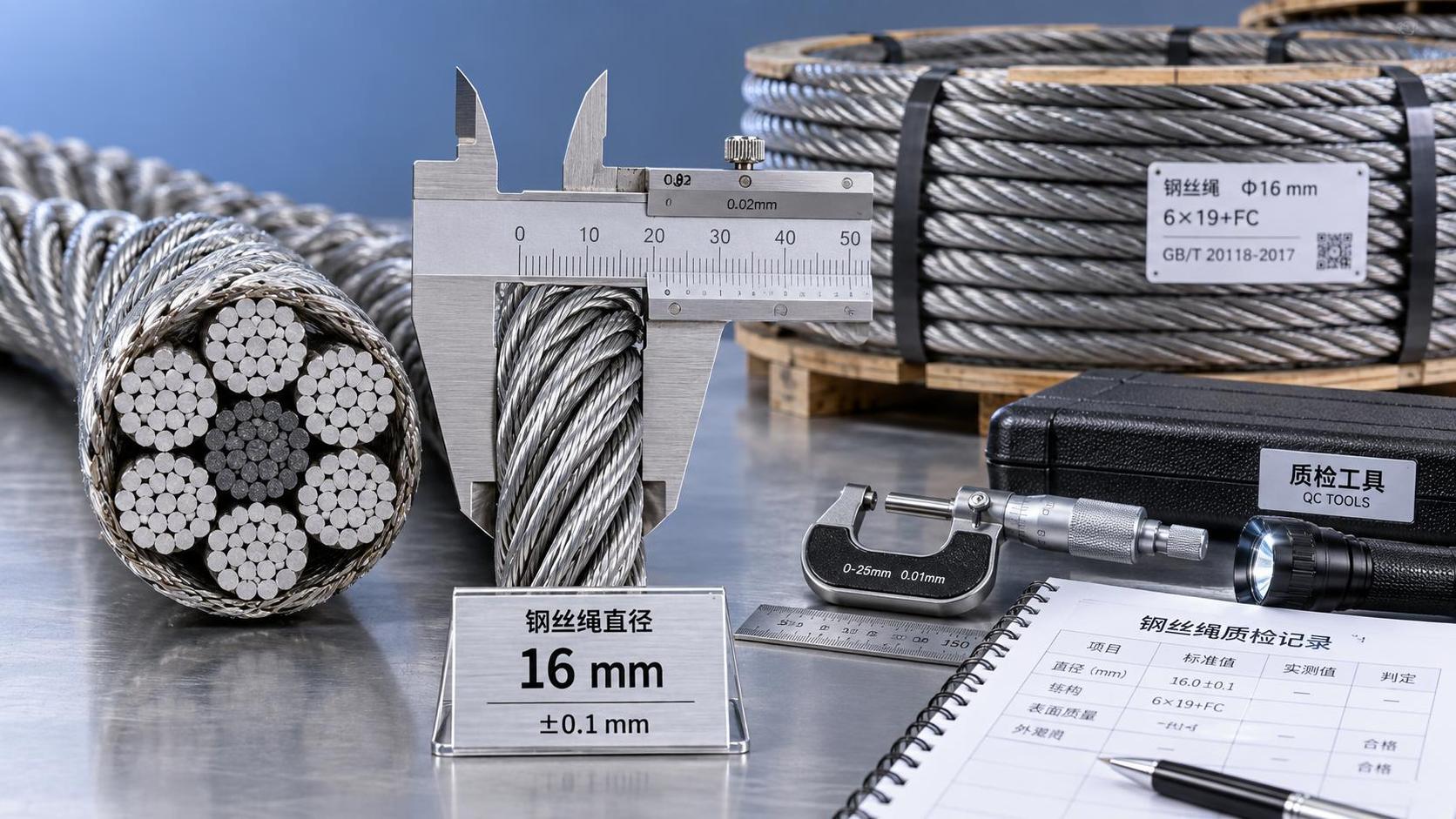
Confirming that a wire rope core 16mm is compatible with the specified rope construction is not a paperwork exercise. For quality inspectors and safety managers, it is a practical safeguard against a rope that looks correct on arrival but behaves incorrectly under load. An unsuitable core can change the rope’s diameter, flexibility, crush resistance, lubrication retention, and service life—sometimes before the rope reaches the lifting site.
The first point to establish is simple but often misunderstood: “16 mm” normally refers to the nominal finished rope diameter, not automatically to the diameter of the core. Core dimensions and core type must be appropriate for the selected strand pattern, lay, wire grades, and intended operating conditions. A 16 mm rope with a fibre core is not interchangeable with a 16 mm independent wire rope core (IWRC) product, even when both carry the same nominal diameter marking.
Start with the complete rope designation
A correct inspection begins with the purchase specification, mill certificate, or rope tag. Do not assess the core in isolation. Review the complete designation, which may include elements such as:
- Nominal rope diameter: 16 mm
- Construction, such as 6×19, 6×36, 8×19, or another specified pattern
- Core type: fibre core (FC), steel core (WSC), or independent wire rope core (IWRC)
- Lay direction and lay type
- Wire finish, including bright, galvanized, stainless steel, or plastic-coated options
- Strength grade, minimum breaking force, and applicable standard
For example, a 16 mm 6×36 IWRC rope generally has a different internal geometry from a 16 mm 6×19 FC rope. The former is usually selected where improved resistance to crushing, higher strength, or multilayer winding performance is required. The latter may offer greater flexibility in applications where bending fatigue is the dominant concern. Neither is “better” without reference to the duty cycle, drum arrangement, sheave diameter, load pattern, and environmental exposure.
What the core actually does inside a 16 mm rope
The core supports the outer strands and helps maintain the rope’s round profile. It also influences how contact pressure is distributed as the rope bends over sheaves or winds onto a drum. If the core is undersized, outer strands may lose proper support, causing distortion, flattening, or accelerated wear. If it is oversized or poorly matched to the closing process, the rope may become overly stiff, uneven, or difficult to compact correctly.
Fibre cores, whether natural or synthetic, can provide flexibility and may retain lubricant. However, they are more vulnerable to compression, moisture-related deterioration, and elevated-temperature conditions than a steel core. An IWRC is itself a small wire rope that supports the outer strands more firmly. It is commonly specified for demanding lifting, mining, marine, and hoisting applications, but it should still be matched to the intended construction rather than selected merely because it is steel.
For QC teams, the critical question is not “Is there a core?” but “Does this core produce the correct finished construction, diameter, mechanical performance, and handling characteristics?”
A practical confirmation sequence for incoming inspection
Begin with document verification before opening coils or cutting samples. Match the supplier’s certificate to the order line, including rope construction, nominal diameter, finish, grade, and core designation. If the certificate only says “steel core” without identifying WSC or IWRC where that distinction matters, request clarification. Vague terminology can conceal a mismatch.
Next, measure the finished rope diameter using a suitable rope caliper. Measurements should be taken at several positions along a straight, unloaded section, avoiding visibly distorted areas and taking readings over the crown of opposite strands rather than in the valleys. Compare the recorded values with the tolerance stated in the governing product standard, contract specification, or approved manufacturer data. Do not apply a generic tolerance from a different rope construction or standard.
Then inspect the rope visually for signs that the core and outer strands are not working as one unit. Warning signs include:
- Uneven strand spacing or pronounced gaps between strands
- A rope profile that appears oval, loose, or unstable
- Local bulges, depressions, or a “core protrusion” effect
- Inconsistent lay length along the inspected section
- Outer strands that shift abnormally when the rope is gently flexed
These observations do not independently prove a core mismatch, but they justify quarantine and further evaluation. Cutting a short sample for destructive examination should only be done under the site’s inspection plan and after preserving traceability. On a cut end, the inspector can confirm whether the core type corresponds to the order and whether the outer strands sit evenly around it.
Check construction compatibility, not just diameter
It is possible for a rope to measure close to 16 mm and still be wrong for the application. Diameter alone does not confirm strand count, wire arrangement, core design, or breaking-force class. In lifting operations, this distinction is particularly important because changes in construction can alter the rope’s resistance to abrasion, fatigue, rotation, crushing, and deformation.
A useful quality-control comparison is to place the approved construction data beside the actual product record. Verify the number of outer strands, the approximate wire pattern where visible, lay direction, and core marking. Where the rope is used in a regulated lifting system, reference the project’s specified edition of ISO, EN, ASTM, API, or other applicable standard rather than assuming that one international designation covers every use case.
Safety managers should also confirm that the selected construction fits the equipment. A steel-cored 16 mm rope may be appropriate for multilayer drum winding or high compressive forces, while an installation involving repeated bending over relatively small sheaves may require a construction chosen specifically for fatigue performance. The rope manufacturer, equipment manual, and lifting plan should point in the same direction.
Common mistakes that create avoidable risk
One frequent error is accepting “16 mm core” as a complete specification. The phrase is incomplete unless it clearly identifies whether 16 mm means the final rope diameter or a separate core component. In most procurement documents, the desired wording should state the finished diameter and full rope construction, such as “16 mm, 6×36, IWRC,” followed by the required grade, finish, lay, and standard.
Another mistake is substituting a fibre-core rope for an IWRC rope because the outside diameter and general appearance are similar. Such a substitution may affect minimum breaking force, drum crushing resistance, and expected service behavior. It must never be accepted without engineering review.
Finally, avoid judging compliance solely from a product photograph or coil label. The label is important for traceability, but it should be supported by certificates, dimensional checks, visual examination, and—where required—independent testing. Reliable acceptance is built from several pieces of evidence, not one reassuring mark.
Consider the full lifting assembly
Wire rope selection is only one part of lifting safety. Hooks, master links, shackles, chain slings, and connection points must have suitable working load limits and be compatible with the lifting method. Where a job calls for alternative or supplementary rigging, a documented option such as the 6-22mm Lifting Chain Sling 1 2 3 4 Legs G80 Welded Chain Sling With Hook may be evaluated according to the lift plan, leg angle, load geometry, and applicable inspection requirements. A chain sling should not be treated as an automatic replacement for wire rope; each system has different handling, inspection, and application considerations.
Build acceptance criteria into the order, not after delivery
The most effective way to confirm a wire rope core 16mm fits its rope construction is to make the requirement unambiguous before production or procurement. Specify the rope construction, core type, nominal diameter, tolerance reference, material finish, mechanical requirement, intended use, and certification documents. For critical lifting or marine service, agree on sampling, marking, traceability, and any third-party inspection requirements in advance.
Manufacturers with control over wire drawing, strand twisting, rope closing, and final inspection are better positioned to maintain consistency from raw wire to finished rope. Even so, the receiving inspection remains essential. A carefully checked 16 mm rope gives the lifting team something more valuable than a correct label: confidence that the internal construction supports the job it was selected to perform.
Navigation
Send Us A Message



Shandong Faster Technology Co., Ltd. is a professional manufacturer of steel wire ropes.
Get in Touch
*We respect your confidentiality and all information are protected.