





How 7x7 steel wire strand performs in repeated bending
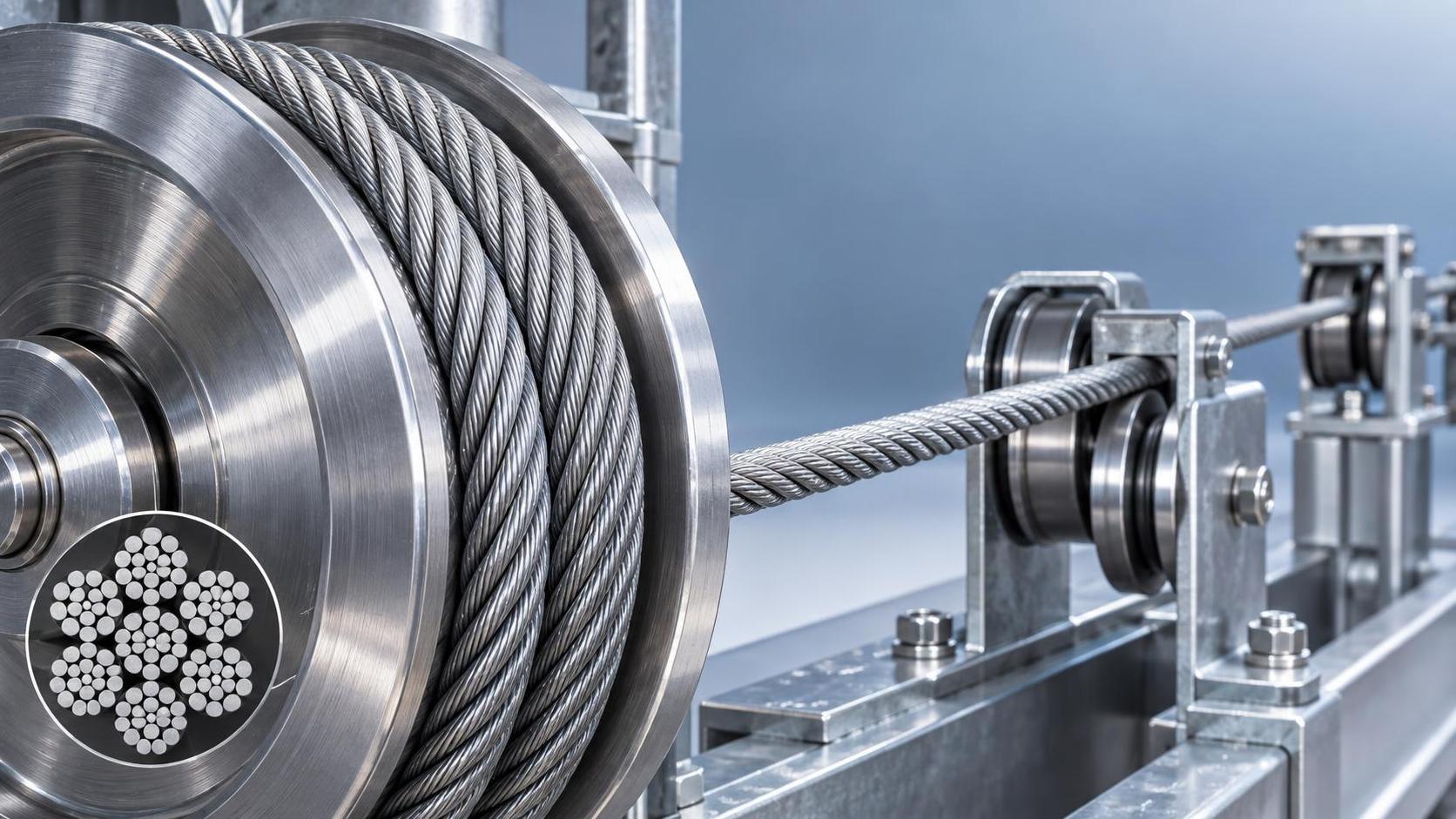
A 7x7 steel wire strand bends more readily than a single solid wire of the same outside diameter because its 49 individual wires can move slightly within the construction. Under repeated bending, however, that flexibility has a limit. Each bend over a sheave, roller, guide, or anchor point produces alternating tensile and compressive stress in the outer wires. Over many cycles, small surface cracks can initiate at highly stressed locations and grow into wire breaks. The strand may retain substantial static tensile capacity while its bending-fatigue condition has already deteriorated.
The 7x7 construction consists of seven strands, each made from seven wires. It is commonly selected where moderate flexibility, dimensional stability, and relatively good resistance to rotation are needed in control cables, small hoists, traction devices, counterbalance mechanisms, and similar moving assemblies. Its repeated-bending performance is governed less by the nominal breaking force alone than by the relationship between strand construction and the actual bending path.
What happens during each bending cycle
When a 7x7 steel wire strand passes around a curved surface, the wires on the outside of the bend extend while those nearer the inside are compressed. As the strand straightens or bends in the opposite direction, the stress reverses. This repeated reversal is more damaging than a sustained straight pull because fatigue damage accumulates at the wire surface, especially where contact pressure, abrasion, or corrosion has already disturbed the surface.
The outermost wires are usually the first place to examine. They experience the greatest bending strain and are also exposed to contact with sheaves and guides. A broken outer wire is therefore not merely a cosmetic defect. Its location matters: clustered breaks near a sheave entry point, termination, or crossover zone suggest localized fatigue or abrasion, while breaks distributed along a longer length may indicate a broader mismatch between the strand and the bending system.
Internal movement also affects the result. During bending, individual wires and sub-strands adjust position relative to one another. Adequate lubrication reduces metal-to-metal friction during this movement. If lubricant has dried out, washed away, or become loaded with abrasive dust, fretting damage can develop between wires even when the outside surface looks acceptable.
Bending diameter changes the fatigue result
The most influential installation variable is the diameter of the sheave or roller relative to the strand diameter. A small bending radius forces a sharper curvature into every wire and raises cyclic stress. The same 7x7 strand can therefore show very different service life in two machines operating at the same load: one may guide it around a properly sized smooth sheave, while the other repeatedly pulls it over a narrow pulley or a tight edge.
Nominal strand diameter alone is not enough to judge suitability. The groove profile must support the strand without pinching it, flattening it, or allowing excessive lateral movement. A groove that is too narrow creates concentrated contact and can crush the outer wires. One that is too wide can permit vibration, twisting, and uneven wear. Misalignment between sheaves creates another problem: the strand rubs against a flange or enters the groove at an angle, combining bending fatigue with abrasive wear.
Reverse bending deserves separate attention. A strand that repeatedly bends in one direction and then immediately bends back in the opposite direction is subjected to more severe stress reversal than one travelling through a single consistent curve. Short travel paths with closely spaced rollers can create this condition even where each individual roller appears acceptable.
Construction, wire quality, and surface condition
A 7x7 steel wire strand offers a practical balance between flexibility and resistance to surface damage, but it is not the most flexible construction available. Finer-wire, higher-count constructions generally tolerate smaller bending radii better because strain is distributed across smaller individual wires. They can also be more susceptible to abrasion, crushing, and contamination in rough service. Selection therefore needs to reflect the dominant failure mechanism rather than treating flexibility as an isolated benefit.
Wire tensile grade changes the balance as well. Higher-strength wires can carry more load, but they may be less forgiving where severe bending, impact, or poor alignment is present. A specification based only on minimum breaking force can unintentionally favor a high-strength option that has a shorter fatigue life in a tightly routed mechanism. The expected tension range, bend radius, cycle frequency, and environmental exposure need to be evaluated together.
Galvanized wire can provide useful protection where moisture promotes corrosion, yet the coating does not eliminate fatigue concerns. Corrosion pits act as stress raisers; once a pit develops, a cyclic crack can start at a lower local stress than on a clean surface. Bright wire may be appropriate in a dry, controlled enclosure, while galvanized strand is often more suitable in damp, outdoor, agricultural, port, or intermittent storage conditions. In either case, trapped water, chemical residue, and compacted debris should be addressed before they initiate surface damage.
Load pattern matters as much as peak load
A strand operating below its static rating can still fail from repeated bending. Peak tension is only part of the loading history. Rapid starts and stops, slack-to-tight transitions, oscillation, and shock loading increase the stress range experienced by the wires. A stable moderate tension passing over a correctly sized sheave is fundamentally different from a lightly loaded strand that repeatedly snaps taut after slack develops.
Overload may leave visible evidence such as elongation, distortion, or flattened areas. Fatigue is often less obvious early on. The strand can remain visually straight and functional until individual wire breaks appear. For this reason, an inspection record should distinguish between tensile overload indicators and bending-fatigue indicators rather than treating every defect as a generic wear condition.
Inspection should focus on the bending zones
Examination is most meaningful where the strand changes direction, enters a fitting, contacts a guide, or cycles through a short travel range. Cleaning the surface first is important because old grease and embedded dirt can conceal fractured wires. The strand should be viewed while relaxed where possible, then observed through a controlled movement cycle to identify rubbing, vibration, intermittent contact, or a changing line of pull.
Wire breaks should be recorded by location and concentration, not simply counted across the entire assembly. A small number of breaks grouped within a short length at the same bending point can be more significant than isolated breaks over a long, non-contact section. Changes in diameter, reduced lay tightness, corrosion, heat discoloration, and damaged end fittings also affect the decision to remove the strand from service. Applicable equipment instructions and governing inspection requirements should define the acceptance limits for the specific installation.
Maintaining fatigue performance after installation
Lubrication should reach the spaces between wires as well as the outer surface. A heavy surface coating that cannot penetrate the strand may make it look protected while internal fretting continues. The lubricant must also suit the environment: it should remain effective under expected temperature, water exposure, dust, and contact conditions without attracting excessive abrasive contamination.
Cutting and terminating require care because a damaged end can introduce torsion or loosen the lay. The strand should be secured before cutting, and fittings should match the intended load path. A termination that forces a sudden bend immediately outside the fitting shifts fatigue damage into a short, difficult-to-inspect section.
Where the duty includes tying, towing, or lighter lifting with intermittent bends, construction should not be substituted solely because two products have similar diameter or breaking-force values. For example, 6x12+7FC Galvanized Steel Wire Rope 3-12mm Use for Tying Towing Light Load Agriculture has a different rope construction and fiber core arrangement from 7x7 strand. Its flexibility, internal support, and behavior over sheaves must be assessed against the actual duty instead of assumed to be interchangeable.
Repeated-bending reliability comes from controlling the whole system: suitable construction, clean and correctly sized bending surfaces, stable tension, preserved lubrication, and early action when localized damage appears. A strand that runs smoothly through a correct path will show a very different fatigue pattern from one forced to compensate for poor geometry at every cycle.
Navigation
Send Us A Message



Shandong Faster Technology Co., Ltd. is a professional manufacturer of steel wire ropes.
Get in Touch
*We respect your confidentiality and all information are protected.