





How to Compare Suppliers of DIN5685 A/C Short or Long Link Chain
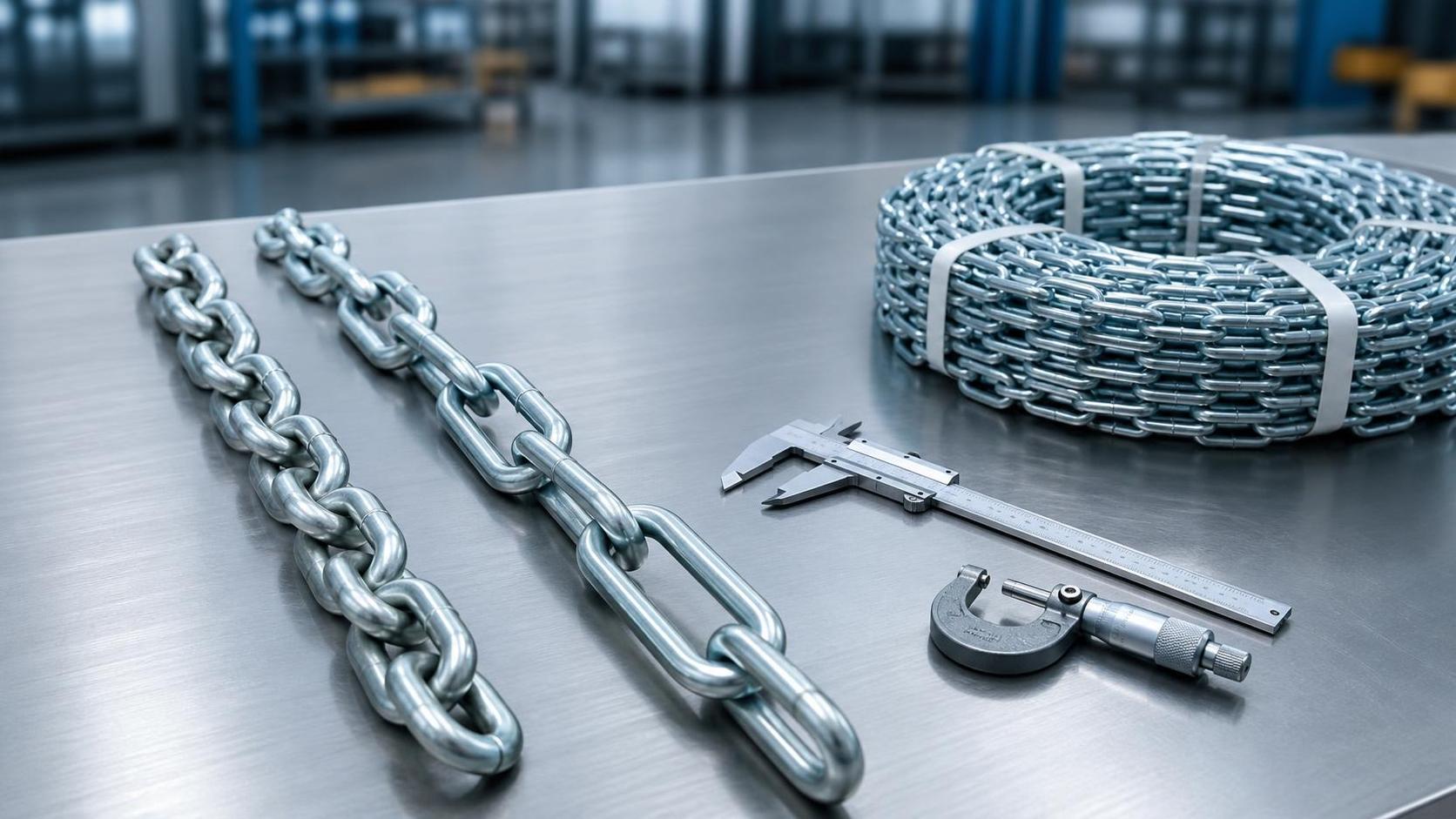
Choosing a supplier for DIN5685 A/C Short or Long Link Chain is not mainly about finding the lowest quote. For procurement teams, the real goal is to identify a manufacturer that can deliver consistent chain quality, stable lead times, and dependable support across repeated orders. If a supplier cannot control materials, dimensions, surface treatment, and inspection standards, a low purchase price can quickly turn into higher operating risk.
When buyers compare options, the most useful approach is to assess suppliers in five areas: standard compliance, raw material and manufacturing control, quality assurance, delivery capability, and customization support. This gives a clearer basis for decision-making than price alone, especially for industrial applications where chain reliability affects safety, maintenance, and project continuity.
What Procurement Teams Are Really Comparing
People searching for DIN5685 A/C Short or Long Link Chain usually want a practical supplier evaluation method, not just a product definition. They need to know which manufacturer can supply the right chain type, maintain consistent quality, and reduce sourcing risk over time.
For procurement professionals, the key concerns are straightforward. Will the chain match the required specification? Can the supplier keep quality stable across batches? Are delivery dates realistic? Can the supplier support custom requirements, documentation, and after-sales communication without delays?
That means a good comparison process should focus on measurable evidence. Product catalogs and sales claims matter less than actual production capability, inspection records, certifications, and responsiveness during quotation and sampling.
Start With the Exact DIN5685 A/C Chain Requirements
Before comparing suppliers, buyers should first define what they are purchasing. DIN5685 A/C Short or Long Link Chain includes different link forms, and the short link and long link versions are not interchangeable in every use case.
Short link chain is often selected when tighter handling, more compact link geometry, or better control in certain assemblies is needed. Long link chain may be preferred where flexibility, lower weight per length, or specific connection needs are more relevant.
Procurement teams should confirm the required nominal size, inside length, inside width, material grade, surface finish, load expectations, and operating environment. Marine, construction, mining, and general industrial applications often require different corrosion resistance and service-life expectations.
If these details are unclear at the start, supplier quotations can look comparable while actually covering different technical assumptions. That is one of the most common sourcing mistakes.
Check Whether the Supplier Can Control the Full Production Process
A supplier of DIN5685 A/C Short or Long Link Chain is stronger when it has real control over production rather than depending heavily on outsourced processing. This matters because chain performance depends on the consistency of wire material, forming accuracy, welding quality, and finishing.
Manufacturers with integrated production systems are usually better positioned to maintain batch consistency. They can trace issues faster, manage process tolerances more effectively, and reduce variation between samples and mass production.
For example, companies with automated production lines and in-house inspection systems can often provide better process stability than traders who rely on multiple subcontractors. In industrial supply, process control is often a better predictor of long-term reliability than a one-time low price.
Shandong Faster Technology Co., Ltd., for instance, emphasizes full-process control from raw materials to finished products. That kind of structure is relevant for buyers because it usually supports more stable output, especially when orders are repeated across multiple projects or sites.
Evaluate Material Options and Surface Treatment Carefully
Material selection has a direct impact on chain performance, service life, and maintenance cost. When comparing suppliers, ask whether they can offer the finish and material condition that fit the actual working environment rather than only the most common stock option.
In many industrial scenarios, buyers may need bright, galvanized, stainless steel, or other protective finishes depending on humidity, salt exposure, abrasion, or appearance requirements. A supplier that can explain the tradeoffs clearly is usually more trustworthy than one that simply says every option is available.
For buyers managing broader lifting and securing categories, this material flexibility also matters across related products. A supplier that already works with galvanized, bright, stainless steel, and plastic-coated solutions may be better equipped to support coordinated sourcing programs beyond chain alone.
This is especially useful when chain purchases are connected with rope and sling requirements. For example, some procurement projects may also involve lifting assemblies such as 3 Leg bright oil steel Wire Rope Sling Hook and Loop 3tons Lifting Slings, where compatibility, documentation, and supplier coordination can improve purchasing efficiency.
Ask for Inspection Standards, Test Records, and Certifications
One of the fastest ways to separate capable suppliers from weak ones is to ask for inspection details. Reliable manufacturers should be able to explain how they verify size tolerance, weld condition, surface quality, and mechanical properties.
Procurement teams should not stop at broad claims like “high quality” or “strict QC.” Ask what is inspected, how often it is checked, whether inspection is done in house, and what records can be provided with shipments.
Certifications such as ISO, CE, SGS, or RoHS may also be relevant depending on market and application, but certifications alone are not enough. Buyers still need to confirm whether the documented system is reflected in actual batch control and shipment consistency.
If a supplier can provide samples, dimensional reports, material documentation, and photos or videos of inspection procedures, that adds practical confidence. Evidence-based communication is more valuable than generic marketing language.
Compare Delivery Capability, Not Just Quoted Lead Time
Lead time is often discussed too simply. A supplier may promise fast shipment, but procurement teams need to know whether that timeline is based on actual production capacity, regular stock, or optimistic sales assumptions.
Ask how much annual output the factory handles, whether production is standardized, and how peak season affects delivery. A manufacturer with substantial production capacity and established scheduling discipline is generally more dependable for ongoing industrial purchasing.
Delivery capability also includes packaging, export handling, and response speed when order details change. If a supplier can only meet small trial orders but struggles with repeat volumes, that becomes a hidden risk for project procurement.
For buyers serving lifting, marine, port, and construction sectors, continuity often matters more than one-off speed. Delayed chain supply can affect equipment readiness, shutdown schedules, and contractor coordination, which makes realistic lead-time management a major selection factor.
Look at Customization and Application Understanding
Not every procurement need is fully standardized. Some buyers need special lengths, packaging methods, surface treatments, or combined supply with other rigging products. In those cases, the better supplier is usually the one with application understanding, not just a catalog.
A manufacturer serving industries such as ships, ports, construction, mining, and lifting often develops a clearer sense of how products are actually used. That can improve communication around specification matching and reduce errors during ordering.
It is also useful when a supplier can support one-stop procurement across related categories such as rope, sling, and chain. This can reduce sourcing complexity, simplify vendor management, and make technical coordination easier for purchasing teams.
However, buyers should still verify that “customization” means real engineering and production support, not only flexible sales language. Ask what has been customized before, what parameters can be adjusted, and how nonstandard orders are reviewed before production.
Build a Practical Supplier Comparison Checklist
To compare suppliers of DIN5685 A/C Short or Long Link Chain effectively, procurement teams should use a simple scoring method. This makes internal review easier and helps separate objective criteria from impression-based decisions.
A practical checklist can include: conformity to DIN5685 A/C requirements, available sizes and finishes, production capacity, inspection capability, certification support, sample quality, lead-time reliability, customization ability, communication speed, and total landed cost.
It is also wise to score suppliers on risk factors such as traceability, complaint handling, and consistency across repeat orders. Procurement decisions should reflect the full cost of supply reliability, not just the unit price on the first quotation.
When possible, start with a sample order or pilot batch. This gives buyers a better view of packaging quality, labeling accuracy, shipment punctuality, and actual product consistency before a long-term supply decision is made.
Conclusion
The best way to compare suppliers of DIN5685 A/C Short or Long Link Chain is to treat the decision as a reliability assessment, not a price comparison exercise. Procurement teams should verify standard compliance, manufacturing control, material options, inspection discipline, lead-time realism, and customization support.
Suppliers with integrated production, stable quality systems, and experience across demanding industrial sectors are usually better positioned to support long-term purchasing needs. For buyers in lifting, marine, construction, mining, and related fields, that approach reduces sourcing risk and improves operational confidence.
In short, the right supplier is the one that can repeatedly deliver the chain you specified, with the quality you expect, on the timeline your operation requires. That is what makes a sourcing decision truly cost-effective.
Navigation
Send Us A Message



Shandong Faster Technology Co., Ltd. is a professional manufacturer of steel wire ropes.
Get in Touch
*We respect your confidentiality and all information are protected.