





How many types of steel wire rope are there?
How many types of steel wire rope are there?
Steel wire rope is not a single product category in the way many buyers first assume. In practice, there are many types, and they are usually classified from several different angles at the same time: material, strand construction, core type, surface treatment, lay direction, and end-use application. That is why two ropes with the same diameter can behave very differently in service.
For lifting, marine, mining, construction, elevators, and port equipment, the question is rarely just “how many types are there?” The more useful question is: which type matches the load, bending condition, environment, inspection routine, and safety margin of the job? A rope that works well on a dry construction site may fail early in a humid coastal setting, while a highly flexible rope may not be the best fit for a static stay or guying application.
That is why steel wire rope selection usually starts with a basic map of the main categories.
The main types by material
One of the clearest ways to divide steel wire rope is by material or surface condition.
Galvanized steel wire rope is common where corrosion resistance matters but cost still needs to stay under control. It is widely used in outdoor lifting support, ships, ports, agriculture, and general industrial fastening. The zinc layer helps resist rust, though the actual performance still depends on coating quality, humidity, abrasion, and maintenance conditions.
Stainless steel wire rope is typically chosen for stronger corrosion resistance, cleaner appearance, or environments where chemical exposure and moisture are ongoing concerns. It is often seen in marine hardware, food-related equipment structures, architectural tension systems, and some specialized industrial assemblies. It is not automatically the strongest option in every case, so buyers still need to compare grade, construction, and working load requirements.
Plastic coated wire rope adds an outer protective layer over the steel rope. This can help with handling, reduce surface damage to surrounding components, and provide an extra barrier in certain environments. It is often selected for fitness equipment, guard systems, decorative or semi-structural applications, and light industrial uses. The coating improves usability, but it can also hide early surface damage, so inspection methods need to be considered.
The main types by construction
If material tells you how the rope may survive the environment, construction tells you how it will behave mechanically.
Single strand rope is relatively simple and may be used in lighter-duty or more specialized applications. Multi-strand rope is far more common in industrial work because it offers better balance between strength, flexibility, and fatigue resistance.
Within multi-strand designs, the number of strands and wires matters a great deal. A rope with more wires is generally more flexible and better suited to running over sheaves or drums. A rope with fewer, thicker outer wires may offer better abrasion resistance but lower flexibility. This is a familiar trade-off in crane, hoist, and traction applications.
Common industrial discussions often revolve around whether the rope needs to prioritize:
- higher flexibility for repeated bending,
- better wear resistance for rough contact conditions,
- greater structural stability,
- or a balance suitable for mixed duty.
Core type also creates different rope families
Another major division is the core. Steel wire rope can use fiber core or steel core, among other variations depending on the standard and design.
Fiber core ropes are often valued for flexibility and may perform well where bending is frequent and crushing loads are moderate. Steel core ropes generally provide better support to the outer strands and are often preferred where loads are heavier, drum pressure is higher, or dimensional stability is more important.
In real projects, the wrong core choice can shorten service life even when the nominal breaking strength looks acceptable on paper. That is one reason experienced buyers do not compare ropes by diameter alone.
Application-specific types are often how buyers think
From an operational point of view, many users group steel wire rope by application: lifting rope, elevator rope, mining rope, marine rope, hoisting rope, towing rope, and static support rope. This is practical because each sector has different priorities.
Elevator ropes, for example, are closely tied to fatigue behavior, dimensional consistency, and traction system compatibility. Mining ropes may face severe abrasion, impact loading, and contamination. Marine ropes need to deal with salt exposure and corrosion risk. Port and shipyard operators often need a mix of strength, handling performance, and predictable inspection intervals.
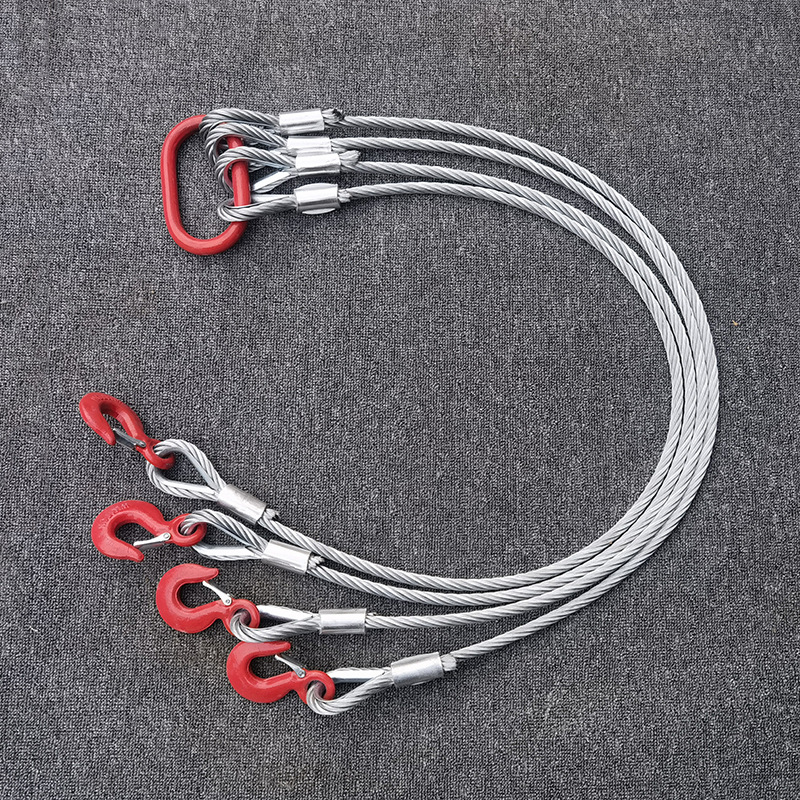
In many of these systems, rope is only one part of the load path. Slings, hooks, sockets, shackles, and chain assemblies also matter. For lighter-duty fixation or non-lifting auxiliary tasks, some projects may use chain instead of rope, especially when flexibility around abrasion, bundling, or low-speed traction is needed. In that context, products such as ASTM A413-80 Standard G30 Proof Coil Chain Galvanized Link Chain Q235 Carbon Steel Chain are more relevant to general binding, hanging, shelf fixation, or small trailer traction than to critical overhead lifting.
So, how many types are there in total?
There is no single fixed number. If you classify only by material, you might list galvanized, stainless, and plastic coated. If you classify by construction, you quickly expand into many more categories. Add core type, lay pattern, diameter range, strength grade, coating method, and industry standard, and the total becomes large.
In other words, steel wire rope has a few broad families and many sub-types. That is the answer most procurement and engineering teams eventually arrive at. The market does not run on one universal rope; it runs on combinations.
What buyers should check before choosing
A sensible selection process usually includes the following checks:
- actual working load and required safety factor,
- static or dynamic use,
- bending frequency over sheaves or drums,
- indoor, outdoor, marine, or corrosive environment,
- required diameter tolerance and compatibility with equipment,
- inspection and replacement practices on site,
- applicable standards and any project-specific documentation needs.
This is also where manufacturing capability matters. Shandong Faster Technology Co., Ltd. works across steel wire rope, slings, and chains, with automated wire drawing, twisting, and rope closing lines, plus inspection equipment for process control from raw material to finished product. Its steel wire rope capacity exceeds 70,000 tons annually, and it can supply single-strand and multi-strand ropes in the 1-20 mm range across galvanized, stainless steel, and plastic coated series. For buyers managing different applications under one project, that kind of rope-sling-chain coordination can simplify technical matching and sourcing consistency.
It also helps when standard products are not enough. Some jobs need pressed slings, some need corrosion-focused rope options, and some need auxiliary chain products in grades such as G30, G43, G70, G80, or G100. The point is not that every job needs everything. The point is that industrial load handling systems rarely operate as isolated components.
A common mistake: choosing by price or diameter only
This mistake shows up often. A buyer compares two ropes of the same diameter and assumes they are interchangeable. But construction, core, coating, and intended service conditions may be different enough to change fatigue life, corrosion behavior, handling, and inspection intervals.
The same logic applies when chain is introduced into the system. A galvanized proof coil chain made from Q235 carbon steel, with electric galvanized, hot-dip galvanized, or black paint finish, may be perfectly suitable for daily bundling, fence protection, or logistics fixation within its stated working load range, yet still not be appropriate for a lifting duty that requires a higher chain grade and different compliance review. Matching the product to the task is more important than forcing one product family into every scenario.
If you are trying to answer how many types of steel wire rope there are, the practical answer is: enough that classification matters more than counting. Start with the environment, load, movement, and standard requirements. Then narrow the options by material, construction, and core. That approach usually leads to a safer and more economical choice than beginning with catalog photos or nominal size alone.
And if the project involves rope, sling, and chain together, it is worth confirming all connection points, end fittings, and non-lifting versus lifting duties before finalizing the specification.
Navigation
Send Us A Message



Shandong Faster Technology Co., Ltd. is a professional manufacturer of steel wire ropes.
Get in Touch
*We respect your confidentiality and all information are protected.