





How many types of steel wire rope are there?
Steel wire rope is not divided into just one or two simple categories. In practice, there are many types of steel wire rope, and they are usually classified by material, strand structure, surface treatment, rope construction, and intended application. For most industrial buyers, the real question is not only how many types exist, but which type is suitable for the working load, environment, bending condition, and service life required.
For lifting, marine, construction, mining, and equipment support applications, choosing the wrong rope can lead to faster wear, corrosion problems, reduced safety margins, and unnecessary replacement costs. That is why understanding the main classifications of steel wire rope is more useful than trying to count every possible variation in the market.
This article explains the common types of steel wire rope, how they differ, and how to evaluate them for real working conditions. It also outlines the factors buyers should compare before placing an order or requesting customization.
How is steel wire rope usually classified?
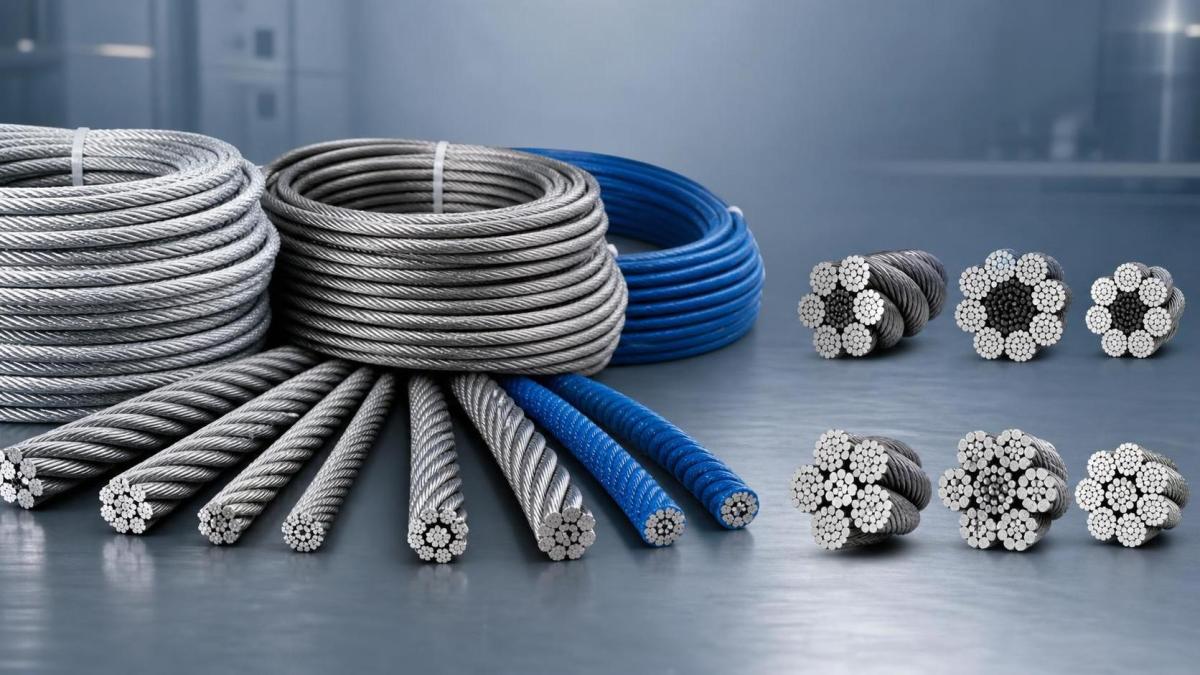
When people ask how many types of steel wire rope there are, manufacturers usually answer by classification method. A rope can be grouped by base material, number of strands, number of wires, core type, coating, flexibility, and end-use environment.
Because these categories overlap, the total number of combinations is very large. For example, a galvanized 6x19 steel wire rope with fiber core is different from a stainless 7x7 rope or a plastic coated multi-strand rope, even though all belong to the steel wire rope family.
So, instead of looking for one exact number, buyers should understand the major categories that affect strength, flexibility, abrasion resistance, fatigue life, and corrosion resistance. These are the factors that directly influence field performance.
What are the main types by material?
One of the most practical ways to classify steel wire rope is by material or surface protection. In industrial purchasing, this is often the first screening factor because it determines how well the rope can resist moisture, salt, chemicals, and outdoor exposure.
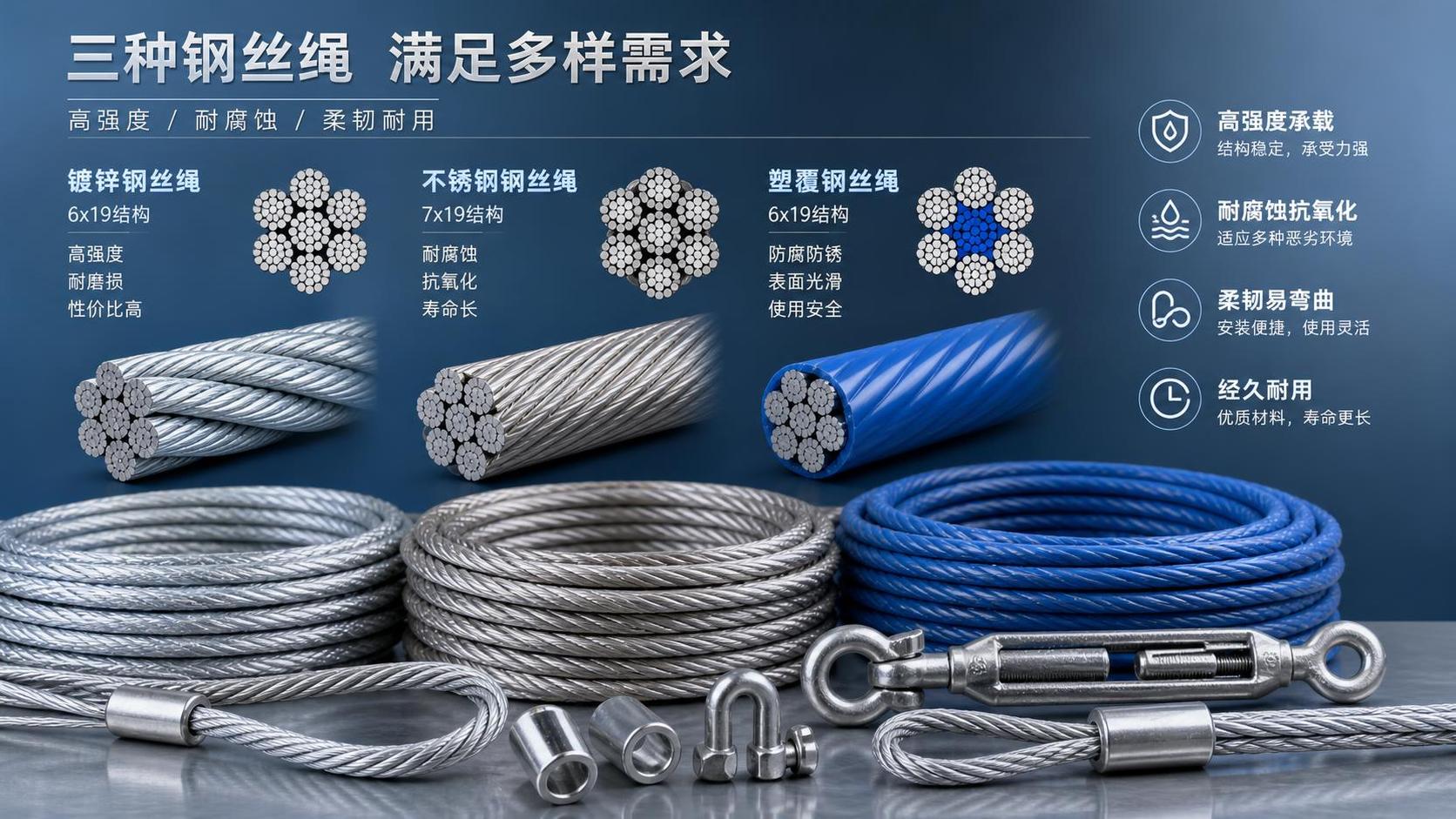
Galvanized steel wire rope is one of the most common choices. It has a zinc coating that helps resist rust and makes it suitable for general outdoor use, construction sites, port handling, agricultural equipment, and some marine environments.
Stainless steel wire rope is used where higher corrosion resistance is required. It is common in marine hardware, food-related environments, decoration, architectural tension systems, and applications where appearance and long-term anti-rust performance both matter.
Plastic coated steel wire rope adds an outer protective layer over the rope. This type is often chosen when surface protection, handling comfort, insulation, or reduced damage to contact surfaces is important. It is widely used in fitness equipment, guardrails, garden structures, and selected industrial fixing tasks.
For many heavy-duty industrial applications, the decision between galvanized and stainless steel wire rope comes down to balancing cost, corrosion level, and expected service life. Stainless steel generally performs better in aggressive environments, while galvanized rope is often the more economical option for broad industrial use.
What are the main types by rope structure?
Another important classification is rope construction. This includes the number of strands and the number of wires in each strand. Common constructions include 1x7, 1x19, 6x7, 6x19, 6x36, 7x7, and 7x19, among others.
1x7 and 1x19 constructions are relatively stiff. They are often used in static applications, guy wires, bracing, and situations where low stretch and shape stability are important. They are not usually the first choice for repeated bending over sheaves.
7x7 and 7x19 constructions offer greater flexibility. These are commonly used when the rope must bend frequently or pass around pulleys. They are often selected for control cables, gym cables, suspension uses, and lighter mechanical systems.
6x19 construction is a common balance between flexibility and wear resistance. It is often used in cranes, hoists, winches, and general lifting applications where both durability and moderate bending performance are needed.
6x36 construction contains more individual wires and is usually more flexible than 6x19. It is often preferred for dynamic applications involving repeated bending, although the smaller outer wires may wear differently depending on contact conditions.
In simple terms, fewer and thicker wires usually mean higher abrasion resistance but lower flexibility. More and thinner wires usually mean better flexibility and bending fatigue performance, but the rope may be more sensitive to external wear in rough contact conditions.
Why does the core type matter?
Steel wire rope is also classified by core type. The core supports the strands and helps the rope keep its shape under load. The two common categories are fiber core and steel core.
Fiber core steel wire rope is often more flexible and lighter. It can also retain lubricant well, which may help internal wear performance in some applications. However, its support strength is lower than steel core in heavy-duty conditions.
Steel core wire rope, including independent wire rope core options, provides higher strength, better crush resistance, and improved structural stability. It is commonly preferred for demanding lifting, hoisting, mining, and high-load industrial operations.
If the rope will face high tension, multilayer drum winding, or difficult mechanical conditions, steel core is usually the safer and longer-lasting choice. If greater flexibility is the top priority and the load is less severe, fiber core may be sufficient.
How do application scenarios affect rope selection?
From a buyer's perspective, application is often more important than technical classification alone. The right steel wire rope for an elevator system is not the same as the right rope for marine lashing, mine hauling, or construction lifting.
For lifting and hoisting, buyers usually focus on breaking strength, working load limits, fatigue resistance, and compliance with operating safety requirements. Rope construction, core type, and lubrication all have a direct impact here.
For marine and port environments, corrosion resistance becomes a primary concern. Galvanized and stainless steel wire rope are both common, depending on exposure level, service life targets, and budget.
For construction and general fixing, durability, handling convenience, and cost control are often key. In some load securing systems, rope works together with chains, hooks, and other hardware to create a complete restraint solution.
For example, in cargo securing, engineering transport, or temporary heavy-object fixation, buyers may combine steel wire rope systems with chain components such as G80 Alloy Steel Welded Marine Lashing Link Chain Hot Dip Galvanized with Double Eye Grab Hooks 8mm 10mm. This kind of component is designed for binding and fixing heavy objects and is used in logistics transportation, lifting assistance, and engineering construction scenarios.
Where stronger anti-deformation performance and durable welding quality are required, alloy steel chain assemblies built to standards such as EN 818-2 can complement rope-based solutions in one project. That matters for buyers who prefer one-stop sourcing of rope, sling, and chain products rather than managing multiple vendors.
What should buyers compare before choosing a type?
Most professional buyers are less concerned with theory and more concerned with making the right specification decision. A practical selection process should begin with working load, safety factor, bending condition, environmental exposure, and service frequency.
First, confirm the actual application load and whether the rope will lift, pull, secure, suspend, or guide. These uses create very different stress patterns, and they should not be treated as interchangeable.
Second, evaluate the working environment. Indoor dry conditions, coastal air, direct seawater exposure, mud, abrasive dust, and chemical contact all influence whether galvanized, stainless, or coated rope is the better option.
Third, assess flexibility versus wear resistance. If the rope runs over pulleys repeatedly, a more flexible construction may perform better. If it sees rough surface contact and limited bending, thicker outer wires may offer better wear resistance.
Fourth, review diameter tolerance, manufacturing consistency, and inspection capability. Reliable suppliers should be able to control the process from raw material through wire drawing, stranding, and rope closing, while also supporting quality verification before shipment.
Fifth, think about customization and supply integration. Many industrial users do not need only rope. They also need slings, fittings, chains, or pressed assemblies that work together within one safe operating system.
How do manufacturers support different industrial needs?
Not all manufacturers offer the same level of production depth. For buyers in industrial equipment and components, it is valuable to work with a supplier that can provide stable quality, broad material options, and customization support for different operating scenarios.
Shandong Faster Technology Co., Ltd. focuses on steel wire rope, sling, and chain manufacturing for industries such as lifting, ships, ports, construction, mining, and elevators. Its production system covers wire drawing, twisting, rope closing, and quality inspection, helping maintain process consistency from raw materials to finished products.
The company can supply single-strand and multi-strand steel wire ropes in diameters from 1mm to 20mm across galvanized, stainless steel, and plastic coated series. This range is useful for buyers who need corrosion resistance, strength, and application-specific selection rather than one standard product for every job.
In addition to standardized rope products, the company also supports customized pressed slings and full specification chain products. For procurement teams, that integrated rope-sling-chain supply model can reduce sourcing complexity and improve compatibility across connected lifting and securing applications.
So, how many types of steel wire rope are there?
The most accurate answer is that there are many types of steel wire rope, and the number depends on how you classify them. By material alone, there are galvanized, stainless steel, and plastic coated options. By structure, there are many constructions such as 1x7, 1x19, 6x19, 6x36, 7x7, and 7x19. By core, there are fiber core and steel core versions.
When these categories are combined with different diameters, coatings, performance grades, and application requirements, the available types become extensive. That is why professional selection should be based on use conditions rather than a simple count.
For industrial buyers, the better question is this: which type of steel wire rope gives the right balance of safety, durability, corrosion resistance, flexibility, and total service value for the actual job? Once that question is answered clearly, the best product choice becomes much easier.
In summary, steel wire rope comes in many forms because industrial work demands many forms. Understanding the main classifications helps buyers avoid overbuying, under-specifying, or using a rope unsuited to the environment. A sound choice starts with application needs, then matches them to rope structure, material, and quality level.
Navigation
Send Us A Message



Shandong Faster Technology Co., Ltd. is a professional manufacturer of steel wire ropes.
Get in Touch
*We respect your confidentiality and all information are protected.