





DIN5685 C Long Link Chain in Suspension and Barrier Applications
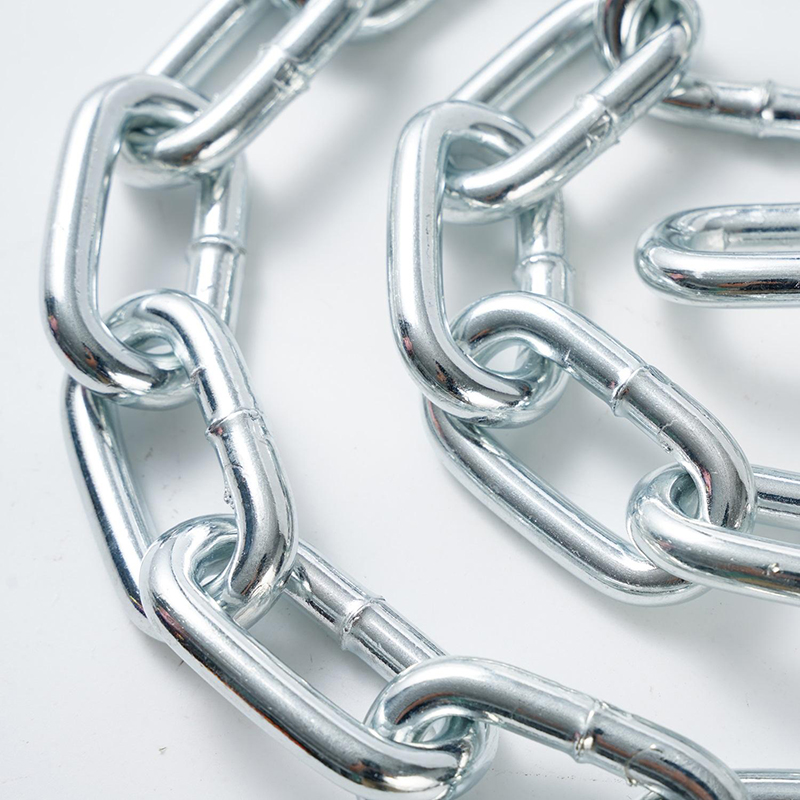
For technical evaluators assessing suspension and barrier systems, DIN5685 C long link chain is rarely selected because it is “strong enough” in a general sense. It is selected because it solves a very specific engineering problem: how to provide a predictable, easy-to-handle chain line for hanging, guiding, partitioning, or light-duty securing without introducing unnecessary weight, stiffness, or cost. Within the DIN5685 A/C short or long link chain family, the long-link C type stands out for applications where installation flexibility and usable length matter as much as nominal strength.
That practical distinction is important. In many projects, especially around ports, workshops, construction access control, equipment zoning, suspended utility runs, or temporary separation systems, the chain is not the primary lifting component. It functions as a support, visual barrier, hanging medium, or spacing element. The evaluation criteria therefore shift. Instead of focusing only on breaking load, technical teams need to look at dimensional consistency, elongation behavior, corrosion exposure, link deformation risk, attachment compatibility, and whether the product is being used within the intent of the standard.
Where DIN5685 C long link chain fits well
The most suitable use cases are those where the chain must pass easily through hooks, eyebolts, posts, rings, or connector hardware, and where frequent handling is expected. Long links make the chain more adaptable in the field. Installers can tension, route, and connect it more quickly than a tighter short-link design. That is one reason DIN5685 A/C short or long link chain remains common in light industrial infrastructure and site control applications.
In suspension systems, DIN5685 C is typically used for hanging signs, lightweight fixtures, protective curtains, partition elements, or non-critical support lines. In barrier applications, it is widely seen in pedestrian guidance, equipment boundary marking, dock edge segregation, restricted-area demarcation, and temporary work-zone isolation. These are all environments where the chain must be visible, manageable, and mechanically reliable under repeated contact, but not treated as a substitute for certified overhead lifting chain.
This is where misuse often begins. Some buyers see “chain” and assume broad load-bearing suitability. Technical assessment should be stricter than that. DIN5685 C long link chain can perform very effectively in suspension and barrier roles, but it should not be casually reassigned to dynamic lifting, shock-loaded restraint, or safety-critical personnel protection unless the full specification, load data, and regulatory suitability are clearly verified.
Why long-link geometry changes application behavior
The geometry of a long-link chain affects more than appearance. Longer internal link dimensions improve reach and hardware compatibility, but they also influence how the chain behaves under load and in service. Compared with short-link chain, a long-link design generally offers easier connection and lower handling resistance, yet it may be more vulnerable to localized deformation if loaded improperly or side-loaded at an angle.
For suspension uses, this matters when loads are not perfectly vertical. If the chain is carrying a hanging panel, cable tray accessory, or divider line that may sway, evaluators should consider whether the load path can create torsion or concentrated stress at individual links. In barrier systems, the issue is different: repeated impact from carts, foot traffic, or equipment contact can gradually distort links if the chain diameter is undersized or the material finish is poorly controlled.
That is why dimensional tolerances and manufacturing consistency deserve more attention than many sourcing teams initially give them. A chain that technically matches the nominal DIN5685 category but varies noticeably in pitch, weld quality, or wire diameter can become difficult to install and unpredictable in service.
Material selection is usually the real decision point
In technical evaluations, the chain form is often straightforward; the material and finish are where project risk sits. Bright finish chain may be acceptable for dry indoor barriers or short-cycle temporary suspension. Galvanized versions are usually preferred for outdoor exposure, construction perimeters, agricultural environments, ports, and utility areas where intermittent moisture is expected. Stainless steel becomes relevant when washdown, marine atmosphere, chemical contact, or appearance retention is part of the requirement.
There is no universally best option. The right choice depends on corrosion pattern, handling frequency, and expected service life. A dry warehouse barrier may not justify stainless steel. A dockside access chain almost certainly should not rely on untreated bright chain if appearance and structural reliability must be maintained over time. Zinc-coated chain performs well in many standard outdoor scenarios, but evaluators should still ask about coating uniformity, red rust expectations, and whether cut ends, weld zones, or abrasion points will expose the base metal prematurely.
Where the chain is integrated into a larger suspended system, compatibility with adjacent components matters as much as the chain itself. If the barrier line interfaces with wire rope assemblies, hooks, shackles, or turnbuckles, corrosion mismatch and wear at the connection points can determine actual service life. In those mixed systems, some buyers pair chain barriers with wire rope support sections for better force distribution. In heavier-duty industrial handling environments, supporting assemblies such as 3 Leg bright oil steel Wire Rope Sling Hook and Loop 3tons Lifting Slings are used for lifting tasks, while DIN5685 C chain remains limited to non-lifting separation or hanging functions. That division of roles is good engineering practice.
What technical evaluators should verify before approval
A useful evaluation starts with a simple question: is this chain being used for guidance and suspension, or for restraint and load bearing? If the application sits anywhere near the second category, documentation becomes critical. Buyers should request confirmed size data, material grade information, finish details, and any available test records. If working load information is presented, it should be checked carefully against the intended use and against the supplier’s actual product basis rather than assumed from generic online tables.
Visual inspection criteria should include weld integrity, surface continuity, burrs, twists, pitch consistency, and obvious ovalization. For projects involving repeated installation and removal, link opening uniformity is especially important because connection accessories must pass through the links without binding or forcing. In barrier projects, one overlooked issue is human interaction. Chains used at waist height or access points should be assessed for snag risk, visibility, and behavior under accidental impact, not just static hanging ability.
Supply stability also matters in practical deployment. A technically acceptable chain is still a poor choice if replacement lengths, matching finishes, or consistent dimensions cannot be maintained across batches. For contractors and OEMs, this becomes a lifecycle issue rather than a purchase-order issue. Manufacturers with process control across raw material handling, forming, finishing, and inspection generally provide better repeatability, which is especially relevant when the same chain specification is used across multiple sites.
Common errors in suspension and barrier design
The most frequent mistake is overestimating what a general-purpose chain standard implies. DIN5685 C is widely used, but “widely used” is not the same as “universally suitable.” Another mistake is choosing based on chain diameter alone. Diameter affects strength, but link proportions, weld quality, finish performance, and connection design often determine whether the installed system behaves reliably.
There is also a tendency to ignore service dynamics. A barrier chain exposed to occasional forklift contact experiences a very different risk profile from a chain that simply marks a pedestrian lane. Similarly, a hanging chain that supports a static sign indoors is not comparable to one suspending equipment guards in a vibrating industrial zone. Technical teams should evaluate movement, impact, abrasion, and environmental cycling as part of the approval decision.
In hybrid systems, confusion between chain and sling functions can create safety problems. Wire rope slings, for example, are engineered for different load paths and performance expectations. Products such as the 3 Leg bright oil steel Wire Rope Sling Hook and Loop 3tons Lifting Slings belong in controlled lifting tasks where branch configuration, force distribution, and load stability are part of the design requirement. DIN5685 C chain should not be substituted into that role simply because it is available on site.
How to make a sound specification decision
If the application is a true suspension or barrier duty, DIN5685 C long link chain is often a rational choice when flexibility, ease of installation, and moderate mechanical reliability are needed. It is especially effective where chain length must be adjusted quickly, where connection hardware varies, or where visual separation is as important as physical guidance.
The decision becomes stronger when three conditions are met: the load case is clearly light-duty and non-lifting; the environment is matched to the correct material or finish; and the supplier can demonstrate consistent dimensional and production quality. If any of those conditions is weak, the chain may still be usable, but it should not be treated as a low-risk default.
For technical evaluators, the key is not whether DIN5685 C long link chain is “good” in general. The real question is whether its geometry, finish, and manufacturing consistency align with the specific suspension or barrier scenario being designed. In that narrower and more practical sense, it remains a highly useful component—provided the specification is disciplined and the application boundary is respected.
Navigation
Send Us A Message



Shandong Faster Technology Co., Ltd. is a professional manufacturer of steel wire ropes.
Get in Touch
*We respect your confidentiality and all information are protected.