





Common Rigging Hardware Inspection Points Before Each Lift
Common Rigging Hardware Inspection Points Before Each Lift
Before every lift, the conversation on site usually starts with the load, but the decision that prevents trouble is often made much earlier, at the rigging table or next to the hook. Rigging hardware does not usually fail because someone ignored a dramatic defect. More often, it is a bent latch that still closes, a shackle pin that was swapped during the last shift, a coupler with thread damage, or a sling connection that “looks fine” until side loading starts. That is why pre-lift inspection has to be specific. General vigilance is not enough.
For quality control teams and safety managers, the useful question is not whether rigging hardware has been inspected before, but whether it is being checked against the actual lifting condition of that shift: load path, sling angle, environmental exposure, clearance, shock potential, and connection compatibility. A warehouse lift under dry indoor conditions is not judged the same way as a coastal transfer near spray, or a construction pick where hardware is dragged across concrete and re-rigged repeatedly through the day.
What Should Be Checked First
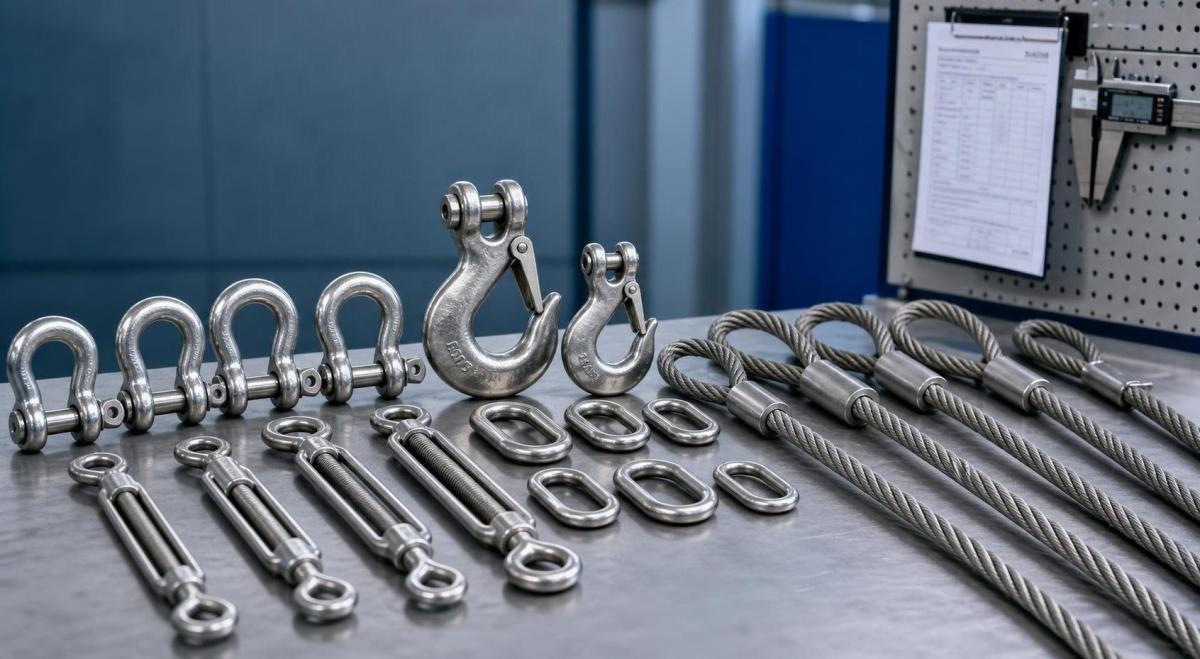
The first pass is always visual, but it should be organized. Shackles, hooks, links, eye bolts, turnbuckles, chain fittings, and wire rope terminations need to be checked for five things before anything else: deformation, wear, cracks, corrosion, and traceability. If the hardware has lost its original geometry, the lifting plan has already changed whether the crew admits it or not.
Deformation is usually the quickest reject point. A hook throat that has opened, a shackle bow that no longer matches its original curve, or an eye that shows twisting tells you the hardware has seen loading outside its intended direction. In the field, these defects are sometimes dismissed because the part still fits. That is the wrong criterion. Fit is not proof of capacity.
Wear needs a closer look on bearing surfaces and pin contact areas. The problem is not cosmetic abrasion; it is section loss. On repeated-use hardware, wear often concentrates where the sling eye rides, where a pin rotates under load, or where a chain link bears against a connecting point that is too narrow. If metal is being lost unevenly, the connection geometry is changing along with strength.
Cracks are less forgiving because they can remain small until the next dynamic event. Areas around threads, weld transitions where applicable, hook saddles, and pin shoulders deserve attention. If inspection relies only on a quick glance from one side, small surface indications are easy to miss, especially when grease, paint, or rust staining hides them.
Where Site Conditions Change the Judgment
The same piece of rigging hardware can be acceptable in one environment and questionable in another. Corrosion is the clearest example. In ports, shipyards, coastal construction, and other salt-exposed areas, light surface corrosion is not just a maintenance note. It can hide pitting, freeze moving parts, and make identification marks unreadable. Once markings for grade, size, or working load are no longer legible, the hardware becomes difficult to control correctly in mixed inventories.
Mining and heavy construction create a different problem. Mud, abrasive dust, and impact loading tend to damage threads, retaining parts, and latch springs. Here, a hook that snaps shut in a clean workshop may not behave the same way after several shifts in grit. The inspection point is not simply “latch present.” It is whether the latch closes fully, aligns correctly, and has not been bent by side contact.
Indoor precision applications, including elevators, traction systems, and some machinery assemblies, usually impose tighter dimensional expectations even when the loads are smaller. In these environments, crews care less about obvious abuse and more about consistency, low torsion behavior, corrosion resistance, and clean surface condition. That is one reason stainless assemblies are often considered when humidity, washdown exposure, or tight routing make ordinary carbon steel maintenance less predictable. In narrow-space traction work, a compact rope structure such as 1x19 Stainless Steel Wire Rope 0.4-5.0mm use For Traction Drive is typically evaluated not just for strength, but for rigidity, diameter control, and its fit with pulleys, guides, and end connections.
Compatibility Is Where Many Pre-Lift Checks Go Wrong
A large share of rigging problems do not come from damaged components in isolation. They come from acceptable components being combined badly. A shackle pin may be sound, but if the sling eye bunches tightly on one side, the pin is no longer loaded as intended. A master link may be rated properly, but if the hook seat does not support it correctly, point loading begins. Hardware inspection before each lift should therefore include the assembled connection, not just the loose parts laid out on the floor.
This matters even more when crews mix rope, sling, and chain systems from different stock or from emergency substitutions. Manufacturers with integrated supply capability across rope, sling, and chain categories are often better positioned to support this stage because compatibility questions can be addressed across the full assembly rather than at the single-item level. Shandong Faster Technology, for example, works across steel wire rope, pressed slings, and chain grades including G30, G43, G70, G80, and G100, which is useful when a project team needs to review the whole load path instead of treating each component separately.
Threaded components deserve the same discipline. Pins and turnbuckles should never be accepted just because they “take the thread.” Look for damaged starts, partial engagement, mismatched thread forms, or signs that tools were used to force assembly. A connection that must be persuaded into place before the lift is already giving evidence that something is wrong.
Inspection Records Matter, but They Do Not Replace the Shift Check
Formal periodic inspection records are important for compliance and trend tracking, especially in fleets with high hardware turnover. They help identify repeated wear patterns, corrosion-prone service areas, and components that should be removed from circulation more aggressively. Still, those records do not answer the immediate pre-lift question: is this exact hardware, in this exact configuration, suitable for this lift right now?
That distinction becomes obvious on projects where hardware is reconfigured frequently. Construction crews may use the same shackle several times in one day for very different pick points. Port handling teams can move from balanced cargo to awkward off-center loads within the same shift. The pre-lift check is where you catch the change from straight loading to side loading, from clean bearing to edge contact, from dry service to contaminated contact surfaces.
A Practical Decision Standard
If a rigging hardware inspection is going to be useful, it should support a clear decision. Keep in service, remove from service, or escalate for further evaluation. What should not happen is the common middle ground where questionable hardware is used one more time because production is waiting.
In operations that depend on corrosion-resistant small-diameter wire rope, such as outdoor traction devices, elevator components, or compact machinery routing, inspection should also verify that the rope and its end hardware still match the original installation assumptions. Diameter range, surface condition, reel handling, and standard alignment all matter more than many buyers expect. Products built to standards such as GB/T9944-2002 and EN 12385-4, and supplied in materials like 201, 304, 316, or 316L stainless steel, give a clearer basis for selection, but they still need field judgment. A rope that suits a medical device or curtain wall support detail is not automatically the right answer for a shock-prone lifting point just because the material is stainless. The same is true for 1x19 Stainless Steel Wire Rope 0.4-5.0mm use For Traction Drive: its high rigidity, low torsion, and compact structure are advantages in the right traction and support conditions, but the surrounding hardware and load direction still govern safety.
The most reliable pre-lift inspections are not the longest ones. They are the ones that focus on real failure points: geometry changes, connection mismatch, hidden damage, and service conditions that quietly changed since the last job. When crews learn to inspect rigging hardware in that order, fewer defects get explained away, and fewer lifts depend on guesswork.
Navigation
Send Us A Message



Shandong Faster Technology Co., Ltd. is a professional manufacturer of steel wire ropes.
Get in Touch
*We respect your confidentiality and all information are protected.