





1x19 Stainless Steel Wire: How to Select Grade, Diameter, and Corrosion Resistance
1x19 Stainless Steel Wire: How to Select Grade, Diameter, and Corrosion Resistance
Choosing the right 1x19 stainless steel wire requires more than matching basic specifications.
Grade selection, diameter tolerance, and corrosion resistance affect load capacity, life cycle, and compliance.
For industrial evaluation, the structure itself matters first.
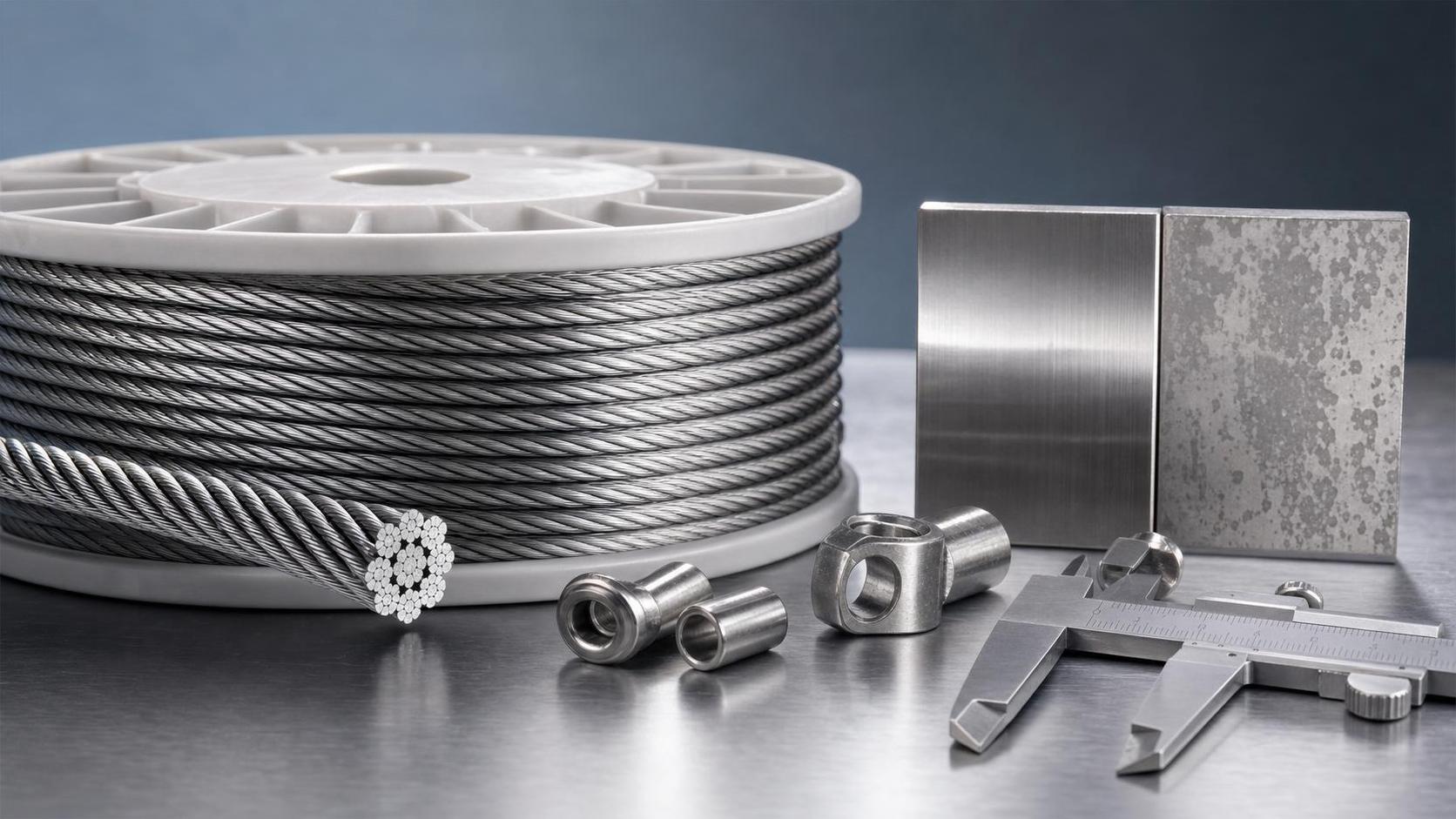
A 1x19 construction uses one center wire with 18 outer wires.
That creates high stiffness, low stretch, and strong straight-line tensile behavior.
Start With the Real Application
Selection becomes easier when the service condition is clearly defined.
1x19 stainless steel wire works well in static or lightly cycling tension applications.
Typical examples include bracing, architectural support, control lines, and fixed restraint systems.
It is less suitable where repeated bending over small pulleys dominates the duty cycle.
In those cases, flexibility may matter more than maximum rigidity.
- Check whether the wire carries static, shock, or fluctuating load.
- Confirm minimum bend radius in the full travel path.
- Review exposure to water, chlorides, chemicals, and temperature swings.
- Match selection to certification and traceability needs.
Choose the Right Stainless Steel Grade
Grade choice is usually the first major decision in 1x19 stainless steel wire selection.
For many indoor or mild outdoor environments, 304 stainless is a practical baseline.
It offers good corrosion resistance, broad availability, and balanced cost.
When chlorides are present, 316 stainless is usually the safer choice.
Marine air, coastal washdown, and deicing salts can quickly expose grade weaknesses.
This is where corrosion resistance directly affects replacement intervals and total ownership cost.
If the environment is aggressive, avoiding under-specification usually saves money later.
Diameter Selection Is More Than a Load Number
Diameter affects breaking force, installation fit, weight, and compatibility with end fittings.
That means 1x19 stainless steel wire should not be chosen from tensile value alone.
Always verify the actual operating load and apply the required safety factor.
Then confirm tolerance against swages, anchors, guides, and routing hardware.
Even small diameter variation can affect assembly consistency in high-volume production.
This becomes more obvious in control cable or façade support applications.
- Define working load, peak load, and required design factor.
- Check nominal diameter against terminal and routing dimensions.
- Review tolerance band and ovality limits with the supplier.
- Request break load data by exact diameter, not by family only.
In some mixed procurement cases, teams also compare stainless and galvanized options.
For example, 1x19 Galvanized Steel Wire Rope 1.5mm 1.8mm 2mm Inner Wire Steel Core Brake Cables may fit cost-sensitive control cable programs where corrosion demands are moderate.
How to Evaluate Corrosion Resistance Properly
Corrosion resistance should be evaluated by exposure type, not by a generic stainless label.
Fresh water, humidity, salt spray, acid fumes, and cleaning agents create very different risks.
Pitting and crevice corrosion often begin where contamination or trapped moisture remains.
That is why surface finish and installation detail matter alongside alloy grade.
- Map the full environment, including shutdown and storage conditions.
- Ask whether chloride concentration changes seasonally or during cleaning.
- Inspect contact points that can trap water or incompatible metals.
- Request test records if the application is compliance-driven.
In practical sourcing, corrosion resistance is a system question, not only a material question.
Check Construction Details and Supply Capability
A strong evaluation also looks at manufacturing consistency and delivery reliability.
For 1x19 stainless steel wire, construction accuracy affects stiffness, torque behavior, and repeatability.
Ask for data on lay quality, tensile properties, and dimensional control.
Also confirm reel length, lead time, packaging, and documentation process.
This matters when replacement schedules are tight or production cannot tolerate supply variation.
Some suppliers in adjacent wire rope categories offer diameters from 1.0mm to 3.5mm, reel lengths up to 3000m, and standards such as SGS, CE, RoHS, GB/T 20118-2006, GB 8918-2006, and DIN3052.
Those references can help benchmark sourcing expectations, even when the final choice is stainless.
A Practical Selection Checklist
- Confirm that 1x19 stainless steel wire matches the bending profile.
- Choose 304 or 316 based on actual corrosion exposure.
- Size diameter from working load, safety factor, and hardware fit.
- Review tolerance, finish, and break load certification.
- Check compatibility with fittings and nearby metals.
- Validate supply capacity, lead time, and standard compliance.
A good decision usually comes from comparing performance risk against lifecycle cost.
That is the most reliable way to select 1x19 stainless steel wire without overbuying or underprotecting the application.
Use the environment, load path, and tolerance requirements as the final filter, then shortlist suppliers who can prove those numbers.
Navigation
Send Us A Message



Shandong Faster Technology Co., Ltd. is a professional manufacturer of steel wire ropes.
Get in Touch
*We respect your confidentiality and all information are protected.