





1x19 Galvanized Wire Strand for Guy Wires: Strength and Termination Choices
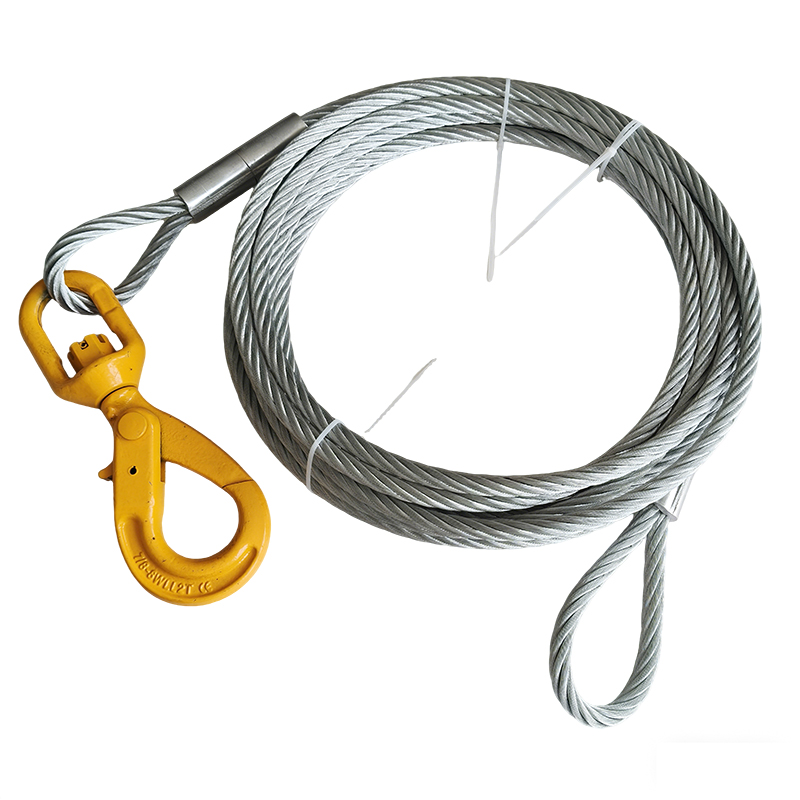
1x19 galvanized wire strand is a suitable candidate for guy wires that carry sustained tension with little bending. Its relatively stiff construction supports stable geometry, but diameter alone cannot establish whether it will perform reliably. Selection depends on the strand’s documented minimum breaking force, the loads imposed by the structure, and the capacity of the complete termination arrangement.
A practical starting point is to evaluate the strand and its end fittings together. A stronger strand offers limited benefit if its termination slips, damages the outer wires, or introduces a sharp bend. For technical evaluators, the decision should begin with load requirements and an approved termination method, then proceed to diameter, strength grade, corrosion protection, and installation details.
Where 1x19 fits—and where stiffness becomes a constraint
The 1x19 construction consists of nineteen wires arranged as a single strand. Compared with flexible, multistrand rope constructions, it has limited flexibility and suits straight, tensioned support members. That makes it relevant to guyed masts, poles, and similar structures where the cable remains substantially stationary after installation.
Its stiffness also sets boundaries. A guy wire may experience changing tension under wind or other service loads without repeatedly bending around a pulley. Those are different operating conditions. Repeated bending, tight routing, and articulation at the ends require separate consideration because local fatigue can govern performance even when the axial load remains below the strand’s strength limit.
A flexible cable product illustrates why construction and dimensions must be read together. The 7x19 PU coated Galvanized steel wire rope 5mm 6mm use for Gym Cable uses a multistrand construction for fitness cable systems. Its listed dimensions distinguish a 3.2 mm steel rope coated to 5.0 mm and a 4.0 mm steel rope coated to 6.0 mm. These coated diameters do not provide a basis for comparing its strength or termination fit with bare guy strand of the same nominal outside diameter.
For a guy-wire installation, check the actual route before selecting hardware. The strand should approach its termination along the intended load axis, without being forced sideways by a bracket or turnbuckle. Where structural movement changes that alignment, the connection needs suitable articulation. A stiff strand should not become the hinge that accommodates movement.
Read strength as an assembly requirement
Minimum breaking force is the starting strength parameter for strand selection. It describes a specified breaking threshold under the applicable test conditions; it is not an allowable working tension. Diameter and wire tensile grade influence this value, but construction details and manufacturing requirements also matter. A diameter-only quotation leaves too much unresolved for technical approval.
Request the minimum breaking force for the exact strand offered, together with its specification and supporting inspection or test documentation. Keep wire tensile strength and complete-strand breaking force separate: a material strength value cannot simply be treated as the capacity of the finished strand.
The required capacity follows from the structure’s load analysis. Installation pretension is only one component. Wind, ice where applicable, temperature effects, structural displacement, and uneven load sharing can change guy tension. Guy angle also matters because the tension needed to provide a given restraining force depends on geometry. A shallower guy arrangement can require greater strand tension for the same horizontal restraint.
Termination performance then enters the calculation. Where the design method uses a documented termination efficiency, the strand’s minimum breaking force is adjusted accordingly before applying the required safety provisions. Where an assembly has a directly established rated capacity, use that rating within its stated conditions. Avoid combining ratings derived on different bases.
A generic efficiency percentage taken from a different rope construction is a weak basis for approval. Performance can depend on strand diameter, wire grade, coating, fitting geometry, and installation procedure. The terminal body, pin, shackle, turnbuckle, and anchor connection also need compatible capacities. The weakest relevant component or connection governs the usable assembly.
Stiffness deserves its own check. Low flexibility does not mean zero extension. Elastic extension, initial seating of the assembly, and movement at connections can affect alignment and pretension. Where mast position or deflection is sensitive, obtain the strand’s relevant load–extension information and define how tension will be set and checked after installation.
Choose the termination before releasing the strand order
Termination selection should be resolved early because it can constrain the strand specification and the installation process. Three approaches merit evaluation: preformed guy grips, swaged fittings, and engineered socket arrangements. Each requires evidence of compatibility with the actual strand.
Preformed guy grips
A preformed grip transfers load through helical elements wrapped around the strand. It can be useful for field installation, but the grip must be specified for the strand’s construction, diameter, strength grade, coating, and intended service. Similar appearance or a nominal diameter match does not establish interchangeability.
Evaluate the complete grip arrangement, including the supporting thimble or connection hardware, installation direction, seating requirements, and any reuse restrictions. The supplier’s application guidance should explicitly cover the selected strand. A grip qualified for a different guy-strand construction should not be assumed suitable for 1x19.
Swaged fittings
Swaged terminals can provide compact, controlled end connections, particularly when assemblies are manufactured to length. Their reliability depends on a matched fitting and strand, suitable tooling, and a defined pressing process. Excessive compression can damage wires; insufficient compression can leave inadequate holding capacity.
Ask for the fitting manufacturer’s compatibility requirements and the assembly producer’s inspection criteria. Relevant controls may include finished dimensions, tooling identification, visual examination, and specified load testing. A general claim that a supplier can press wire-rope slings does not establish that a particular terminal is qualified for this guy strand.
Site adjustability also needs attention. A factory-finished assembly must allow for the actual distance between connection points, terminal dimensions, and sufficient turnbuckle adjustment to achieve the specified pretension.
Sockets and field-made eyes
Engineered socket systems may suit some applications, provided their design and preparation procedure cover the selected strand. Poured and mechanical systems have different installation controls, and their ratings cannot be transferred from one arrangement to another.
Clip-fastened eyes need especially careful evaluation. Stiff 1x19 strand resists forming around a thimble, and familiar wire-rope clip instructions may not cover this construction. Use such an arrangement only when the hardware manufacturer explicitly supports the exact application and provides installation and capacity information. The same compatibility check applies to wedge sockets.
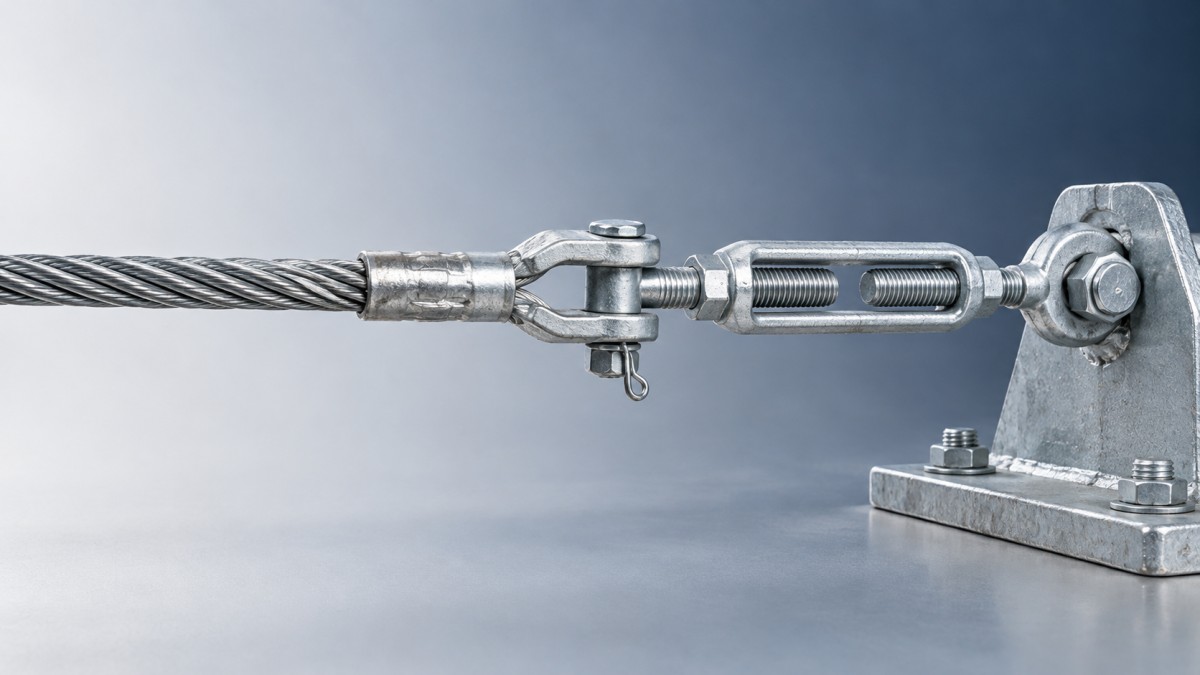
At every termination, examine the load path: strand entry, support radius, alignment, pin fit, and clearance under tension. A fitting can have adequate nominal strength while its surrounding geometry creates damaging local bending.
Specify corrosion protection and acceptance evidence together
Galvanizing provides corrosion protection, but the word “galvanized” does not define coating quantity, quality, or expected service life. The strand specification should identify the applicable coating requirements and the evidence used to demonstrate compliance. Exposure to salt, industrial contaminants, persistent moisture, and abrasion can change the protection needed.
Terminations deserve particular attention because they can retain moisture, obscure the strand surface, or damage zinc during assembly. Specify compatible fitting finishes and an approved treatment for exposed or damaged areas where required. A protective covering also needs a drainage and inspection strategy; trapping water around an end connection can undermine its purpose.
For technical comparison, a useful procurement package should state:
- The strand construction, nominal diameter and tolerance, strength grade, minimum breaking force, and applicable specification.
- The galvanized coating requirements and associated acceptance documentation.
- The termination make and type, compatibility evidence, assembly capacity, and installation procedure.
- The finished assembly length, length reference points, adjustment allowance, and required inspection or testing.
- The installation pretension, tension-setting method, and provisions for subsequent inspection.
Inspection access should influence the choice as much as initial assembly convenience. The finished connection needs a practical way to detect slipping, broken wires, corrosion, loose hardware, or loss of tension. Establish acceptance and replacement criteria appropriate to the structure and fitting system before installation.
A quotation becomes technically useful when it identifies a strand specification and a supported termination arrangement that together satisfy the design load. If it provides only a diameter, a strength claim, and a photograph of the fitting, the next step is to obtain the missing assembly evidence before committing to that combination.
Navigation
Send Us A Message



Shandong Faster Technology Co., Ltd. is a professional manufacturer of steel wire ropes.
Get in Touch
*We respect your confidentiality and all information are protected.