





7x7 Stainless Steel Cable for Railings: Sizing, Tension, and Fitting Selection
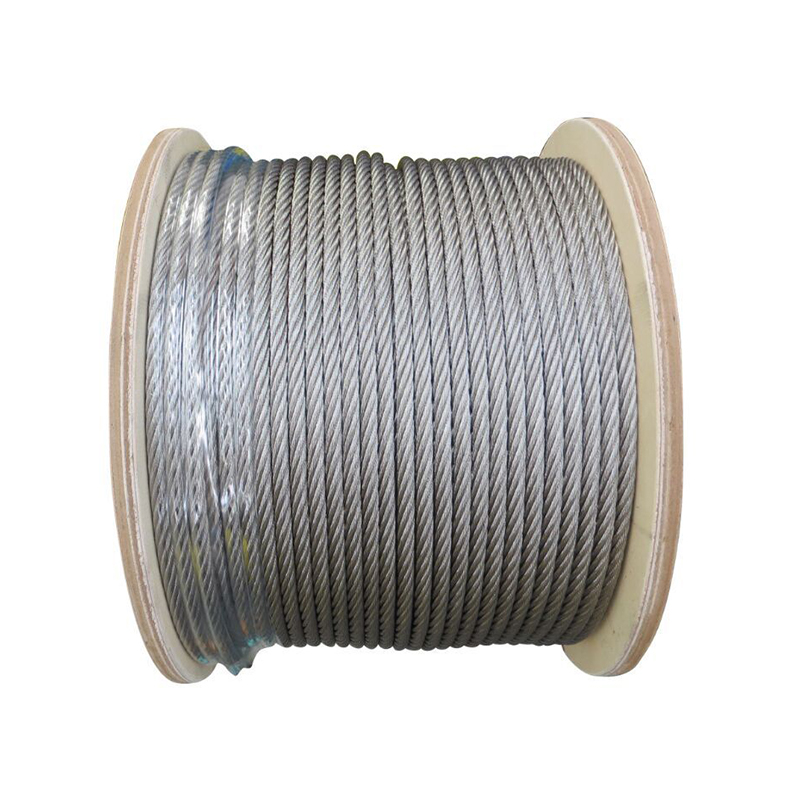
Specifying 7x7 stainless steel cable for a railing starts with the complete guard assembly, not the cable’s breaking strength. Diameter, unsupported span, installed tension, end fittings, and post stiffness must work together to limit movement under the applicable loading and opening requirements. A stronger cable cannot compensate for flexible posts or an unsuitable termination.
The practical decision is whether a proposed 7x7 cable-and-fitting combination has documented suitability for the intended railing layout. Set the required performance and exposure conditions before ordering cable, then coordinate the post design and tensioning procedure around that combination. Treating these as separate purchases creates avoidable compatibility problems and inspection risk.
Confirm that 7x7 construction fits the railing design
A 7x7 cable consists of seven strands, each containing seven wires. It offers more flexibility than 1x19 construction, while being less flexible than 7x19. That flexibility can help with handling and certain routing arrangements, but does not automatically make it the best choice for straight architectural railing runs.
Compared with 1x19, 7x7 generally exhibits more constructional stretch as its wires and strands settle under load. This is separate from elastic extension of the steel itself. The distinction matters because initial settling can reduce installed tension, requiring adjustment after installation. A fitting specified only for 1x19 must not be assumed suitable for 7x7, even when the nominal diameter matches.
For a straight run where minimal stretch is important, compare a documented 7x7 system with an equivalent 1x19 system before committing. Where 7x7 is selected, obtain the cable manufacturer’s specifications and the fitting supplier’s explicit approval for that construction. Neither a generic “stainless cable” description nor a diameter match establishes compatibility.
Construction and coating also identify fundamentally different applications. For example, 7x19 PU coated Galvanized steel wire rope 5mm 6mm use for Gym Cable is intended for moving fitness-equipment cable systems, not as an interchangeable railing specification. Its stated finished diameters include the coating; railing fittings must be selected around the actual metallic cable diameter and approved construction.
Size the cable around span and deflection—not appearance alone
Cable diameter influences breaking strength, axial stiffness, fitting dimensions, and visual weight. It does not independently determine whether a railing complies. Under transverse loading, cable movement also depends on pretension, clear span between supports, cable spacing, and movement of the supporting structure.
These sizes are comparison points, not universal recommendations. Inch and metric descriptions should not be treated as exact substitutes without checking tolerances. A fitting designed for 3.0 mm cable may not accept 1/8-inch cable correctly.
Distinguish terminal-to-terminal run length from unsupported span. Intermediate pass-through supports can reduce local cable movement, but they are not necessarily designed to resist the longitudinal forces carried by end posts. Their holes, guides, and attachments still require detailing for transverse loading and cable protection.
Confirm the locally adopted guard requirements, including required height, structural loads, opening limitations, and any restrictions on climbable infill. Where an opening criterion applies under loading, unloaded cable spacing is insufficient evidence. Leave an appropriate design margin rather than setting spacing at the maximum permitted opening and assuming it will remain unchanged.
Set tension from the assembly’s limits
There is no universal installation tension for every 7x7 stainless steel cable railing. Use the value and measurement method specified for the approved assembly. Cable strength, termination capacity, post stiffness, anchor capacity, and the available adjustment travel all constrain the setting.
Increasing pretension reduces cable movement, but also increases sustained forces on the frame. For illustration, ten parallel cables each tensioned to 1 kN impose approximately 10 kN of combined longitudinal pull on an end post, before considering other design actions. This is a force illustration—not a recommended cable tension. The distribution of those forces over the post height also creates bending demand.
A post that bends inward during tensioning shortens the distance between terminals and changes cable tension. Increasing the setting to compensate can worsen the deformation. Review end-post sections, base plates, anchors, edge distances, and the supporting substrate before installation. A connection to a structural slab is not equivalent to a connection through decking into an inadequately assessed support.
At corners, determine whether cables terminate or pass through a purpose-designed guide. Redirecting a tensioned cable introduces a resultant force at the corner; a drilled hole is not automatically an acceptable turning detail. Sharp contact edges can also damage wires.
Install and tension in a balanced sequence defined by the system supplier, rather than fully tightening one cable while adjacent rows remain slack. Use a tension gauge suitable for the cable’s diameter and construction, and record readings at a consistent location. Hand feel and turnbuckle torque are unreliable substitutes because friction and cable behavior affect the result.
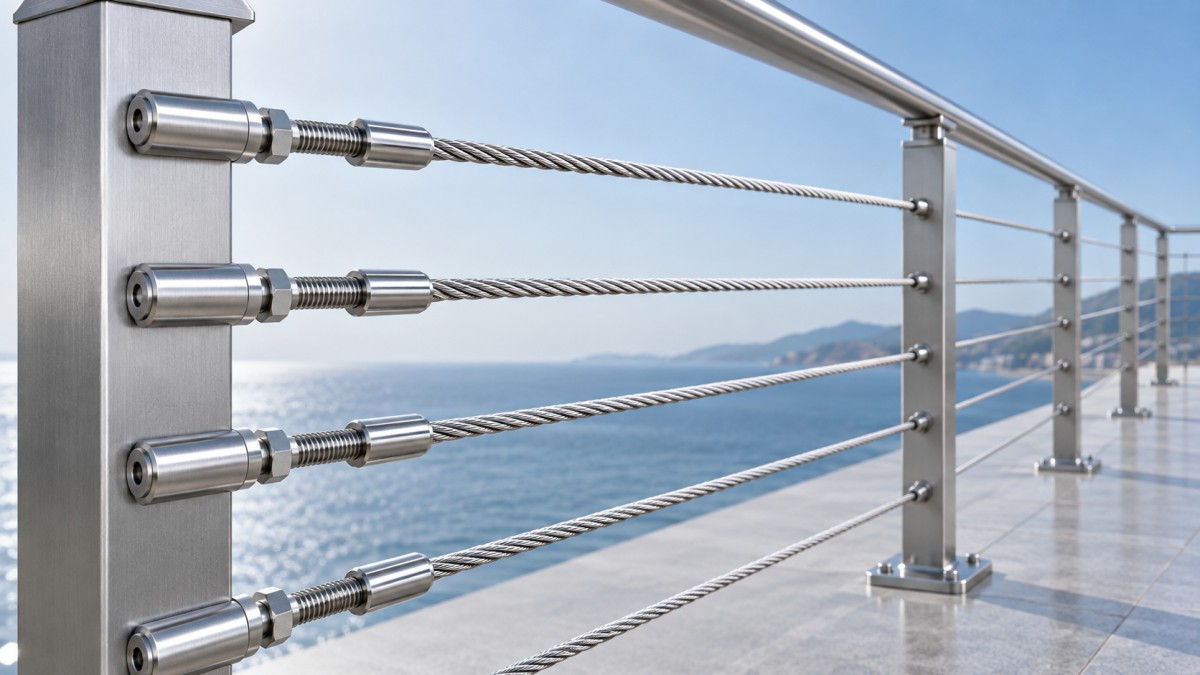
Reserve sufficient threaded travel for initial adjustment and subsequent settling. Follow the supplier’s recheck interval, and consider temperature when comparing readings: differential thermal movement between cable and frame can change tension. Do not use routine retensioning to conceal persistent post movement or slipping terminations.
Select fittings as load-carrying components
End fittings must match the cable’s diameter, construction, material, and required capacity. Ask for termination performance for the actual combination being supplied. Cable minimum breaking force is not the same as usable assembly capacity, and termination efficiency should not be assumed to be 100%.
Swaged terminals require the prescribed tooling, dies, insertion depth, and inspection criteria. Factory swaging can reduce field operations, but demands accurate length information and adequate adjustment allowance. Field-swaged terminals permit on-site fabrication, provided access, tool control, and installer competence are established.
Mechanical or swageless fittings offer another installation route, but “swageless” does not mean universally compatible. Gripping elements may be construction-specific, and some designs are unsuitable for particular strand arrangements. Obtain explicit confirmation for 7x7 rather than relying on a product photograph or nominal size.
Before procurement, resolve:
- The load-bearing interface: through-post, threaded insert, surface bracket, or another engineered connection.
- Post thickness, terminal seating geometry, and access for installation and adjustment.
- Minimum thread engagement, locking method, and remaining adjustment travel.
- Cable cut length, including insertion lengths and the fitting’s prescribed starting position.
Stair runs require angle-compatible terminals or approved seating details. Forcing an angled cable into a fitting intended for a straight pull can create side loading. Exposed tails and threads should be finished without sharp edges, while maintaining the manufacturer’s required engagement.
Specify corrosion resistance and acceptance evidence
Grade 316 stainless steel is generally preferred over 304 where chloride exposure is significant, including coastal locations. It is not immune to corrosion. Salt accumulation, sheltered crevices, contaminated fabrication tools, and incompatible adjacent materials can undermine performance. Cable, fittings, and surrounding connections need coordinated material selection and drainage.
Define cleaning access and maintenance expectations alongside the material grade. A protected railing that receives little rain washing may retain contaminants despite appearing sheltered. Avoid carbon-steel contamination during cutting and fabrication, and follow the supplier’s surface-treatment recommendations.
The purchase specification should identify stainless grade, 7x7 construction, nominal diameter and tolerance, minimum breaking force, surface condition, length requirements, and batch traceability. Require fitting compatibility documentation separately. A general quality-system certificate does not establish that the completed guard meets the project’s requirements.
Close installation acceptance with evidence for the assembly: approved drawings, material records, termination inspections, tension readings, post alignment, anchor checks, and opening measurements under the applicable assessment conditions. Resolve any required testing before ordering. Cable can be delivered correctly and still become part of an unacceptable railing if its supports, fittings, or installation controls were never coordinated.
Navigation
Send Us A Message



Shandong Faster Technology Co., Ltd. is a professional manufacturer of steel wire ropes.
Get in Touch
*We respect your confidentiality and all information are protected.