





Where 1x19 steel wire strand is a poor choice for bending
Where 1x19 Steel Wire Strand Is a Poor Choice for Bending
For quality control and safety managers, selecting the right wire rope construction is not simply a strength calculation. It is a fatigue, routing, inspection, and service-life decision. A 1x19 steel wire strand has clear strengths: it is stable, relatively low in stretch, and well suited to straight, static, or lightly tensioned applications. Yet the same construction can become a poor engineering choice when a line must repeatedly travel over sheaves, pass around small radii, or flex under changing loads.
The risk is easy to underestimate because a strand may meet its nominal breaking-strength requirement at installation. Failures often emerge later, after repeated bending has concentrated stress in individual outer wires. The safer specification question is therefore not “Is 1x19 strong enough?” but “Will this construction tolerate the bending cycle, sheave geometry, and inspection conditions of the installed system?”
Why the construction matters
A 1x19 steel wire strand consists of 19 wires laid into a single strand. Compared with flexible multi-strand wire ropes, it has fewer internal interfaces that can accommodate movement during bending. This produces a firm, straight-running product, but it also means the individual wires must absorb more of the deformation when the strand is forced around a curve.
In a static tension member, that rigidity can be useful. It helps maintain alignment in guy wires, architectural bracing, guardrails, trellis systems, and other applications where the strand remains substantially straight after installation. In contrast, a moving rope system relies on controlled internal movement between wires and strands. Constructions with more, smaller wires are generally better able to distribute bending strain and tolerate cyclic service, although the final selection must still account for rope grade, lubrication, load, and equipment design.
Situations where repeated bending creates a poor fit
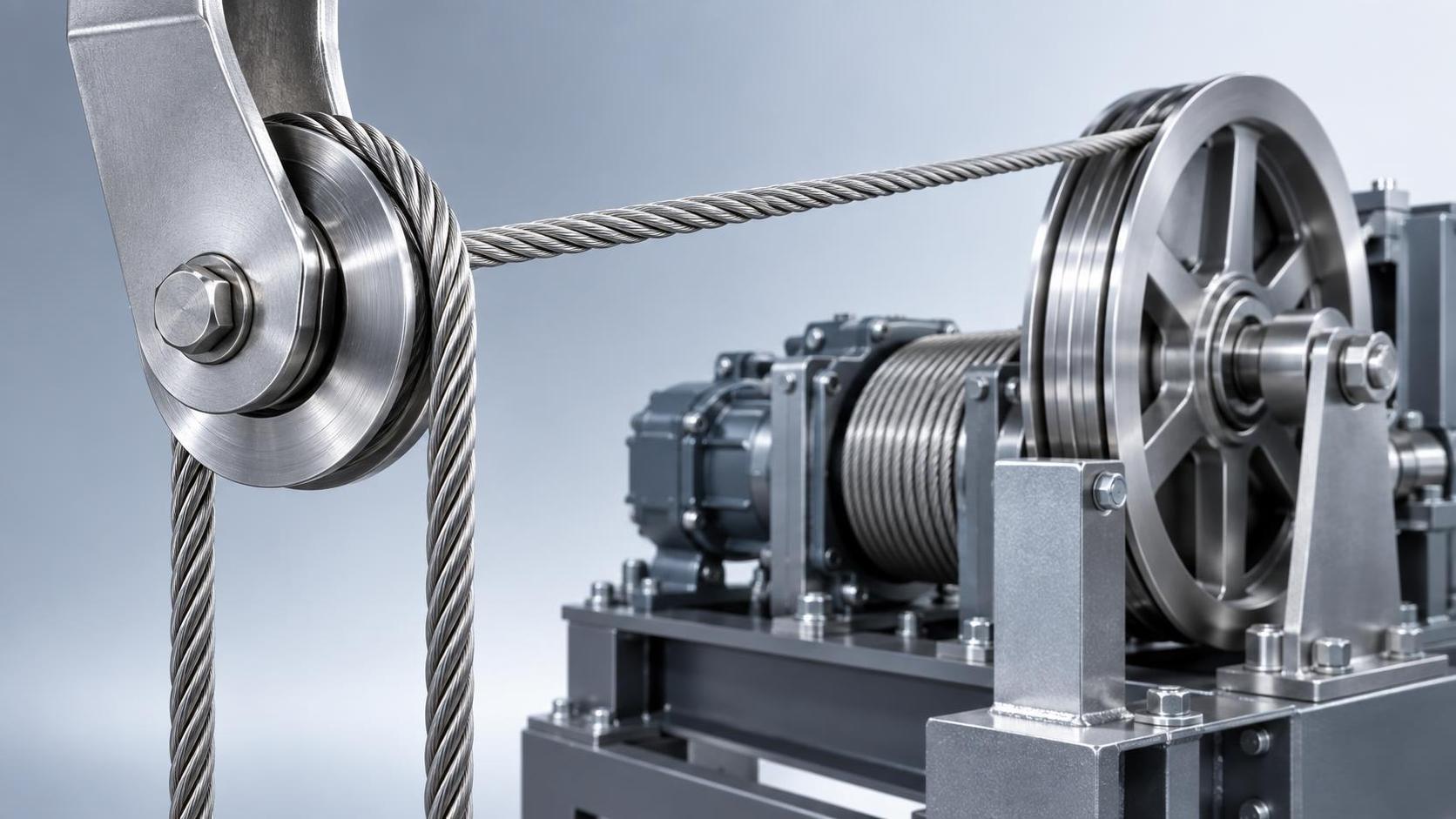
A 1x19 steel wire strand should be treated cautiously, and often avoided, in any duty where it repeatedly runs over a pulley or sheave. Hoists, winches, crane reeving systems, elevator traveling arrangements, and powered traction equipment typically create recurring bend-and-straighten cycles. Even when the travel speed is low, frequent cycles can drive fatigue damage.
Small sheaves are especially problematic. As the sheave diameter decreases relative to strand diameter, bending becomes more severe. The appropriate diameter ratio is not universal; it should be checked against the applicable equipment design standard, rope supplier guidance, and the actual duty cycle. A diameter that appears generous in a lightly used installation may still be unsuitable in a continuously operating mechanism.
Other warning conditions include tight routing around fairleads, sharp terminal exits, repeated movement at a guide point, and alternating loads that make a strand whip or oscillate. A fixed line can also experience damaging localized bending when vibration from machinery, wind, vessel movement, or cyclic loading is concentrated near a clamp, socket, eye, or structural edge.
Do not confuse occasional deflection with a designed bend
Some installations are described as “static” even though they contain movement. A mast stay may see wind-driven vibration. A tensioned support line may be displaced during maintenance. A restraint line may be pulled around a temporary guide during operation. These events may be infrequent, but they still deserve review if the line bends at the same point each time. The problem is often not the total amount of movement; it is repeated stress at one short section.
For safety teams, the practical inspection implication is clear: do not examine only the visible straight span. Pay close attention to the strand immediately before and after fittings, around sheaves, at fairleads, and where a line touches structure. Broken outer wires, flattening, localized corrosion, birdcaging-like distortion, or a change in lay appearance should trigger a documented engineering assessment rather than a simple cosmetic judgment.
Common specification mistakes
The most common mistake is selecting by tensile capacity alone. High static strength does not equal high fatigue resistance. Another is assuming that stainless steel, galvanizing, or a plastic coating will solve a bending problem. Those material and coating choices can be important for corrosion resistance, handling, or environmental exposure, but they do not change the fundamental flexibility limits of a 1x19 construction.
Terminations deserve equal scrutiny. If a rigid strand must turn sharply at an eye, thimble, or anchor point, the fitting geometry should support the intended bend rather than pinch the wires. Field modifications are particularly risky. A strand that is kinked, crushed, or bent over an improvised edge should not be assumed to retain its original service capability simply because no wires have visibly broken.
In lifting-related systems, teams should also distinguish between a stationary support member and a rope intended for running duty. The distinction affects not only construction choice but also inspection intervals, termination method, safety factor, and compliance with the governing local or project requirements.
A more reliable selection path
Before approving a strand, gather the conditions that determine bending performance: strand diameter, minimum bend radius in service, sheave and groove dimensions, expected number of cycles, load range, shock loading, environmental exposure, and the exact termination arrangement. If any of these points are unknown, the application is not yet fully specified.
For lines that must flex repeatedly, a more flexible multi-strand rope construction is often the better starting point. The correct alternative is not determined by flexibility alone. Abrasion, crushing resistance, rotation behavior, lubrication needs, and corrosion exposure may all influence the decision. In demanding environments such as ports, ships, mining, construction, and elevators, the rope should be selected as part of the whole system rather than as an isolated component.
The same principle applies when the task is not a running-rope application at all. Truck load restraint, fixed cargo binding, and certain towing duties may be better served by an appropriately rated chain assembly rather than by a wire strand forced through unsuitable bends. For example, the NACM90 Yellow Galvanized G70 Truck Tow Chain 5/16" 3/8" 1/2" Transport Chain is intended for transport-related binding and towing applications in its available sizes. Its suitability still depends on the applicable regulations, working-load requirements, connectors, and the intended use; transport chain should not be assumed suitable for overhead lifting unless the relevant system requirements explicitly permit it.
What purchasing and QC teams should request
A meaningful supplier review should go beyond a catalogue description. Request confirmation of construction, diameter tolerance, material and finish, nominal breaking force or relevant rating, intended application, and the recommended termination method. For an installed project, it is also useful to confirm whether the supplier has reviewed the minimum bending radius and whether the proposed construction is static-only or appropriate for the planned running duty.
Shandong Faster Technology Co., Ltd. supports this type of specification work with wire drawing, twisting, and rope-closing production capability, as well as inspection across the process from raw material to finished rope. Its range includes single- and multi-strand steel wire ropes from 1 mm to 20 mm in galvanized, stainless steel, and plastic-coated series, alongside pressed sling processing and chain products from G30 through G100. That rope-sling-chain capability is useful when a project requires a comparison of fundamentally different restraint, traction, or fixing solutions instead of a default substitution.
A 1x19 strand is not a poor product; it is a poor match for repetitive bending. When a line travels, flexes, vibrates at a fixed point, or turns tightly around hardware, treat construction flexibility as a primary safety requirement. Reviewing the route and duty cycle before release is far less costly than investigating wire breaks after the system is already in service.
Navigation
Send Us A Message



Shandong Faster Technology Co., Ltd. is a professional manufacturer of steel wire ropes.
Get in Touch
*We respect your confidentiality and all information are protected.