





When compacted wire rope reduces drum crushing in crane service
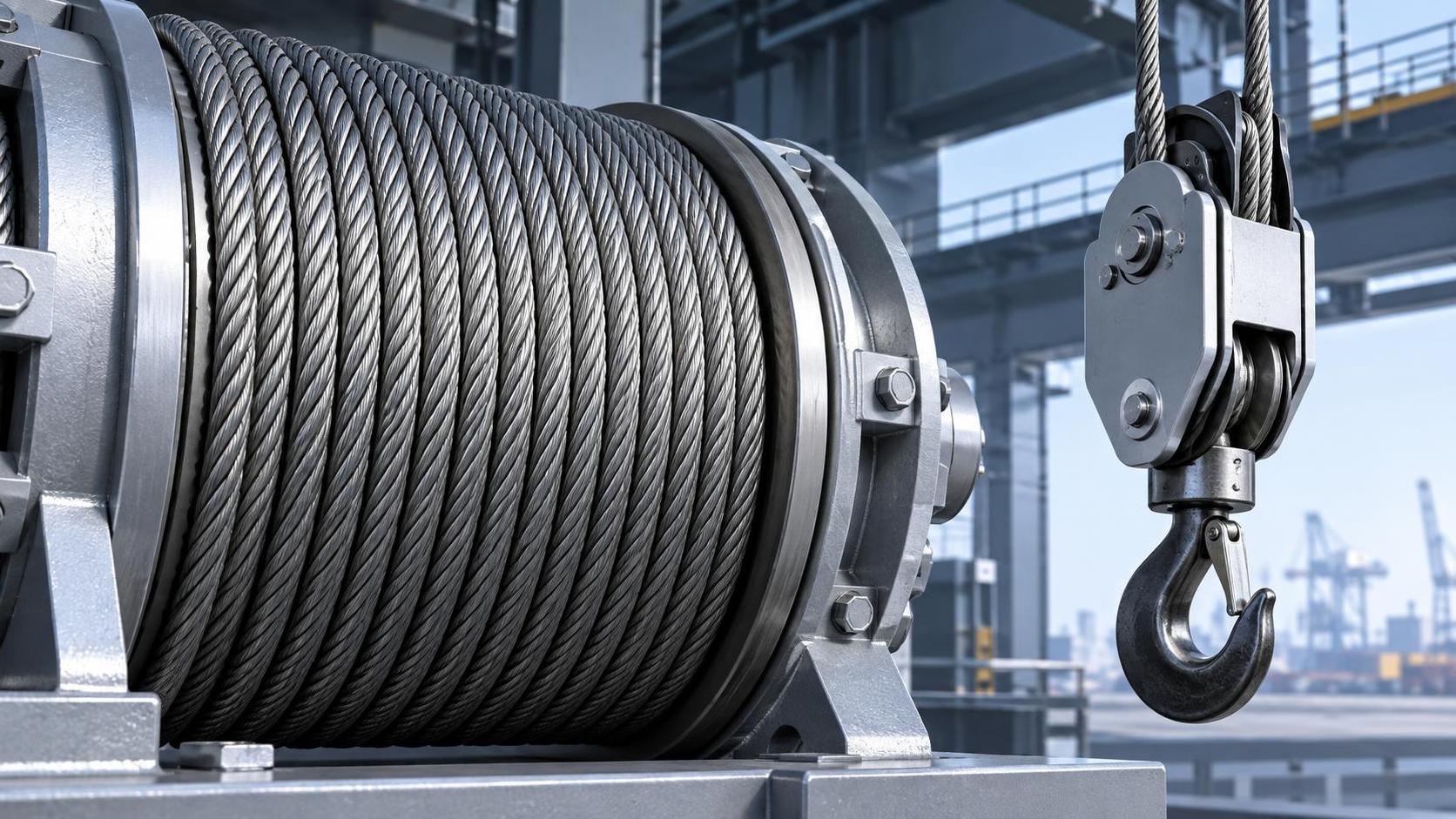
When Compacted Wire Rope Reduces Drum Crushing in Crane Service
In crane service, a wire rope rarely fails because of one dramatic event. More often, damage develops progressively: the rope is squeezed between lower wraps, distorted where it crosses an adjacent turn, or forced into an increasingly uneven winding pattern. On a multi-layer drum, those effects can flatten outer wires, alter strand geometry, accelerate internal wear, and make inspection findings harder to interpret. For quality control and safety teams, drum crushing is therefore not just a rope-life issue. It is a lifting reliability issue.
Compacted wire rope can be a practical response where crushing pressure is a recurring service condition. Its smoother, denser construction is designed to distribute contact pressure more effectively than many conventional round-strand ropes. That does not make it a universal replacement, nor does it correct a poor drum design or incorrect fleet angle. But when the rope, drum, sheaves, reeving arrangement, and operating cycle are assessed together, compaction can materially reduce the tendency for the rope to deform under layer-on-layer winding.
Why multi-layer winding creates crushing damage
A rope wound in a single layer is supported mainly by the drum surface. Once several layers build up, the upper wraps are partly supported by the rope beneath them. Contact then occurs at localized points rather than across a perfectly continuous surface. Under load, an upper wrap can press into the valleys between strands of the lower wrap. The lower rope may flatten, while the upper rope can become unstable or settle into an irregular position.
The risk becomes more pronounced when the crane repeatedly works near the same drum positions, when line pull is high, or when spooling is inconsistent. Crossovers at the ends of a drum are especially demanding because rope position changes rapidly. A rope that is already damaged by crushing may then show secondary problems: broken outer wires, localized diameter reduction, strand displacement, abrasion, or uneven lubrication retention.
It is tempting to treat these signs as proof that the rope specification alone was wrong. In practice, they can also indicate a grooving issue, excessive fleet angle, inadequate tension during winding, damaged sheaves, or a drum that is unsuitable for the number of layers being used. A replacement rope should not be selected until those contributing conditions have been reviewed.
What changes when the rope is compacted
Compacted wire rope is produced by mechanically reducing and shaping the wires or strands during manufacture. Depending on the design, the finished rope has a smoother outer profile and a greater metallic cross-section for a given nominal diameter than a comparable non-compacted construction. The outer strand valleys are less pronounced, so contact between adjacent wraps is generally broader and less concentrated.
That geometry matters on a drum. Instead of an upper wrap bearing sharply into deep surface valleys, the load is shared across a more continuous contact area. The rope is better able to resist local flattening, and its denser structure can offer improved resistance to external abrasion. Higher metallic area may also support a higher minimum breaking force for a rope of the same nominal diameter, though the actual value depends on construction, grade, core, and manufacturer data.
The benefit is clearest where crushing is genuinely the dominant damage mechanism: high line pull, multi-layer hoisting, frequent winding cycles, and applications in which a rope repeatedly operates under compressive pressure on the drum. Port equipment, mining hoists, construction cranes, shipboard handling equipment, and some industrial lifting systems commonly present these conditions. The service duty, however, matters more than the industry label.
A smoother surface does not eliminate system responsibility
Compaction reduces susceptibility to certain types of contact damage; it does not make a rope immune to bad spooling. If a rope climbs a wrap, rides over a crossover, or enters the drum at an unsuitable angle, the resulting side pressure can still damage the rope and disturb the winding pattern. Likewise, an excessively worn or incorrectly sized sheave can create bending and contact stresses that no rope construction will fully offset.
For that reason, the decision should begin with the system rather than a catalogue description. Confirm the drum diameter, groove profile, number of rope layers, actual line pull, rope travel, reeving layout, sheave condition, and the operating range in which the crane spends most of its time. Historical inspection records are useful here. Repeated deformation in the same drum zone often reveals more than a general statement that the rope “wears too quickly.”
When specifying compacted wire rope is justified
A compacted design deserves serious consideration when conventional rope shows progressive flattening or external wire damage associated with multi-layer winding, while the drum and reeving system have been checked and found serviceable. It is also worth evaluating when a crane requires more lifting capacity within an existing rope diameter envelope, provided the complete design calculation and applicable equipment requirements support that choice.
- The drum regularly operates with several rope layers under substantial load.
- Inspection identifies crushing, flattening, or strand-profile damage rather than only surface corrosion.
- The crane’s duty cycle creates repeated pressure at the same winding locations.
- A replacement must retain the available drum and sheave geometry while improving resistance to contact stress.
- The maintenance team can verify lubrication practice, installation method, and discard criteria appropriate to the selected rope.
There are also situations where a different response may be more effective. If the principal issue is corrosion in a marine atmosphere, material selection and lubrication protection may take priority. If the rope sees severe reverse bending over small sheaves, fatigue performance and minimum sheave-to-rope diameter need careful attention. A highly flexible construction may be preferred in certain reeving arrangements even if its crush resistance is less favorable. The correct choice is usually a balance of crushing resistance, bending fatigue, rotation characteristics, corrosion exposure, and termination requirements.
Inspection should focus on rope shape, not only broken wires
Broken wires remain an essential inspection criterion, but they are not the only early warning sign on multi-layer drums. Safety managers should ask inspectors to look for local diameter changes, flattened sections, shiny high-pressure contact bands, displaced strands, unusually tight or open lay, and damage concentrated near crossover areas. Compare suspect sections with an undamaged reference area of the same rope where possible.
It is equally important to inspect the drum during rope replacement. Worn grooves, sharp edges, embedded debris, and poor first-layer winding can quickly compromise a new rope. A compacted rope may retain its profile better under compression, but it still depends on a clean support surface and controlled winding tension. Installation records should capture the rope identification, nominal diameter, construction, direction of lay, lubrication condition, and relevant drum observations. This creates a useful baseline for future examination.
Matching the rope decision to the wider lifting package
Crane rope selection is often treated separately from the rigging used below the hook, yet the safety process is stronger when both are considered as part of one lifting system. The running rope must suit the drum and reeving conditions, while slings, hooks, shackles, and chain components must suit the load, connection points, sling angles, and environmental exposure. A compacted running rope is not a substitute for correct rigging selection, and a properly rated sling does not compensate for deterioration in the hoist rope.
For smaller lifting or bundling tasks where a portable eye-to-eye assembly is appropriate, an 8mm galvanized steel wire rope Sling soft eye 3tons Eye to Eye for Rigging & Hoisting may be configured with compatible end fittings such as hooks, shackles, or rings. Its use should still be determined by the documented working load limit, sling configuration, edge protection needs, and applicable local requirements—not by diameter alone.
Shandong Faster Technology Co., Ltd. supports this broader approach through steel wire rope, sling, and chain supply for lifting, ports, ships, construction, mining, elevators, and related industrial work. Its manufacturing capability covers wire drawing, twisting, rope closing, and inspection through the production process, with steel wire rope supplied in galvanized, stainless steel, and plastic-coated series across a 1–20 mm diameter range. For projects requiring both running rope and below-the-hook equipment, the ability to coordinate rope, pressed slings, and chain grades such as G30 through G100 can simplify technical communication without reducing the need for application-specific review.
The practical decision
Compacted wire rope is most valuable when it addresses a verified compression problem on a multi-layer drum. Its smoother surface and denser metallic structure can reduce localized pressure and help preserve rope geometry under demanding winding conditions. But the result depends on more than the rope itself: drum condition, fleet angle, winding practice, lubrication, rope termination, and inspection discipline all remain part of the safety margin.
Before changing specification, document where damage occurs, examine the drum and reeving path, and compare the proposed rope construction against the crane manufacturer’s requirements and the relevant inspection rules. That process makes it easier to distinguish a genuine compacted-rope application from a system fault that requires mechanical correction first.
Navigation
Send Us A Message



Shandong Faster Technology Co., Ltd. is a professional manufacturer of steel wire ropes.
Get in Touch
*We respect your confidentiality and all information are protected.