





When 6x19 IWRC wire rope suits abrasive lifting duty
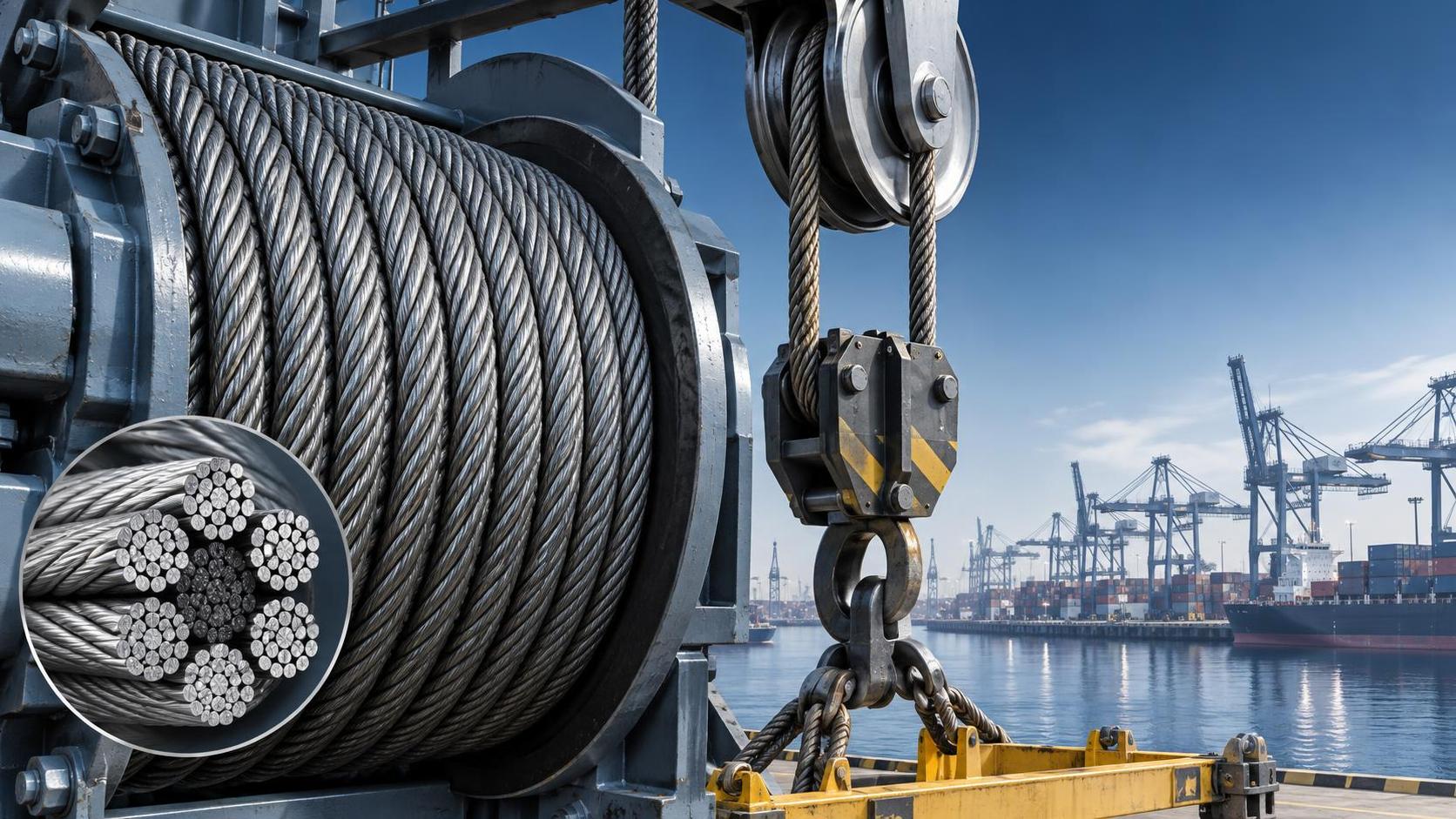
A 6x19 IWRC wire rope is a strong candidate for abrasive lifting duty when the rope is exposed to external rubbing, contact with rough loads, drum crushing, or moderate repeated bending—and when durability matters more than maximum flexibility. Its advantage is not simply a higher breaking force. The practical value comes from a relatively robust outer-wire profile combined with an independent wire rope core (IWRC), which helps the rope retain its shape under pressure.
That combination is especially relevant in ports, construction yards, mining support work, scrap handling, and industrial lifting systems where a rope may run over sheaves but also scrape against edges, guides, hooks, load surfaces, or contaminated equipment. It is not automatically the best choice for every hoisting system. Where fatigue from frequent bending over small sheaves is the dominant failure mechanism, a more flexible construction may provide a better service balance.
Why abrasive duty changes the rope-selection logic
Abrasive damage removes material from the outside wires. Once outer wires lose diameter, their ability to carry load declines, and wire breaks can develop sooner. Dirt, ore fines, sand, cement residue, rust particles, and poor lubrication make the problem more severe because they turn normal rope movement into a grinding process.
In this environment, a rope with comparatively larger external wires generally offers more sacrificial wear material than a finer-wire construction of the same nominal diameter. This is why the 6x19 family is commonly considered when external wear resistance is a leading concern. The exact outer-wire geometry still depends on the full construction designation; “6x19” is a classification and does not, by itself, define every strand pattern or performance characteristic.
The IWRC is equally important. Unlike a fiber core, an independent wire rope core gives the outer strands a firm metallic support. Under multilayer winding on a drum, high line pull, or pressure at crossover points, the core helps resist flattening and local strand displacement. A rope that keeps a more stable cross-section is less vulnerable to crushing-related damage and is more likely to spool predictably.
For abrasive lifting duty, the relevant question is therefore not “Is 6x19 IWRC wear-resistant?” but rather: Is external wear and compressive loading more damaging in this installation than bending fatigue? If the answer is yes, this construction deserves serious consideration.
Conditions where 6x19 IWRC is usually well matched
A 6x19 IWRC rope is most defensible when several operating conditions occur together:
- The rope experiences contact abrasion from rough or contaminated load surfaces, guides, fairleads, or handling equipment.
- Drum pressure is substantial, particularly on multi-layer drums where lower wraps carry the pressure of upper layers.
- Loads are heavy enough that resistance to crushing and deformation is more important than easy handling.
- Sheave and drum diameters meet the applicable equipment and rope-manufacturer recommendations for the selected rope grade and duty.
- The lifting cycle is intermittent or moderate rather than a very high-cycle, small-radius running application.
- The application needs a rope that remains dimensionally stable during repeated spooling.
Common examples include general-purpose hoist lines on rugged equipment, port-side lifting subject to abrasive contamination, construction lifting where ropes can rub against structural elements, and mining-related handling systems where dust and surface wear are difficult to eliminate. In these uses, a more flexible rope can be a false economy if it wears through outer wires quickly or suffers premature flattening on the drum.
The construction is also relevant where a rope must tolerate incidental side pressure. An IWRC does not eliminate the risk created by poor fleet angle, incorrect drum grooving, or tight crossover points, but it provides a more stable internal structure than a fiber-core alternative.
When the same rope may be the wrong choice
Abrasive conditions do not cancel the importance of bending fatigue. A 6x19 IWRC rope has fewer, larger wires than finer-wire constructions such as 6x36-class ropes. That generally makes it more resistant to outer-wire wear, but less flexible in repeated bending. If the rope continuously travels over relatively small sheaves, cycles at high frequency, or works in a system with numerous bends, fatigue performance may become the governing criterion.
In such cases, a 6x36WS construction can offer a more appropriate compromise. Its layered Warrington-Seale strand arrangement combines outer wires intended to support wear resistance with a greater number of internal wires that improve flexibility and fatigue behavior. For tower crane and running-rope applications where both drum pressure and repeated bending need attention, 6x36WS Galvanized Steel Wire Rope 8-20mm used for tower cranes illustrates the type of alternative that should be evaluated against the machinery’s reeving arrangement rather than selected solely by nominal strength.
A 6x19 IWRC rope should also not be selected merely because the stated minimum breaking force is high. Breaking force is a baseline qualification, not a prediction of in-service life. A rope can have adequate nominal capacity and still fail early because of abrasion, twisting, shock loading, improper reeving, insufficient lubrication, or incompatible termination practice.
The checks that should appear on the purchase specification
Ordering “6x19 IWRC, diameter X” leaves too much room for interpretation. A procurement specification should connect rope design to the lifting system and operating hazard. At minimum, it should identify the exact construction, nominal diameter, rope grade, lay direction and lay type, finish, minimum breaking force, lubrication requirement, length, reel arrangement, and the standard against which the rope is supplied.
For regulated or engineered lifting equipment, the applicable machinery, lifting, and regional requirements govern the final selection. EN 12385-4 is one commonly referenced standard for stranded wire ropes used in lifting applications, while GB/T and other national standards may apply according to the destination market and project documentation. A standard number on a quotation should not be treated as sufficient evidence of suitability. The buyer should confirm that the declared rope category, testing documentation, marking, and intended use align with the project requirement.
There are several details that affect the commercial and operational outcome:
- Rope grade and breaking force: Compare like-for-like construction, diameter, and grade. Do not compare a supplier’s breaking-force figure unless the referenced standard and calculation basis are clear.
- Surface finish: Bright rope may be suitable for controlled, well-lubricated indoor service. Zinc-coated finishes can add corrosion protection, but galvanizing is not a substitute for proper lubrication or inspection in abrasive service.
- Lay specification: Ordinary lay, Lang lay, right-hand lay, and left-hand lay behave differently in contact wear, rotation tendency, and drum interaction. The equipment design should determine the requirement.
- Lubrication: The rope needs internal lubrication for wire-to-wire movement and an external film to reduce corrosion and abrasive attack. The lubricant must be compatible with the operating temperature, environment, and any later field relubrication.
- Reel and packaging: Reel type, winding direction, flange strength, and rope-end protection affect whether the rope reaches site without handling damage or twist problems during installation.
Do not confuse abrasion resistance with abuse tolerance
The strongest reason to select a 6x19 IWRC wire rope is its balanced response to wear and crushing. It is not a license to accept poor installation conditions. A rope dragged across a sharp edge, wound onto a damaged drum, or operated with misaligned sheaves will deteriorate regardless of construction.
Particular attention is needed at the interface between the rope and the machine. Worn sheave grooves can pinch the rope and accelerate crown-wire damage. Grooves that are too wide reduce support and promote flattening. Incorrect fleet angle can force the rope against drum flanges or create severe crossover pressure. Dead-end connections and sockets must be designed for the selected rope type and installed according to the termination supplier’s requirements. These conditions are often more influential than a small difference in quoted rope price.
Inspection planning should match the anticipated failure mode. In abrasive duty, attention should focus on outer-wire diameter loss, local flat spots, crown-wire breaks, crushed sections, uneven diameter, corrosion under deposits, and damage near sheaves, drum crossover zones, and terminations. Replacement criteria must follow the applicable lifting rules, equipment instructions, and rope manufacturer guidance; a visual check for broken wires alone is not enough to judge an abraded rope.
A practical buying decision
Choose 6x19 IWRC where the duty is heavy, rough, and mechanically demanding: the rope sees external wear, drum pressure, and a need for structural stability, while bending cycles remain within a range suitable for a comparatively less-flexible construction. It is particularly rational when the alternative is a fiber-core rope that may compress or deform under the same winding pressure.
Move toward a finer-wire, more flexible design when repeated bending dominates and the reeving system is demanding. Upgrade the finish or corrosion-control approach when moisture, salt, chemicals, or long idle periods create corrosion risk. In every case, specify the complete rope—not just its diameter and nominal construction—and require documentation that makes the supplied rope traceable to the agreed standard, grade, and breaking-force requirement.
The sound procurement decision is based on the mechanism expected to end rope life. If that mechanism is external abrasion combined with crushing and rugged handling, 6x19 IWRC is often a technically credible and commercially sensible choice. If fatigue is likely to end service first, its wear advantages may not offset the loss of flexibility.
Navigation
Send Us A Message



Shandong Faster Technology Co., Ltd. is a professional manufacturer of steel wire ropes.
Get in Touch
*We respect your confidentiality and all information are protected.