





How to assess a wire rope exporter before a container order
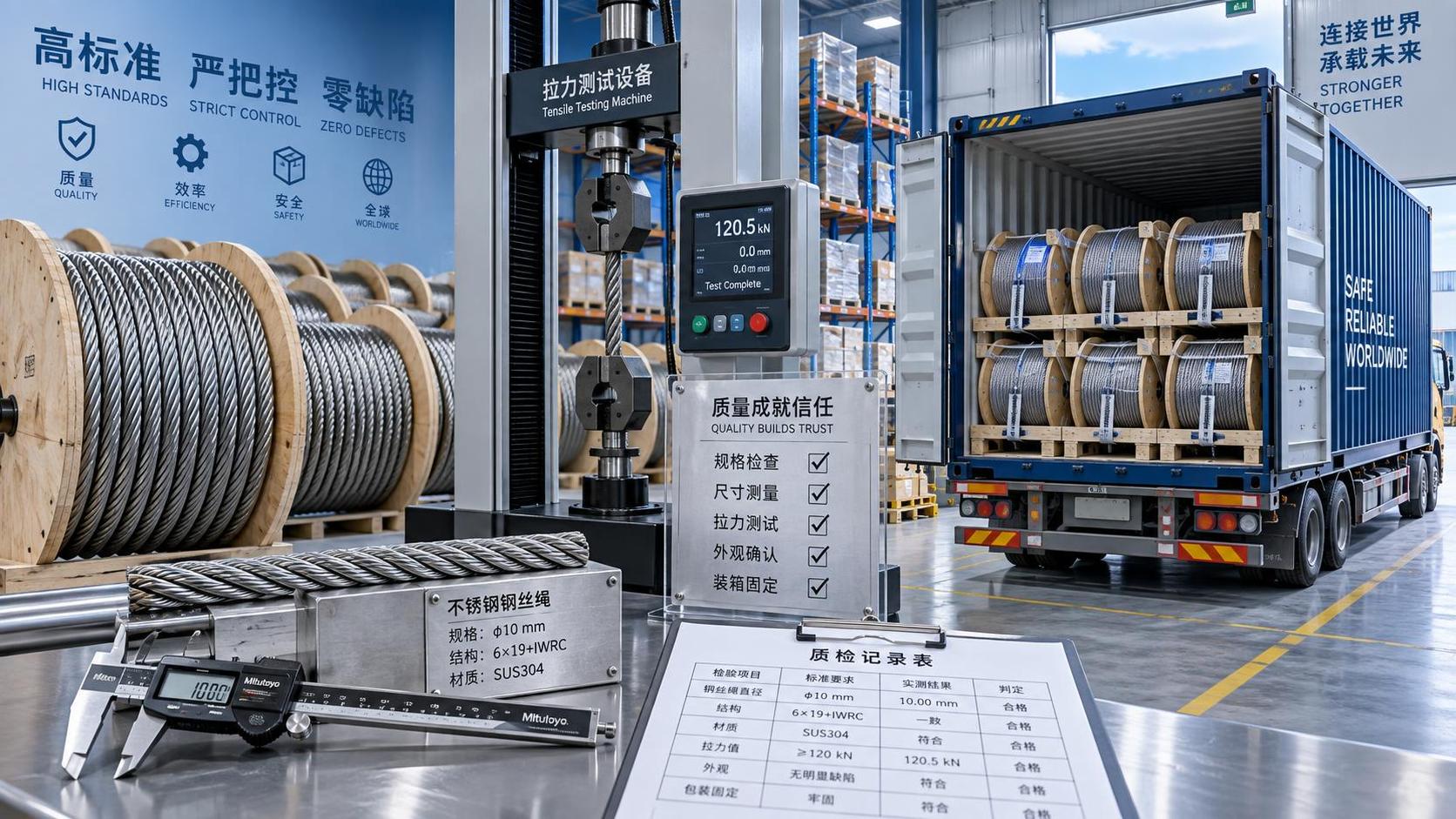
A container order can turn a small specification gap into a costly warehouse problem. The quotation may look competitive, yet the delivered rope can arrive with inconsistent diameter, unclear tensile data, unsuitable reel packing, or a material grade that does not match the operating environment. For a buyer evaluating a wire rope exporter, the practical question is not simply “Can this supplier make wire rope?” It is whether the supplier can repeatedly deliver the agreed construction, material, documentation, packaging, and timing across a full container.
The most reliable assessment starts with evidence rather than sales claims. Before approving a supplier, verify the product specification, traceability process, manufacturing control, inspection capability, export readiness, and response to technical exceptions. Price should be compared only after the offered products are confirmed to be technically equivalent.
Start by locking the purchase specification
“Steel wire rope” is too broad to support a container-level decision. A quotation for the same nominal diameter can conceal major differences in construction, wire grade, coating, core, lay direction, lubrication, breaking force, and reel length. A supplier cannot be fairly assessed if the inquiry itself leaves those points open.
Prepare a specification sheet that identifies the intended use: lifting, restraint, winching, marine control cable, outdoor fixation, mining equipment, or another application. Then state the required details in measurable terms:
- Rope construction, such as 6x19, 6x37, 7x7, or another required configuration
- Nominal diameter and allowable tolerance
- Material and finish: bright, galvanized, stainless steel, or plastic coated
- Core type where relevant, including fiber core or independent wire rope core
- Required minimum breaking force and testing basis
- Lay direction, preforming requirement, lubrication, and cutting or end-treatment needs
- Reel type, rope length per reel, labeling language, and container loading expectations
This step prevents an exporter from quoting a technically lighter version merely because the request was incomplete. It also makes later inspection meaningful. A comparison between two prices is valid only when both suppliers are pricing the same rope, the same reel length, and the same packing method.
Check whether the factory controls the process that affects consistency
For a container order, production consistency matters more than a single acceptable sample. Wire drawing, stranding, rope closing, surface treatment, and packing all affect the finished product. Ask which stages are completed in-house and which are outsourced. Outsourcing is not automatically a problem, but the exporter should be able to explain who controls the inputs, how incoming materials are checked, and how responsibility is managed when a defect is found.
A capable supplier should be prepared to describe its control points from raw wire through finished reels. Useful questions include:
- How are wire rod or steel wire batches identified and separated?
- How is wire diameter checked during drawing?
- How are strand pitch, rope diameter, and lay quality monitored during closing?
- What triggers adjustment when a rope runs outside the agreed tolerance?
- How are reels identified so that finished goods can be traced to a production batch?
- How are mixed sizes or material grades prevented during packing?
The answers should be specific enough to connect to the order. Statements such as “quality is strictly controlled” do not show how a batch can be traced or how a nonconforming reel would be isolated. For a first container, request sample inspection records or a redacted example of a batch record. The purpose is not to audit proprietary methods; it is to determine whether the supplier operates with repeatable controls.
Review test capability, not just a certificate list
Certificates can indicate that a management or product system exists, but they do not replace lot-specific verification. Ask what inspection is performed on the rope you intend to buy and how the results will be reported. Dimensions, visual condition, weight per unit length, zinc coating where applicable, and tensile or breaking-force tests may all be relevant depending on the product and application.
For lifting, rigging, or load-bearing use, confirm the required safety and design standards with the responsible engineering or safety team before placing the order. A general-purpose rope should not be assumed suitable for a critical lifting duty solely because the exporter supplies lifting-related products. The construction, termination method, design factor, inspection regime, and applicable local requirements all need separate confirmation.
Ask the exporter to clarify four points: the sampling method, the test equipment used, the unit of measurement, and whether the report will identify the actual production lot. A test report that cannot be linked to the shipped reels provides limited protection if a later issue arises. If an independent pre-shipment inspection is planned, agree on the inspection criteria before production starts, rather than debating acceptance after the container is packed.
Use the sample stage to test communication and documentation discipline
A sample is useful, but it should test more than the rope itself. Treat the sample request as a smaller version of the purchase process. Does the exporter confirm the construction and material grade in writing? Are the quoted reel length, package weight, and lead time clearly stated? Does the sample label identify diameter, construction, grade, batch, and length in a usable format?
Documentation errors often become larger at container scale. Review a draft commercial invoice and packing list early, especially where customs classification, country-of-origin requirements, markings, or buyer-specific labels matter. The packing list should make it possible to reconcile reel count, net weight, gross weight, dimensions, and total quantity. Vague descriptions such as “wire rope, assorted” may create avoidable issues during receiving or customs clearance.
Also confirm how the supplier handles technical changes. A reliable exporter should not substitute a material grade, reel type, or packaging method without written approval. This is particularly important when a buyer needs stainless steel rather than galvanized rope, or a specific plastic-coated diameter that affects fittings and routing.
Assess the offer through application fit
Material selection is often where apparently low-cost offers become expensive. Galvanized wire rope may suit many general outdoor and industrial duties, but stainless steel is commonly considered where moisture, salt exposure, washdown, or corrosive conditions make surface protection more demanding. Within stainless products, the stated grade still needs to match the environment and the buyer’s engineering requirement; “stainless” alone is not a complete specification.
For example, a buyer sourcing compact rope for outdoor fixation, fence systems, clotheslines, small manual hoists, yacht control cables, or rope-net applications may need to compare strength, flexibility, corrosion resistance, and coating choice rather than focus only on diameter. A 7x7 construction uses seven strands and typically offers moderate flexibility with stronger individual wires than a finer-wire construction such as 7x19. It may be appropriate where strength and controlled bending are important, while tighter-radius or highly flexible routing may call for a different construction.
When reviewing this category, the product details for 7x7 Stainless Steel Wire Rope 0.5-6mm use For clothesline and fence provide a useful example of the questions that should be settled before ordering: stainless grades listed as 201, 304, 316, or 316L; diameters from 0.5 mm to 6 mm; non-coated or plastic-coated options; and reel lengths from 500 m to 3,000 m. These choices affect not only performance but also container planning, handling, and the buyer’s downstream cutting process.
Look beyond quoted lead time
A stated production lead time is meaningful only when the exporter can explain what it includes. Clarify whether the timeline begins after deposit, artwork approval, technical confirmation, or raw-material availability. Ask whether it includes final inspection, packing, booking support, and container loading. For repeat orders, determine whether capacity is reserved or simply estimated at the time of inquiry.
Container planning should also cover the physical shipment. Rope on wooden, iron, plastic reels, or coils can have very different stacking behavior and gross weight. Confirm the preferred reel type, allowable reel dimensions, palletization if needed, moisture protection, and whether reels require securing measures inside the container. Improperly restrained reels can shift in transit, damage flanges, or make receiving more difficult even when the rope itself meets specification.
Compare total landed risk, not the unit price alone
When two offers differ materially in price, identify the exact source of the difference. It may be material grade, actual metallic area, construction, rope weight, reel length, testing scope, packing quality, or commercial terms. Request a side-by-side clarification rather than assuming one supplier has found a more efficient process.
Payment terms should also match the level of verification available. Before authorizing the final balance, ensure that the agreed inspection records, quantity confirmation, packaging photos where appropriate, and shipping documents are available according to the purchase agreement. This is not a substitute for a clear contract; it is a way to make the release process reflect the risks of a container shipment.
A dependable wire rope exporter is usually recognizable through disciplined detail: clear questions before quoting, written confirmation of technical requirements, traceable production information, practical responses to packing concerns, and no reluctance to define what will be inspected. Those habits are more valuable to a container buyer than a fast quotation that leaves the critical conditions unspecified.
Navigation
Send Us A Message



Shandong Faster Technology Co., Ltd. is a professional manufacturer of steel wire ropes.
Get in Touch
*We respect your confidentiality and all information are protected.