





Stainless Steel Wire Rope Purchasing: Verifying Grade, Traceability, and Tests
Stainless Steel Wire Rope Purchasing: Verifying Grade, Traceability, and Tests
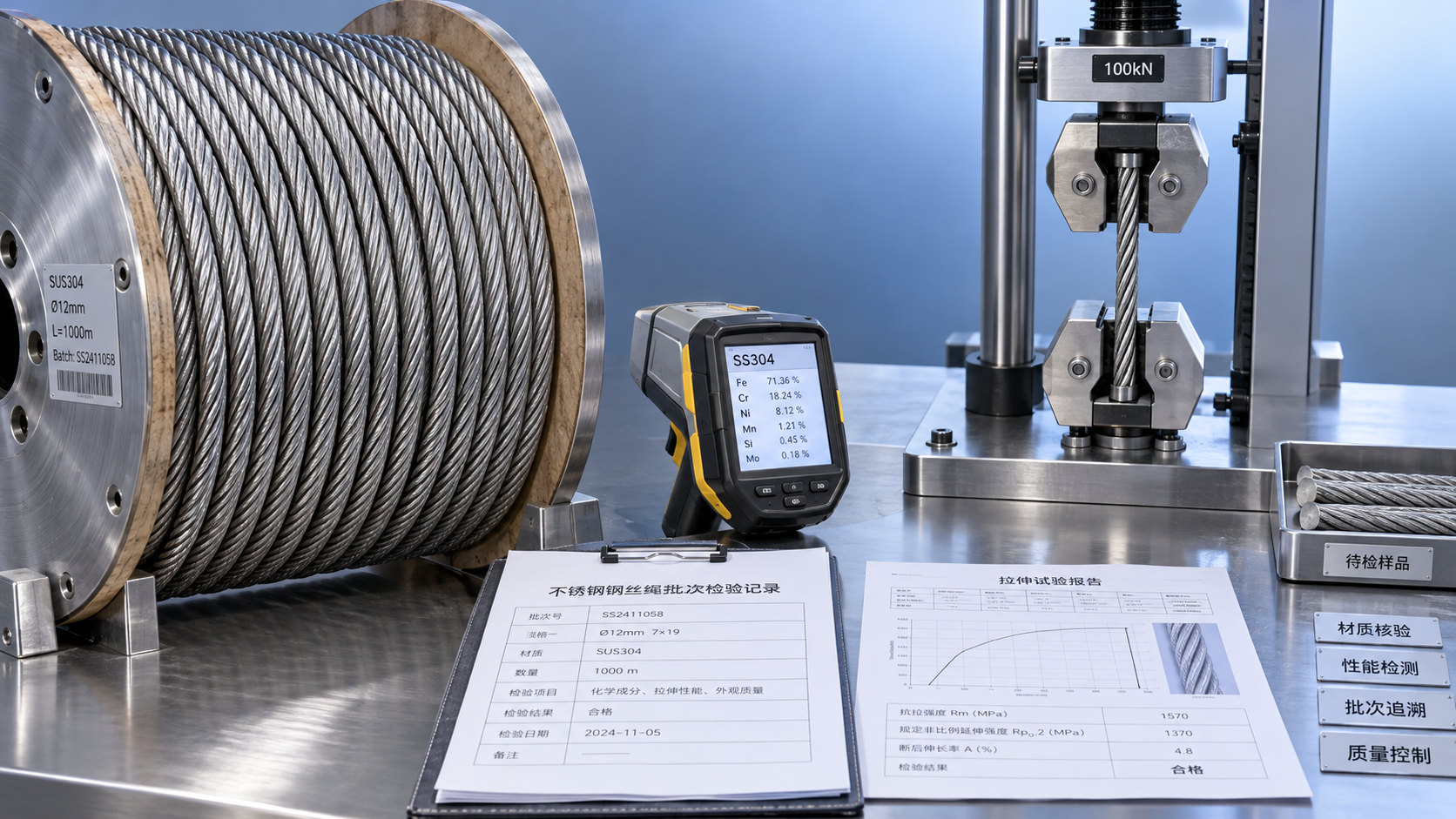
Buying stainless steel wire rope requires more than comparing prices and nominal diameters. An unsuitable material grade, incomplete traceability, or missing test evidence can create corrosion risks, approval delays, and costly replacements. The useful question is not simply “Does the supplier offer stainless rope?” It is “Can the supplier prove that this delivered reel matches the material, construction, and performance we ordered?”
That distinction matters when purchasing for marine equipment, construction restraints, lifting assemblies, or moving machinery. Two ropes with the same outside diameter can differ substantially in flexibility, breaking force, corrosion resistance, and suitability for their terminations. A lower quotation is only meaningful once those differences have been resolved.
Specify the service conditions before choosing the grade
“Stainless steel” is not a complete purchasing specification. Common options include 304 and 316, but the selection should reflect chloride exposure, temperature, cleaning chemicals, drainage, and whether the rope remains wet. Grade 316 contains molybdenum and generally provides better resistance to chloride-related pitting than 304. It is not immune to corrosion, particularly where salt deposits or trapped moisture create crevice conditions.
For a sheltered indoor restraint, 304 may be a reasonable choice after engineering review. For equipment exposed to seawater splash, 316 is often considered, but the exposure may demand additional precautions or a different material solution. Specify the exact grade designation and governing material specification; do not accept “marine grade” as the only description.
Construction deserves equal attention. A 7x7 rope is generally less flexible than a comparable 7x19 rope, which matters when the cable repeatedly bends around pulleys. Neither construction alone establishes suitability for a hoist or elevator. Equipment requirements, sheave geometry, fatigue duty, and termination design still need checking.
Verify chemistry rather than appearance
Ask for material documentation showing the grade, heat identification, and chemical composition. Where an EN 10204 Type 3.1 inspection certificate is required, state that requirement in the purchase order and confirm what material or product the certificate covers. A certificate for incoming wire does not, by itself, prove the finished rope’s breaking performance.
Positive material identification can provide an additional check. Handheld XRF can help distinguish common 304 and 316 alloys through their elemental composition, but it does not reliably establish the low carbon content needed to distinguish grades such as 316 and 316L. Thin wires, surface contamination, and sampling arrangements also affect interpretation. Agree the method and sampling plan rather than requesting a vague “grade test.”
A magnet test is not reliable proof of grade: cold working can make some austenitic stainless steels show magnetic response.
Traceability must reach the reel you receive
A genuine certificate can still be irrelevant to your delivery. The supplier needs a documented link between incoming wire, production records, the finished-rope batch, and individual reels. If several wire heats enter one production batch, the records should preserve those connections instead of implying a single heat origin.
Ask the supplier to demonstrate one complete traceability chain before order approval: material heat identification to wire lot, wire lot to rope production batch, and batch to reel label and test report. This is more revealing than collecting a folder of certificates with no explanation of how they relate.
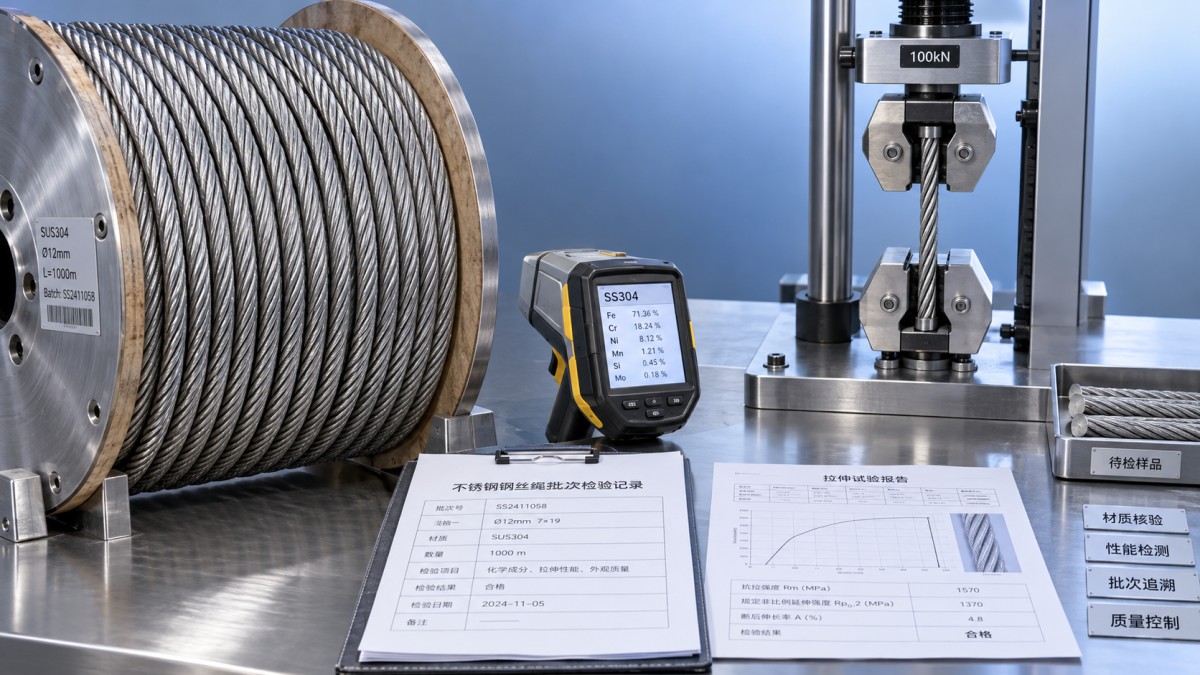
At receipt, check reel identification against the packing list and inspection documents before cutting the rope. When a reel is divided into shorter lengths, transfer its identification to the cut lengths or their controlled records. Otherwise, traceability can disappear inside your own warehouse even when the supplier’s documentation was correct.
Read the breaking-force report, not just the headline number
Separate three concepts: individual wire tensile strength, finished-rope minimum breaking force, and the allowable working load of the installed system. They are not interchangeable. A high wire strength does not automatically establish rope performance, and a rope’s breaking force is not its permitted lifting load.
A useful finished-rope report should let you check:
- The tested batch, specimen identification, rope diameter, and construction.
- The applicable test method and agreed minimum breaking-force requirement.
- The measured result, units, test date, and responsible testing organization.
- The specimen preparation, gripping or termination arrangement, and any reported abnormal failure.
- Whether the result represents your production batch or only an earlier qualification sample.
Agree sampling frequency before production. Testing every reel, testing a defined production lot, and accepting a historical type-test report provide different levels of assurance and carry different costs. For safety-critical work, the project specification should determine the evidence required.
Also review dimensional inspection, lay direction, surface condition, and lubrication where relevant. State the applicable rope standard and edition, such as the relevant part of EN 12385 where appropriate, rather than accepting a generic standards list. An ISO management-system certificate, an SGS report, and a claim of CE conformity answer different questions; none automatically proves that a particular reel meets your purchase specification.
Compare alternatives without confusing galvanized and stainless rope
Not every fence, bundling line, or static fixing needs stainless steel. Where the environment and maintenance plan permit, galvanized carbon-steel rope may offer a more economical option. Its corrosion protection depends on a zinc coating, however, so it is not a direct material substitute for stainless steel wire rope.
For comparison, Shandong Faster’s 7x7 Steel Core Galvanized Steel Wire Rope 1.2-5.0mm use for Bundle and Fence covers diameters from 1.2 to 5.0 mm, with listed reel lengths of 500–3000 m. It belongs in a separate galvanized-rope evaluation, not in a stainless-grade approval. Do not transfer its carbon-steel strength data to a stainless quotation or assume that its listed applications authorize a particular lifting duty.
Make the quotation include the cost of acceptance
Compare quotations on the same basis: material grade, construction, diameter tolerance, minimum breaking force, reel length, terminations, documentation, testing, packaging, and delivery terms. Ask whether independent testing and inspection certificates are included. A cheaper price per metre can lose its advantage if missing evidence causes a shipment to be held or retested.
Shandong Faster Technology Co., Ltd. combines wire drawing, stranding, rope closing, and inspection capabilities, supplying stainless, galvanized, and plastic-coated ropes within its stated 1–20 mm range. It also provides customized pressed slings and chains. That manufacturing scope is useful when buying an assembled solution, but rope and termination requirements should still be documented separately.
Before releasing the order, obtain a sample document package and agree how nonconforming deliveries will be handled. If the supplier cannot connect the grade certificate, production batch, reel identity, and test result clearly, resolve that gap before dispatch—not after the rope has been installed.
Navigation
Send Us A Message



Shandong Faster Technology Co., Ltd. is a professional manufacturer of steel wire ropes.
Get in Touch
*We respect your confidentiality and all information are protected.