





How wire rope strand construction affects fatigue life in sheaves
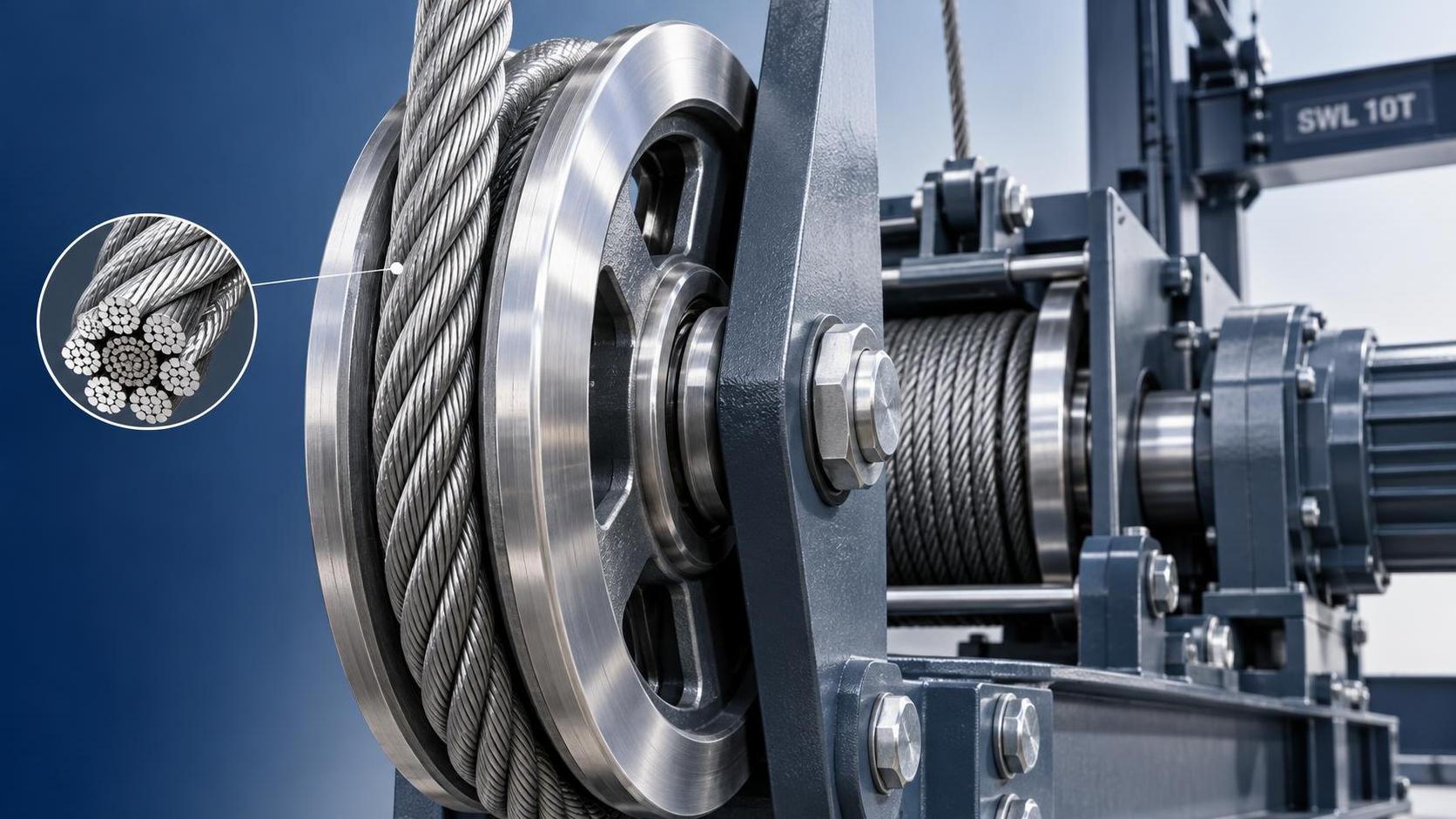
When a rope repeatedly bends over a sheave, fatigue life is governed less by its nominal breaking strength than by how its individual wires and strands accommodate that bending. A wire rope strand construction with more, finer wires is generally more flexible and better suited to repeated bending. A construction with fewer, larger outer wires is usually more resistant to abrasion and crushing, but may fatigue sooner when the sheave diameter is small or the duty cycle is high.
This distinction matters because broken wires caused by bending fatigue often develop gradually in localized areas near sheave contact zones. The rope may still appear serviceable when viewed from a distance, yet its remaining safety margin can decline quickly once fatigue cracks begin to propagate.
Why strand construction changes bending fatigue behavior
A wire rope is not a solid steel bar. It is a system of individual wires twisted into strands, then closed around a core. Each time the rope passes over a sheave, the wires must move slightly relative to one another while the rope changes curvature. The smaller the sheave relative to rope diameter, the more severe that bending action becomes.
Fine wires can tolerate repeated bending better because each wire experiences less strain for the same rope curvature. This is why flexible constructions containing more wires per strand are commonly considered when a rope runs continuously over sheaves, drums, or traction systems. The trade-off is that fine outer wires can be more vulnerable to abrasion, corrosion damage, and mechanical surface wear.
Coarser-wire constructions are often more durable where the dominant problem is external wear: contact with rough surfaces, abrasive dust, cross-winding, or pressure in a drum groove. Their larger wires have greater material at the surface, but their reduced flexibility makes them less forgiving in repeated bend-over-sheave service.
Strand count alone is not the selection rule
A common purchasing error is to assume that a higher wire count automatically means a longer rope life. It improves bending flexibility, but fatigue life in sheaves depends on the complete operating system. A flexible rope on an undersized, worn, or misaligned sheave can still fail early. Likewise, a wear-resistant rope may perform well in a low-cycle application even if it is not the most flexible construction available.
The sheave diameter-to-rope diameter relationship is especially important. As the rope bends around a tighter radius, cyclic stress rises in the individual wires. Quality teams should evaluate the rope construction together with the sheave geometry specified for the equipment, rather than approving a rope solely by diameter, strength grade, or visual similarity to the previous installation.
Groove condition also changes the result. A groove that is too narrow pinches the rope and increases contact pressure. One that is too wide reduces support and can encourage flattening, instability, and uneven loading across strands. Sharp groove edges, embedded particles, poor alignment, and damaged bearings can turn an apparent fatigue issue into a combined fatigue-and-abrasion failure.
Lay pattern and internal movement
Lay direction and lay length influence how strands contact the sheave and how wires move under load. A longer lay generally improves flexibility and can help a rope conform around sheaves, but it may be less resistant to crushing or external damage in some applications. A shorter lay tends to provide a firmer structure and may be preferred where the rope is exposed to abrasion, squeezing, or demanding drum conditions.
The correct choice depends on which damage mechanism controls replacement intervals. For a crane hoist with frequent cycling over sheaves, bending fatigue may be the primary concern. For a drag, winch, or installation exposed to abrasive handling, surface wear and deformation may be more important. Treating all lifting ropes as interchangeable because they share the same nominal diameter creates an avoidable inspection and safety risk.
The core affects fatigue indirectly
The core does not carry the same role as the outer strands, but it supports rope geometry and affects internal lubrication. A fiber core can retain lubricant and provide elastic cushioning between strands. That can be useful in applications where repeated bending is important and where the rope is not subject to excessive crushing pressure.
For example, a 6x19+FC Galvanized Steel Wire Rope 3-16mm Fiber Core Lifting Steel Cable uses six strands with 19 wires per strand around a fiber core. This type of construction is a practical middle ground where moderate flexibility, outer-wire wear resistance, and lubricant retention are all relevant. It can fit general lifting and handling duties in construction, ports, logistics, mining, and shipping, provided the sheave arrangement, loading pattern, and environmental exposure match the rope’s intended use.
It should not be treated as a universal answer for high-cycle reeving systems. Where reverse bends are frequent, sheaves are compact, or the rope is subject to intense multi-layer drum pressure, the construction and core type should be selected specifically for those conditions.
What to inspect when fatigue is suspected
Fatigue breaks usually appear as broken wires concentrated in a relatively short rope length, often near repeated contact points with sheaves. They may occur without the deep scoring or flattened surface associated with severe abrasion. Inspection should therefore go beyond counting visible broken wires across the rope generally.
- Identify whether wire breaks are concentrated at recurring sheave contact zones.
- Check both crown and valley areas of the strands; early fatigue damage may not be visible from one viewing angle.
- Inspect sheave grooves for incorrect profile, sharp edges, corrosion, packed debris, and localized wear.
- Verify sheave alignment and free rotation. A seized or misaligned sheave forces abnormal rubbing and bending.
- Review duty changes, including increased lifts, higher line speed, shock loading, or a revised reeving path.
- Assess lubrication condition. Dry ropes experience higher internal friction as strands and wires move during bending.
Broken-wire patterns should be treated as diagnostic evidence, not merely a discard-count issue. Replacing the rope without correcting a damaged groove or alignment problem can produce the same failure pattern on the replacement rope.
Selection should start with the duty cycle and sheave system
Before approving a rope specification, establish whether the service is primarily high-cycle bending, abrasive contact, crushing on drums, corrosion exposure, or a combination of these. Then compare strand construction, core type, surface finish, rope diameter, and strength designation against the equipment arrangement.
For corrosion-prone port or marine work, galvanizing may protect against environmental attack, but it does not remove the need for correct sheave geometry and lubrication. For high-frequency lifting, selecting a construction solely for corrosion resistance or tensile strength can miss the mechanism that actually limits service life.
Reliable rope performance comes from matching the wire rope strand design to the bending path, then maintaining the sheaves as part of the same system. That approach gives inspection teams a clearer basis for identifying premature fatigue, approving replacements, and preventing repeated failures.
Navigation
Send Us A Message



Shandong Faster Technology Co., Ltd. is a professional manufacturer of steel wire ropes.
Get in Touch
*We respect your confidentiality and all information are protected.