





How to assess traceability at a wire rope mill
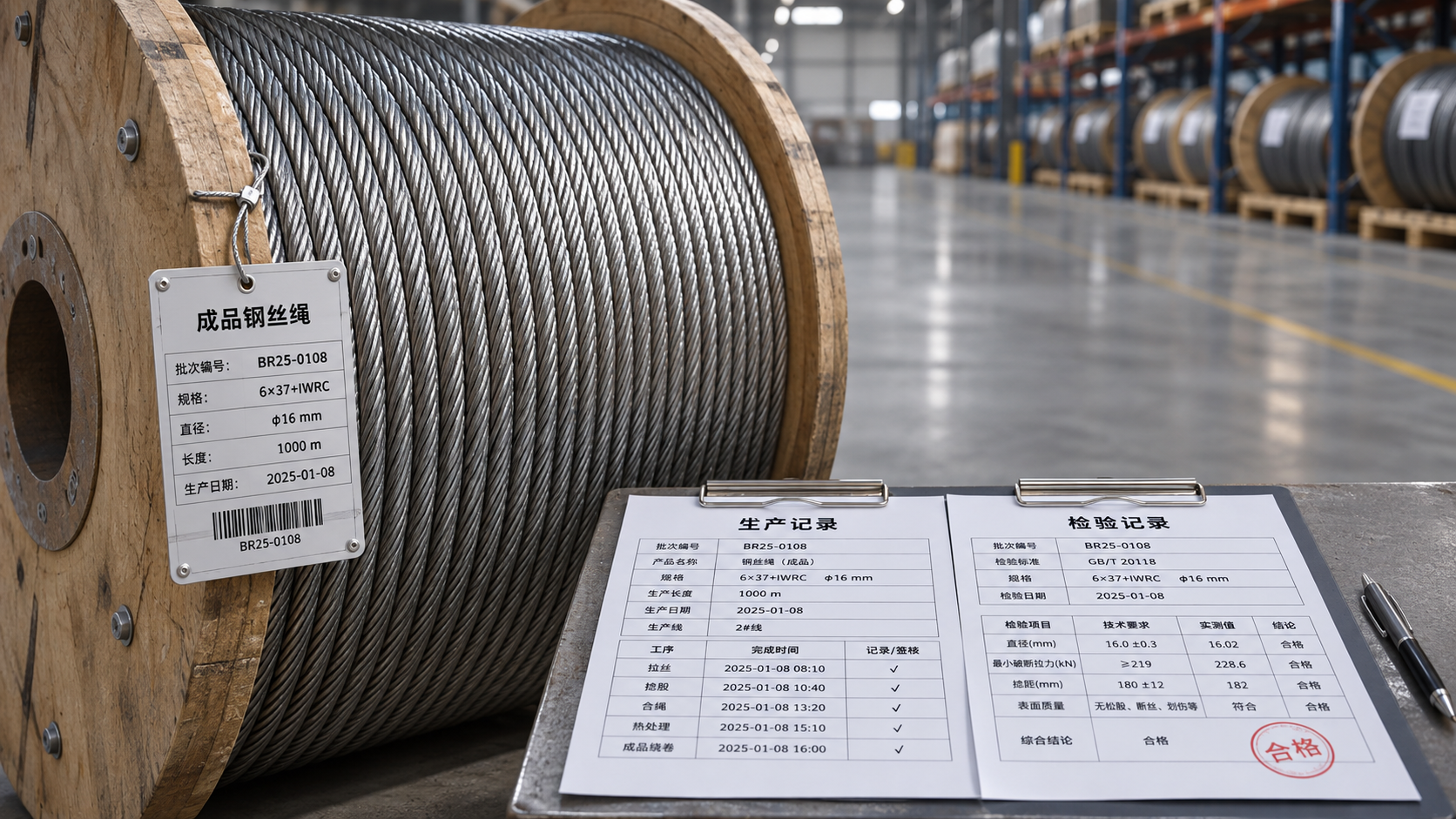
A traceability system is only useful if a finished reel can be linked to the materials, manufacturing records and inspection results that apply to it. When assessing a professional wire rope mill, ask for a live demonstration using an actual reel number. A well-organized certificate pack is helpful, but it does not prove that the mill can identify every affected shipment when a defect is discovered.
For purchasing decisions, the question is not simply whether a supplier has records. It is whether those records are specific enough, accessible enough and retained long enough to support acceptance checks, incident investigations and decisions about potentially affected stock.
Start with a reel and follow the evidence backward
Select a finished reel from the warehouse or a recent shipment. Ask the mill to use its reel identification to retrieve the associated production order, rope specification, inspection results and relevant material records. Compare each document with the physical label and purchase order as the records are presented.
The trail should identify the rope construction, nominal diameter, length, finish and other ordered characteristics. It should also connect the reel to the wire and core materials used in production. Depending on how the mill organizes production, that connection may pass through several identifiers, such as a production lot, closing run, strand batch and incoming material lot. Different numbering systems are acceptable if the links between them are clear.
A certificate that matches the product description but cannot be tied to the selected reel is weaker evidence than a record linked to its actual production history. Likewise, a reel label that identifies only the customer or order may not distinguish one production batch from another.
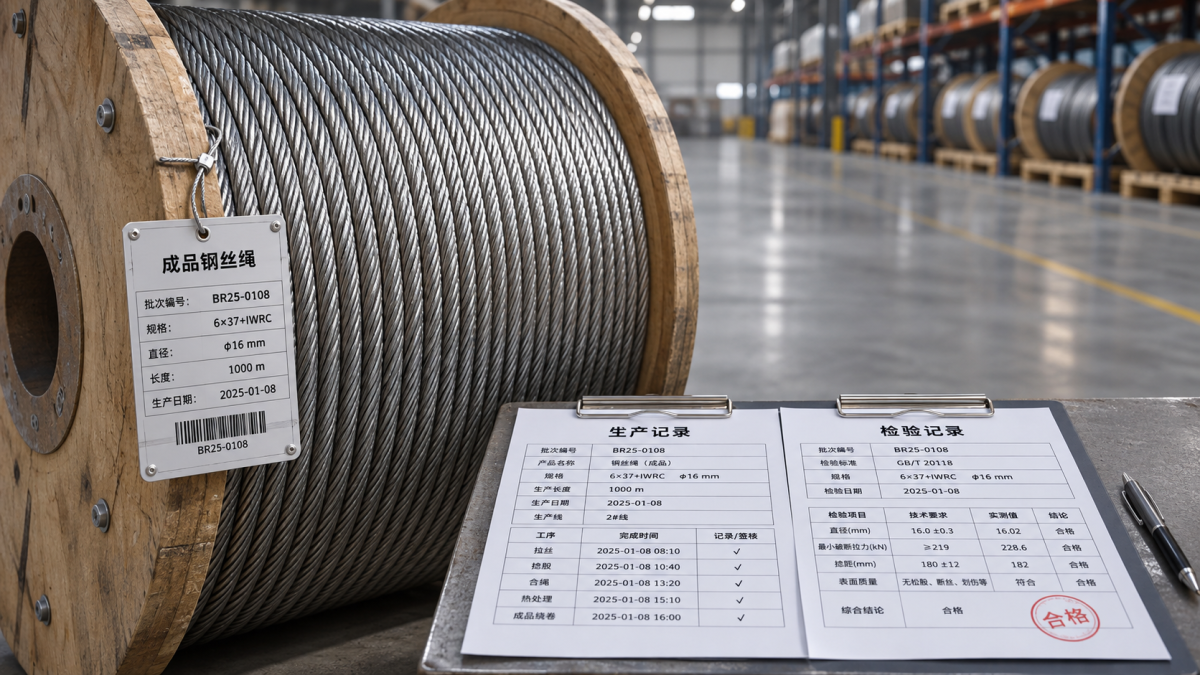
Pay particular attention to handovers. During drawing, stranding, rope closing, testing and reeling, material may be transferred between machines or combined with material from other lots. Ask how operators record those changes and how identification is maintained when a reel is divided, relabeled or repacked. These transitions are where an apparently complete paper trail can lose its connection to the physical product.
Then test the trail in the other direction
Backward traceability helps identify what went into a reel. Forward traceability shows where material went after production. Choose a wire lot or a production batch from the first exercise and ask the mill to identify the finished reels and shipments associated with it.
The response should make the scope of the search clear. If several raw-material lots were used in a production run, the records should show how the mill determines which reels could be affected. Where it cannot separate them reliably, all potentially affected reels may need to be treated as part of the investigation. That wider scope can mean more stock on hold and a larger interruption to operations.
Ask who can perform this search, how quickly the information can be retrieved and what happens outside normal working hours. A digital system can make searches faster, but handwritten records can also support traceability if they are legible, controlled and retrievable. The test is the result, not the software used.
Check what the records actually prove
Traceability links evidence to a product; it does not establish conformity by itself. Review the underlying records against the purchase specification and the inspection requirements agreed for the order.
- Incoming material: Look for the supplier and lot identification, material certificates where specified, and records linking received wire and core material to production.
- Manufacturing: Check the production order and records that identify the relevant drawing, stranding and rope-closing lots or runs. Where a process parameter is specified or controlled, ask how the applicable record is linked to the reel.
- Inspection and testing: Look for the measured characteristics, test results, acceptance criteria and disposition. Establish whether a result applies to the selected reel, a sample from its production lot or a broader group.
- Release and dispatch: Check that the released quantity, reel identifiers, labels and shipment documents agree. Ask how the mill prevents material awaiting inspection or rejected material from being shipped.
Test reports require particular care. A breaking-force result for a sample can support acceptance of the lot represented by that sample, but it is not a separate test of every reel. The sampling arrangement and acceptance criteria should be agreed before production, especially for lifting applications. The required minimum breaking force must come from the applicable rope specification and size, not from the tensile strength grade alone.
Review exceptions as well as successful results. Ask to see how a nonconforming result is recorded, who has authority to decide its disposition and how a retest or correction is linked to the original record. An overwritten result or an unexplained replacement certificate makes an investigation harder.
Apply the same checks to the rope being purchased
The level of detail needed depends on the application and the purchasing specification. For a galvanized fiber-core rope, the buyer may need records that distinguish the specified coating route, rope construction, core and tensile grade, in addition to diameter and length. A generic description such as “galvanized steel cable” leaves too much room for substitution.
For example, Shandong Faster lists the 6x19+FC Galvanized Steel Wire Rope 3-16mm Fiber Core Lifting Steel Cable in diameters from 3 to 16 mm. For an order, specify the required diameter, construction, finish, tensile grade, length and applicable minimum breaking force, then ask what records will accompany each reel. The product listing alone does not establish that a particular rope is suitable for a lifting system; equipment requirements, operating conditions and applicable selection criteria still determine suitability.
If the rope is supplied as part of a fabricated sling, extend the traceability check beyond the rope mill. The finished sling may involve separate cutting, pressing, fittings, identification and inspection steps. Establish which organization holds each record and how the finished sling identifier connects to its components. A traceable rope does not automatically make the assembled sling traceable.
Put the traceability requirements into the quotation
Suppliers may offer different levels of documentation and identification under otherwise similar quotations. Ask each bidder to state what is included before comparing prices. Useful purchasing terms include:
- The identification required on each reel and the documents that must reference it.
- The material certificates, inspection records and test reports to be supplied with the shipment, and those available on request.
- The production-lot definition, sampling basis and handling of mixed material lots.
- Record retention period, retrieval contact and expected response time for an investigation.
- Rules for subcontracted processing, relabeling, partial reels and notification of nonconforming material.
- Any separate charges for additional testing, documentation or customer-specific identification.
A lower quote can still be the right choice when the supplied evidence matches the application and purchasing requirements. It becomes less attractive when essential records, additional testing or individual reel identification must be added later. Compare the complete order cost, including the effort needed to receive, store and retrieve the documentation.
Use the demonstration to make the decision
Before approval, agree on a practical traceability exercise: select a reel, follow it back to its material and production records, then trace one of those lots forward to affected reels or shipments. Record any missing links and ask how they will be addressed before the first delivery.
Give particular weight to unresolved gaps at reeling, subcontracting and shipment. If the mill can only narrow a concern to a large production period, decide whether the resulting quarantine and replacement exposure is acceptable for the intended use. The strongest purchasing decision combines an appropriate rope specification, verifiable records and a response process that can be used when a problem occurs.
Navigation
Send Us A Message



Shandong Faster Technology Co., Ltd. is a professional manufacturer of steel wire ropes.
Get in Touch
*We respect your confidentiality and all information are protected.