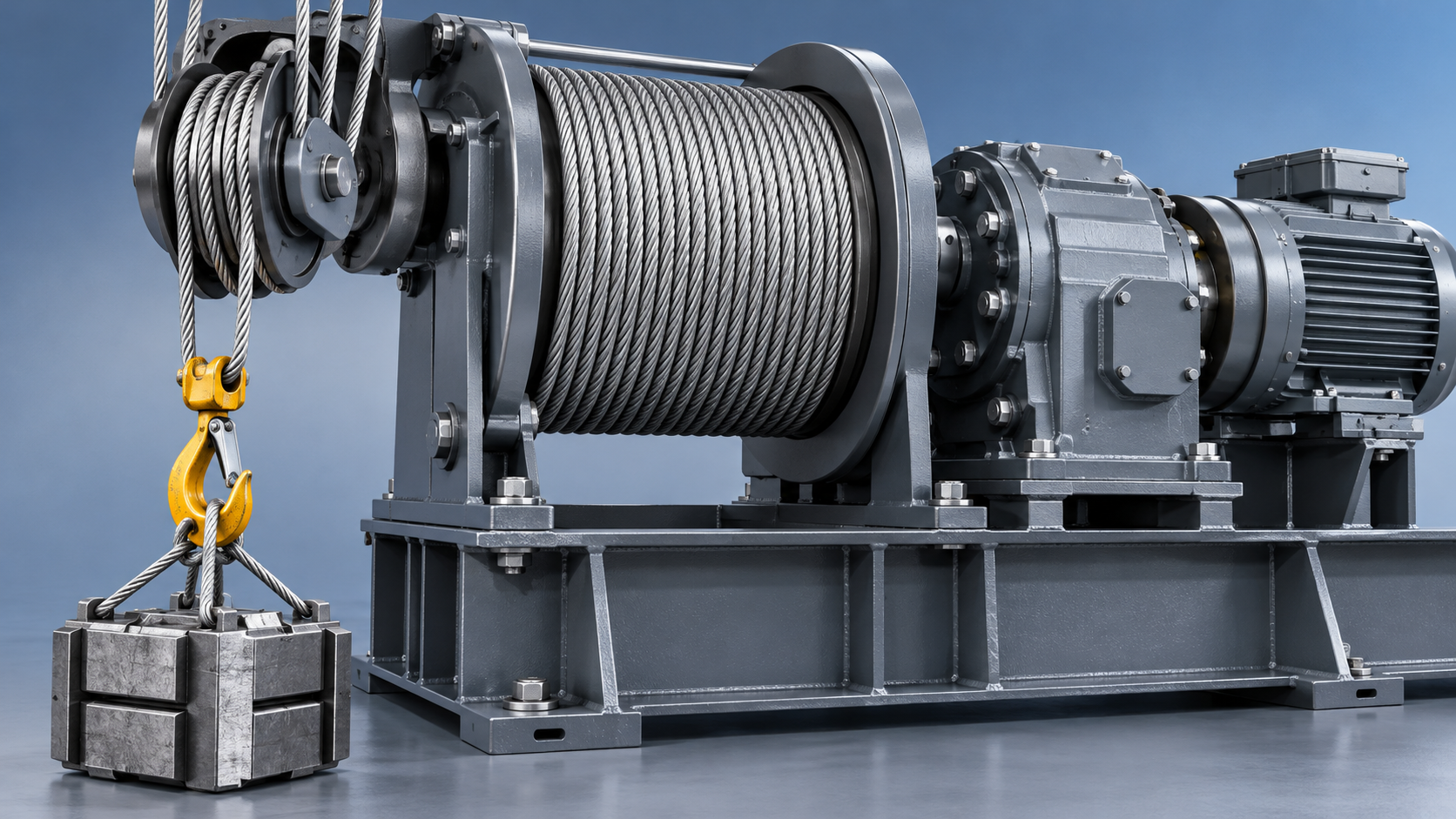
Knowing how to choose wire rope for a hoist starts with its approved rope specification. Diameter and breaking strength alone cannot establish suitability for lifting.
Technical evaluators must consider the required design factor, sheave and drum geometry, duty cycle, and operating environment to balance strength, fatigue resistance, and corrosion protection.
An unsuitable rope can accelerate wear, disrupt operations, and compromise lifting safety, even when its nominal strength appears adequate on a supplier’s product data sheet.
This guide explains how these selection factors interact, helping you compare rope constructions, core types, and materials against hoist manufacturer specifications and applicable equipment standards.
What Rope Strength Does Your Hoist Actually Require?
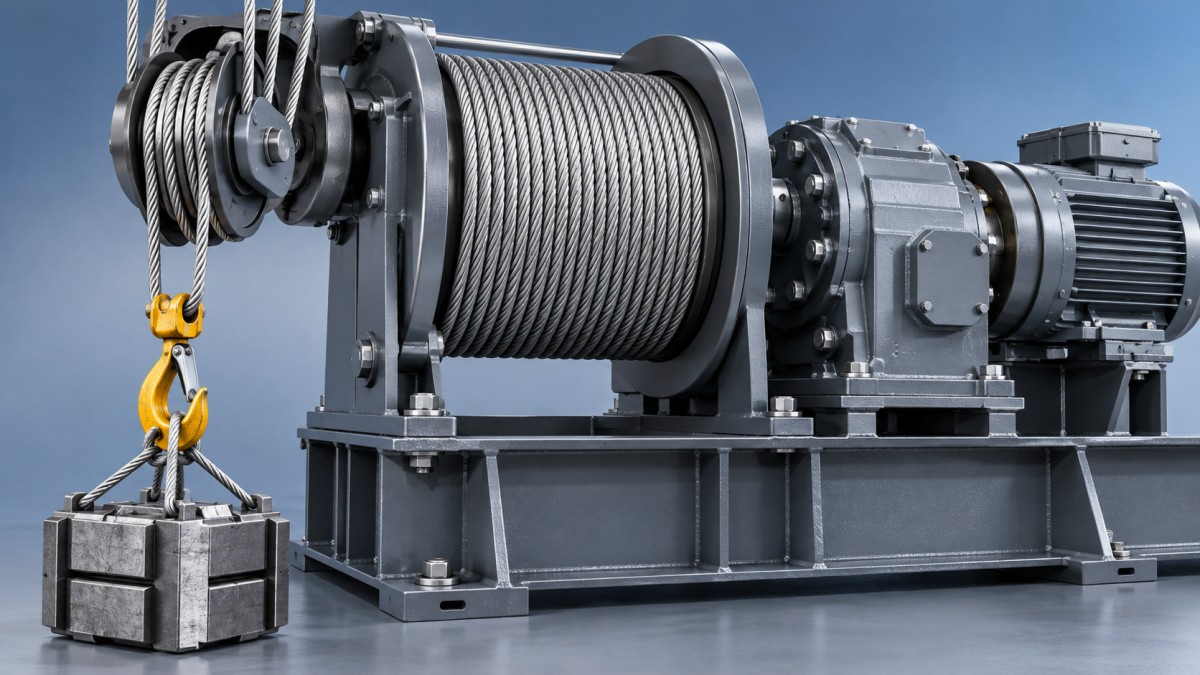
Start with the hoist manual, approved rope designation, rated capacity, reeving arrangement, and applicable lifting requirements. Treat these as the boundaries for evaluating replacement options.
The load at the hook differs from tension in an individual rope part. Include the hook block, lifting attachments, and other suspended equipment when calculating.
Multiple supporting rope parts reduce nominal line tension, but sheave friction prevents perfectly equal load sharing. Acceleration and other operating effects also require appropriate allowances.
Use the manufacturer’s calculation method or an engineering assessment to establish maximum design rope tension. Dividing payload by the number of supporting parts is insufficient.
As a basic screening relationship, required minimum breaking force equals maximum design rope tension multiplied by the applicable design factor. Follow the governing calculation conventions.
For example, a 20 kN design rope tension and a specified factor of five imply 100 kN minimum breaking force before any additional required adjustments.
This illustrates the calculation, not a universal design factor. Equipment type, service conditions, and governing requirements determine the factor and treatment of termination efficiency.
Minimum breaking force is not working load limit. Increasing rope strength also does not authorize increasing the hoist’s rated capacity or changing its approved reeving.
Will the Rope Fit the Sheaves and Drum Correctly?
Confirm nominal diameter and permitted diameter tolerances before comparing strength grades. A stronger rope with an unsuitable diameter can create damaging contact with existing grooves.
Inspect sheave grooves for wear, correct profile, alignment, and free rotation. Narrow grooves pinch the rope; excessively wide grooves provide inadequate support under operating loads.
Check the specified D/d ratio, where D is the defined sheave or drum diameter and d is nominal rope diameter. Follow the manufacturer’s measurement convention.
Smaller D/d ratios generally increase bending severity and shorten fatigue life. A flexible construction cannot compensate for geometry outside the approved limits of the equipment.
Review drum groove pitch, fleet angle, anchorage, required dead wraps, and available rope capacity. Multilayer spooling also introduces crossover contact, crushing, and repeated local abrasion.
Match the specified lay type and direction where required. These influence spooling behavior and must be considered alongside drum design, reeving, and rope installation procedures.
Which Construction Matches the Dominant Failure Mechanism?
Choose construction by identifying whether bending fatigue, abrasion, crushing, or load rotation dominates service. These mechanisms demand different properties and often create competing selection priorities.
Ropes with more, smaller wires generally offer greater flexibility and bending fatigue resistance. Constructions with larger outer wires often provide better resistance to abrasive wear.
An independent wire rope core, or IWRC, generally provides greater strength and resistance to crushing than a fiber core, although actual performance depends on construction.
Long lift heights, certain reeving arrangements, and freely suspended loads may require rotation resistant rope. Ordinary six strand rope should not be assumed suitable automatically.
Rotation resistant constructions have specific handling, installation, and inspection requirements. Swivel use must follow rope and hoist manufacturer instructions because it can affect rope stability.
When Is a Galvanized 6x37 IWRC Rope Worth Evaluating?
For compatible lifting equipment requiring flexibility and corrosion protection, a galvanized 6x37 IWRC construction can be a candidate, subject to verified strength and geometry requirements.
Shandong Faster’s 6x37 Galvanized Steel Wire Rope 10-22mm used for lifting machinery is listed with an IWRC option for technical evaluation against the hoist’s approved specification.
Its published diameter range is 10–22 mm, with reel lengths of 500–3,000 m. Confirm the exact construction, finish, required cut length, and availability before ordering.
The 6x37 designation alone does not establish every construction detail. Request the strand arrangement, core designation, lay, rope grade, diameter tolerance, and guaranteed minimum breaking force.
The supplied product tables contain differing breaking force and weight figures across standard headings, including repeated values for different grades. Obtain clarification before making calculations.
Request a corrected specification for the exact rope offered, supported by traceable inspection documentation. Marketing descriptions of flexibility or compression resistance cannot establish hoist compatibility.
How Should Duty Cycle Change Your Selection?
Two hoists carrying identical loads can impose very different rope demands. Record operating hours, lifts per hour, travel length, load spectrum, and acceleration patterns carefully.
Count significant bending events along the rope path, including reverse bends. Frequent operation over several sheaves can make fatigue resistance more important than additional nominal strength.
For multilayer drums, inspect crossover zones and locations repeatedly passing through heavily loaded contact points. Local damage may govern replacement before the remaining rope deteriorates.
Use previous inspection records to identify recurring failure patterns. Broken wires, flattened strands, corrosion, and diameter reduction help distinguish operating problems from unsuitable rope selection.
Compare purchase cost with expected service life, inspection effort, and replacement downtime. Any life expectancy estimate should reflect comparable equipment and conditions rather than general claims.
Which Finish and Lubricant Suit the Operating Environment?
Describe actual exposure: indoor humidity, outdoor rain, salt spray, chemical contact, dust, immersion, or elevated temperature. Each can change the appropriate material and maintenance requirements.
Galvanizing provides corrosion protection, but it does not eliminate internal corrosion or lubrication needs. Verify the offered coating process and compatibility with the intended service.
Stainless steel may suit selected corrosive environments, but substitution requires checking strength, fatigue behavior, and equipment approval. Material choice must follow the complete operating specification.
Plastic coatings can alter effective diameter, groove contact, and inspection access. Use coated rope only where the hoist manufacturer explicitly permits that construction and coating.
Select lubricant for temperature, water exposure, penetration, and compatibility with existing lubrication. In dusty environments, unsuitable surface lubrication can retain abrasive particles and accelerate wear.
What Must Be Verified Before Purchase and Installation?
Create a purchase specification stating diameter, construction, core, lay, finish, rope grade, minimum breaking force, length, lubrication, termination details, and the applicable standard and edition.
Request traceability and relevant inspection or test documentation for the supplied rope. Verify what each certificate covers; a general certificate does not establish suitability for your hoist.
Confirm installation procedures, handling requirements, and manufacturer specified initial operation checks. Inspect sheaves and drums before fitting new rope, since worn components can damage it quickly.
Establish inspection intervals and discard criteria using applicable requirements and manufacturer instructions. Where relevant, ISO 4309 addresses crane rope care, inspection, and discard criteria.
The best choice satisfies strength, geometry, fatigue, rotation, and environmental requirements together. Approve a rope only when its documented specification matches the hoist’s intended operating conditions.