





How End Fittings Change the Performance of a 4 Leg Wire Rope Sling Carbon Steel
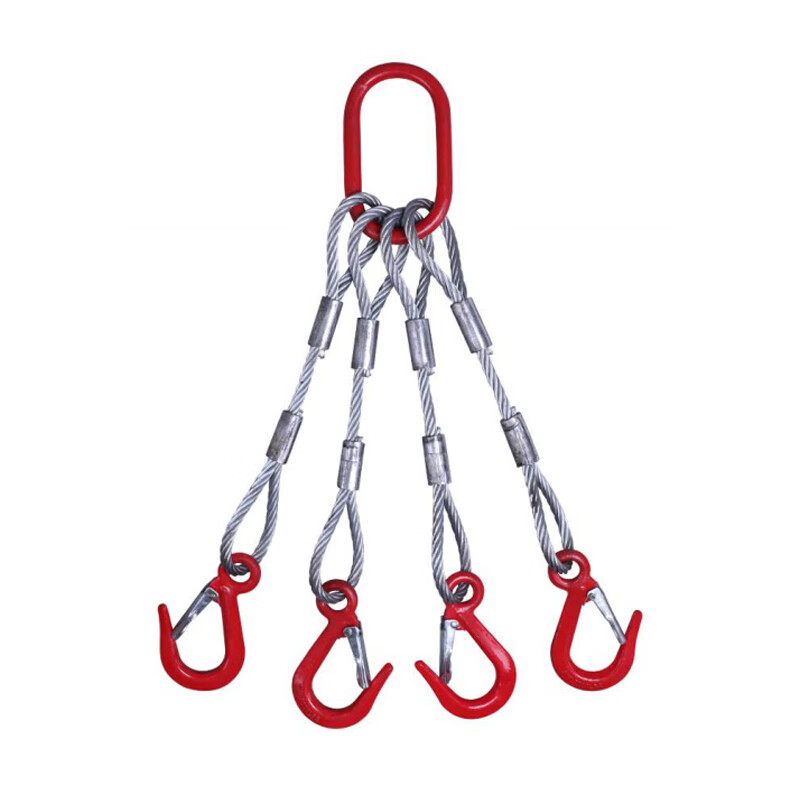
How End Fittings Change the Performance of a 4 Leg Wire Rope Sling Carbon Steel
For technical evaluators, the performance of a 4 Leg Wire Rope Sling Carbon Steel assembly is rarely determined by rope diameter alone. In practice, the end fittings often decide how efficiently the load is transferred, how evenly the four legs share force, and how quickly wear appears at the connection points. A well-chosen rope can still underperform if the master link, hooks, thimbles, ferrules, or sockets do not match the actual lifting geometry.
This matters even more in industries such as ports, mining, shipbuilding, construction, and heavy equipment handling, where multi-leg slings face side loading, angle variation, repeated shock, and abrasive contact. In those conditions, end fittings are not accessories. They are structural parts of the sling system.
Why the fitting changes the sling, not just the connection
A four-leg sling works as a system. Each leg may be made from carbon steel wire rope with suitable construction and tensile grade, but the actual working behavior depends on how the leg terminates and interfaces with the load and top assembly. End fittings influence at least four things at once: load path, bending radius, rotation tendency, and local stress concentration.
Take a simple example. A soft eye can offer flexibility and compact handling, but if it bears directly against a small pin or a sharp connection edge, the rope sees tighter bending and higher local compression. Add a thimble, and the eye keeps a more stable form, usually reducing distortion and surface wear. The same rope, same diameter, and same rated concept can behave very differently over time.
The top end is just as important. The master link and sub-link arrangement affects leg articulation. If the components are undersized for the actual angle range, the sling may not seat properly, which can create unequal loading between legs. Technical reviews should therefore look beyond nominal working load and inspect how each fitting moves under real rigging conditions.
Common end fitting choices and their practical effect
In a 4 Leg Wire Rope Sling Carbon Steel configuration, the most common terminations include soft eyes, thimble eyes, ferrule-secured eyes, spliced eyes, and socketed ends. Each has its place, but the choice should come from the lifting task rather than habit.
Soft eyes are often selected where flexibility and lighter handling matter. They can be useful for smaller assemblies, irregular shapes, or jobs where the sling has to be passed through narrow points. A compact example is 8mm galvanized steel wire rope Sling soft eye 3tons Eye to Eye for Rigging & Hoisting, which shows why soft-eye designs remain relevant for rigging and bundling work: they are portable, adaptable, and easy to pair with different end hardware. But that same flexibility is not always ideal for heavier or more repetitive duty if the contact surface is poor.
Thimble eyes usually improve shape retention at the eye and provide a clearer bearing surface. For repeated lifting cycles or interfaces with shackles and hooks, this often helps reduce premature deformation. Ferrule-secured slings, whether aluminum-alloy or steel ferrule types, can provide consistent manufactured terminations, but evaluators still need to check the ferrule process quality, dimensional compatibility, and inspection traceability.
Socketed ends are more likely to appear where higher loads, more rigid terminations, or specific engineering control are required. They can perform very well, but they are less forgiving of mismatch in alignment. If the lift involves frequent angular change, a more articulated connection may prove more durable in service.
Load distribution problems often start at the fittings
In theory, four legs suggest four-way support. In reality, load sharing is often uneven, and many rigging standards treat multi-leg slings conservatively for exactly this reason. The end fittings contribute directly to that imbalance. If one hook seats earlier, one leg has less freedom to align, or one eye is forced into a tighter angle than the others, the assembly may shift load toward two legs long before operators notice.
This is where fitting geometry matters more than catalog language. Hook throat size, latch design, link diameter, eye dimensions, and the bearing radius at connection points all influence whether the sling settles naturally or fights its own configuration. When technical teams evaluate a 4-leg assembly, they should review the complete connection stack, not just the wire rope specification.
Material and environment still shape fitting decisions
Carbon steel wire rope slings are widely used because they balance strength, availability, and cost. But the end fitting selection should still reflect the environment. Corrosive marine exposure, wet port handling, dusty mining sites, and outdoor construction lifts all affect wear mechanisms. Galvanized rope may be preferred in some cases for corrosion resistance, while bright or stainless variants can be more suitable in others depending on the service conditions and compatibility requirements.
A manufacturer with full-process control is in a better position to support these decisions. Shandong Faster Technology Co., Ltd. produces steel wire rope, slings, and chains with automated wire drawing, twisting, and rope-closing lines, alongside inspection equipment that supports control from raw material to finished product. That matters because end fitting performance is only reliable when rope quality, termination method, and final inspection are managed as one process. With annual wire rope output above 70,000 tons and supply capability across 1-20mm diameters in galvanized, stainless steel, and plastic coated series, the company can support both standardized and customized sling builds for different industrial conditions.
What technical evaluators should verify before approval
A useful review is usually less about asking for the “strongest” fitting and more about checking whether the fitting matches the lift. In most projects, the following points deserve attention:
- Whether the end fitting preserves an acceptable bending radius for the rope
- Whether the connection allows natural alignment without side loading
- Whether eye, hook, link, and shackle dimensions are compatible in practice, not only on paper
- Whether the termination method can be inspected clearly during service life
- Whether environmental exposure calls for galvanized, stainless, or other protective choices
- Whether the sling will be used in repeated cycles, shock loading, or abrasive contact
This is also why one-stop supply can help, especially when a project includes rope, sling, and chain elements in the same lifting path. Shandong Faster’s integrated “rope-sling-chain” capability, including chain grades such as G30, G43, G70, G80, and G100, is relevant here not as a sales point but as an engineering advantage: fewer mismatched interfaces, clearer responsibility for compatibility, and more practical customization when the application is not standard.
Even on lighter-duty assemblies, the principle is the same. A product such as the 8mm galvanized steel wire rope Sling soft eye 3tons Eye to Eye for Rigging & Hoisting may suit narrow-space handling, manual bundling, small equipment lifting, or general rigging because it combines portability with flexibility. But if the task changes to frequent heavy lifting with abrasive hardware contact, a thimble or another termination style may be the more defensible technical choice.
A better evaluation question
When reviewing a 4 Leg Wire Rope Sling Carbon Steel design, the better question is not “Which fitting is best?” It is “Which fitting keeps the rope working as intended in this exact lifting system?” The answer usually depends on load angle, connection hardware, inspection method, environment, and expected duty cycle.
If those inputs are still unclear, approval should wait until the termination type, hardware interface, and applicable standards are checked together. That extra step often prevents the most expensive mistake in lifting equipment: selecting a good rope and then weakening it at the ends.
Navigation
Send Us A Message



Shandong Faster Technology Co., Ltd. is a professional manufacturer of steel wire ropes.
Get in Touch
*We respect your confidentiality and all information are protected.