





Galvanized Rope vs Stainless Steel Rope for Coastal Outdoor Installations
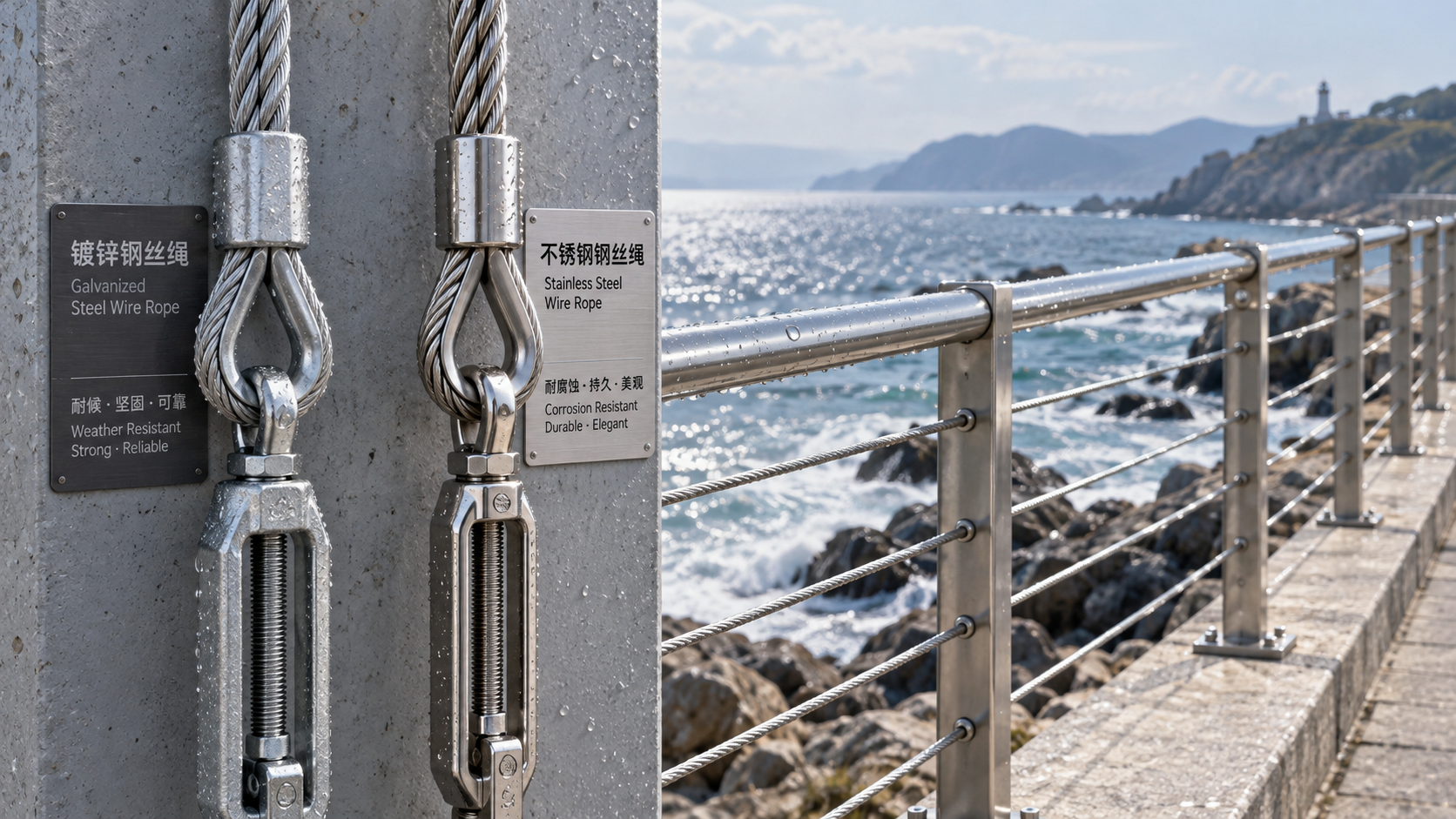
Galvanized Rope vs Stainless Steel Rope for Coastal Outdoor Installations
Salt spray, persistent humidity, and demanding loads make coastal wire rope selection more complicated than choosing a corrosion-resistant material. Galvanized rope provides economical zinc protection; stainless steel rope can offer better resistance to marine exposure, depending on its alloy grade and installation details. Neither choice removes the need to check rope construction, minimum breaking force, terminations, and maintenance access.
A useful starting question is not simply “How close is the installation to the sea?” It is “Where will salt collect, and can someone inspect and clean those locations?” An exposed cable washed by rain may face different conditions from a sheltered cable beneath a balcony, where chloride deposits remain undisturbed.
Judge the exposure before comparing materials
Coastal exposure varies considerably. Airborne salt, direct sea spray, intermittent immersion, and continuously wet crevices should not be treated as one environment. Sheltered fittings, cable crossings, and sleeves deserve particular attention because they can retain moisture and concentrate salts as water evaporates.
Galvanized rope relies on a zinc coating that provides barrier and sacrificial protection to the underlying steel. That protection is finite. Abrasion at sheaves, movement inside fittings, and aggressive salt exposure can consume or damage the coating. Once protection is depleted locally, steel corrosion can progress even while other sections still look acceptable.
Stainless steel relies on a passive surface film rather than a sacrificial zinc layer. Grade 316 contains molybdenum, which improves resistance to chloride-related pitting compared with 304. For exposed coastal architectural cables, 316 is generally the stronger starting candidate. It is not immune to pitting or crevice corrosion, especially where salty water remains trapped.
Grade 304 may remain viable in milder exposure with effective cleaning and drainage, but choosing it solely because the rope is labeled “stainless” is a weak specification. Persistent wetting or direct marine exposure requires a more detailed materials assessment; even 316 should not be assumed suitable without review.
Corrosion resistance does not establish load capacity
A same-diameter substitution is not necessarily a like-for-like replacement. Galvanized carbon-steel rope and stainless steel rope can have different minimum breaking forces because wire strength, construction, and manufacturing specifications differ. Compare documented values for the exact products, not generic material descriptions.
For lifting equipment, the evaluation must also cover bending fatigue, core type, lubrication, sheave geometry, and the equipment manufacturer's requirements. A rope suitable for a static balcony installation is not automatically suitable for repeated travel over pulleys. Likewise, a corrosion-resistant rope is not automatically an approved lifting rope.
Construction changes behavior. A 7x7 rope provides a useful balance of flexibility and stiffness for many small cable assemblies; a comparable 7x19 construction is generally more flexible. However, neither designation alone establishes fatigue life or working load. The allowable load must account for the applicable design factor, termination efficiency, and service conditions.
For structural tension systems, check stretch and pretension as well as strength. Wind-induced movement, vibration, and excessive installation tension can turn an apparently static cable into a fatigue-sensitive component.
The termination can become the weak point
Coastal rope assemblies often deserve their closest inspection at sleeves, anchors, thimbles, and tensioners. These locations combine concentrated load, restricted drainage, and surfaces that are difficult to see. Specifying stainless rope while leaving fitting materials undefined only solves part of the problem.
Dissimilar metals in electrical contact can create galvanic corrosion risks when saltwater supplies the electrolyte. Severity depends on the metals, exposed surface areas, and local conditions. Aluminum sleeves or tracks used with stainless cable therefore require assembly-specific compatibility checks rather than blanket approval or rejection.
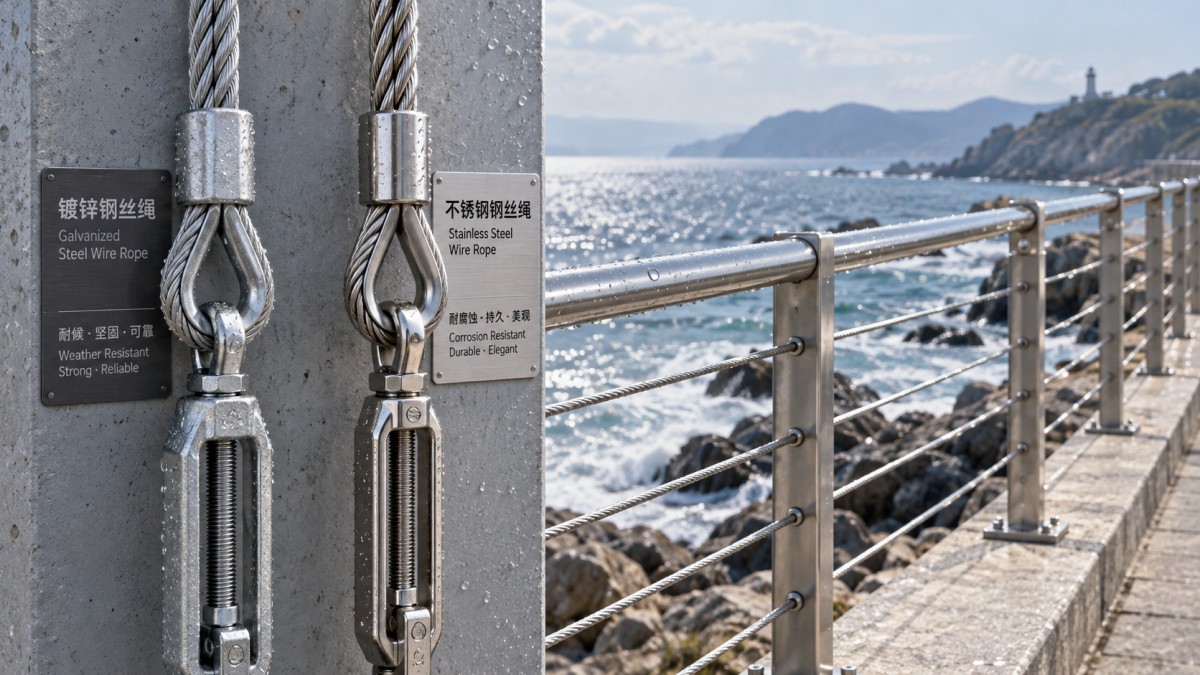
Specify drainage and avoid details that trap water around rope ends. Where swaging is used, confirm that the sleeve, tooling, and pressing procedure are suitable for the rope. Plastic coatings should not be assumed to carry clamping loads: the termination supplier must define whether coating removal is required and how the exposed transition is protected.
A coated balcony cable needs a system-level review
For coastal balconies and window openings, 7x7 Nylon coated stainless steel 304 316 wire rope use for Invisible Grille illustrates a different selection problem from industrial lifting. Available options include 304 or 316 stainless steel with PA6 nylon coating and listed diameters of 1.5, 2.0, 2.5, and 3.0 mm. Confirm whether the specified diameter refers to the steel rope or the finished coated cable.
The slim, matte-coated cable can preserve sightlines, while the coating can reduce surface abrasion. It does not make the assembly maintenance-free. Request evidence of coating suitability for outdoor UV exposure and inspect damaged areas where moisture could enter. Fall-protection performance depends on cable spacing, anchors, tracks, pretension, and the supporting structure—not rope strength alone. Any emergency opening must also satisfy the project's applicable safety requirements.
When does galvanized rope remain the sensible choice?
Galvanized rope can be practical where exposure is manageable, inspection is straightforward, and replacement is planned. An accessible industrial installation with established lubrication and inspection routines presents a different decision from a high-level architectural cable that needs specialist access whenever it requires attention.
In the latter situation, stainless steel's higher initial price may be easier to justify. Access equipment, shutdowns, replacement fittings, and labor can outweigh the rope purchase price. Still, there is no defensible universal lifespan multiplier for stainless versus galvanized rope: exposure and assembly details vary too much.
Neither option should be inspected only for visible rust. Check broken wires, deformation, wear, fitting movement, and corrosion at concealed interfaces. Establish inspection intervals and discard criteria from the equipment requirements and applicable standards. Coated rope needs additional attention because the jacket can obscure the underlying wire condition.
Make the enquiry specific enough to compare offers
Shandong Faster Technology Co., Ltd. manufactures galvanized, stainless steel, and plastic-coated ropes across a stated 1–20 mm diameter range, alongside customized pressed slings and chain products. Its wire drawing, twisting, rope closing, and inspection capabilities are relevant to sourcing a coordinated assembly. They do not replace application-specific verification.
A useful technical enquiry should identify:
- Salt exposure, wetting conditions, cleaning access, and intended service.
- Construction, core, steel diameter, coating dimensions, and minimum breaking force.
- Operating loads, movement, pretension, and required design factor.
- Termination materials, assembly procedure, and documented assembly capacity.
- Inspection access, traceability documents, and replacement criteria.
Choose galvanized rope when its protection and maintenance demands fit the installation. Favor an appropriately specified stainless grade when chloride exposure or difficult access makes corrosion resistance more valuable. Before approving either, resolve the least visible details: the wet crevice inside a fitting, the actual steel diameter beneath a coating, and the verified capacity of the finished assembly.
Navigation
Send Us A Message



Shandong Faster Technology Co., Ltd. is a professional manufacturer of steel wire ropes.
Get in Touch
*We respect your confidentiality and all information are protected.