





6x12 FC Wire Rope: Understanding Fiber Content and Breaking-Force Ratings
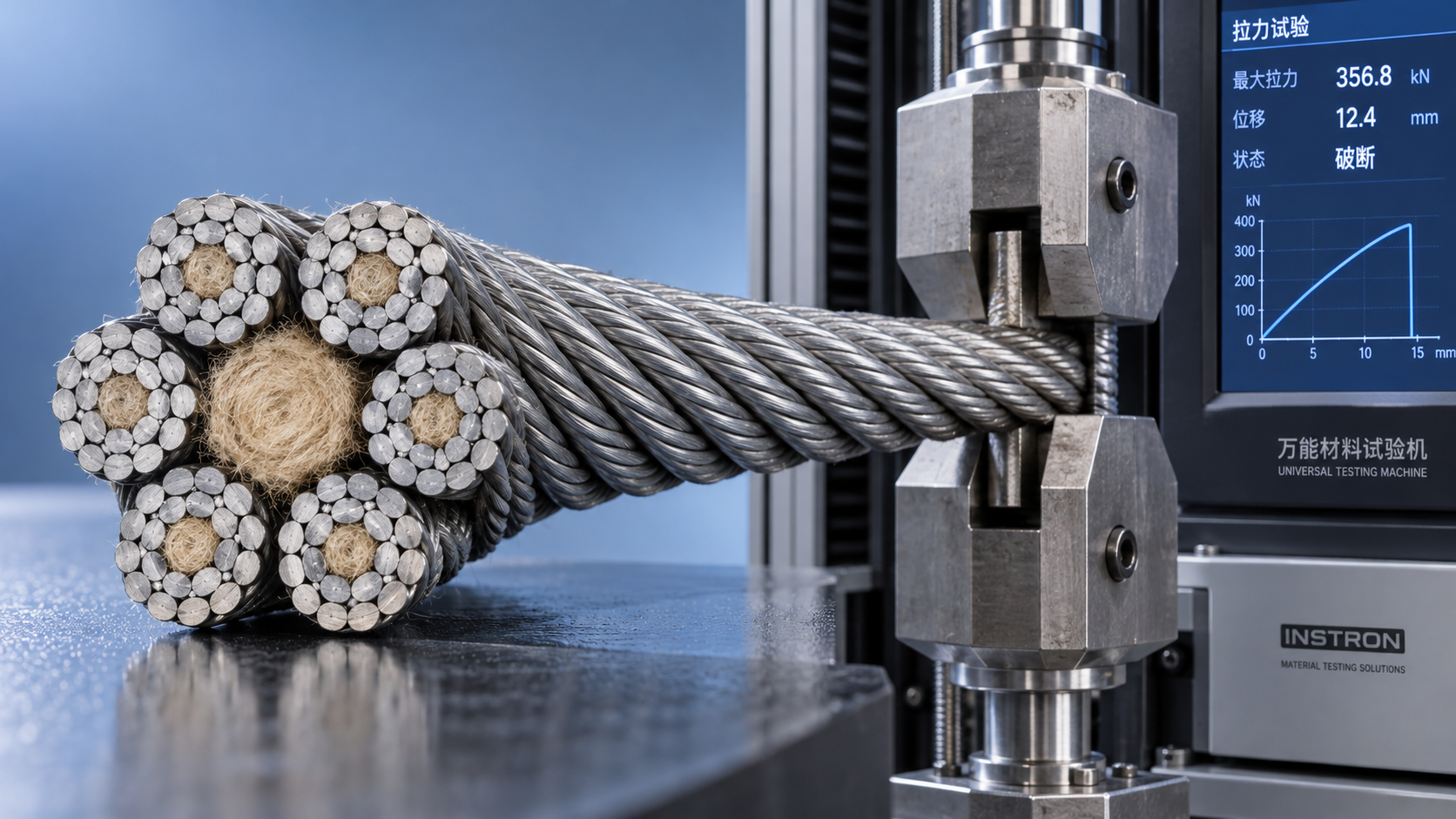
A 6x12 FC wire rope cannot be evaluated reliably from its diameter and a single breaking-force figure. The designation describes a construction, but it does not fully establish the amount of fiber, the steel cross-section, or suitability for lifting. Two ropes sold under similar descriptions may have different internal arrangements and strength ratings.
For technical evaluation, the first decision is whether the documented construction suits the operating conditions. The second is whether the stated breaking force belongs to that exact rope and can support the required working-load calculation. Fiber can improve flexibility and retain lubricant, but it also affects strand support, dimensional stability, and resistance to crushing.
What “6x12 FC” reveals—and what it leaves open
The designation 6x12 describes six strands with twelve steel wires per strand; FC identifies a fiber core. The important qualification is that a short commercial designation may not describe every fiber element inside the rope.
Some 6x12 constructions have a fiber center within each strand as well as a central rope core. These may be described more explicitly as 6x12 + 7FC, indicating seven fiber cores in total. A drawing or detailed construction specification is therefore more useful than assuming that “FC” refers only to one central core.
This distinction directly affects strength comparisons. Fiber occupies space within the nominal rope diameter without providing the load-bearing contribution of steel wire. Counting the steel wires alone does not establish the metallic cross-sectional area: wire diameters, strand geometry, and the spaces occupied by fiber also matter.
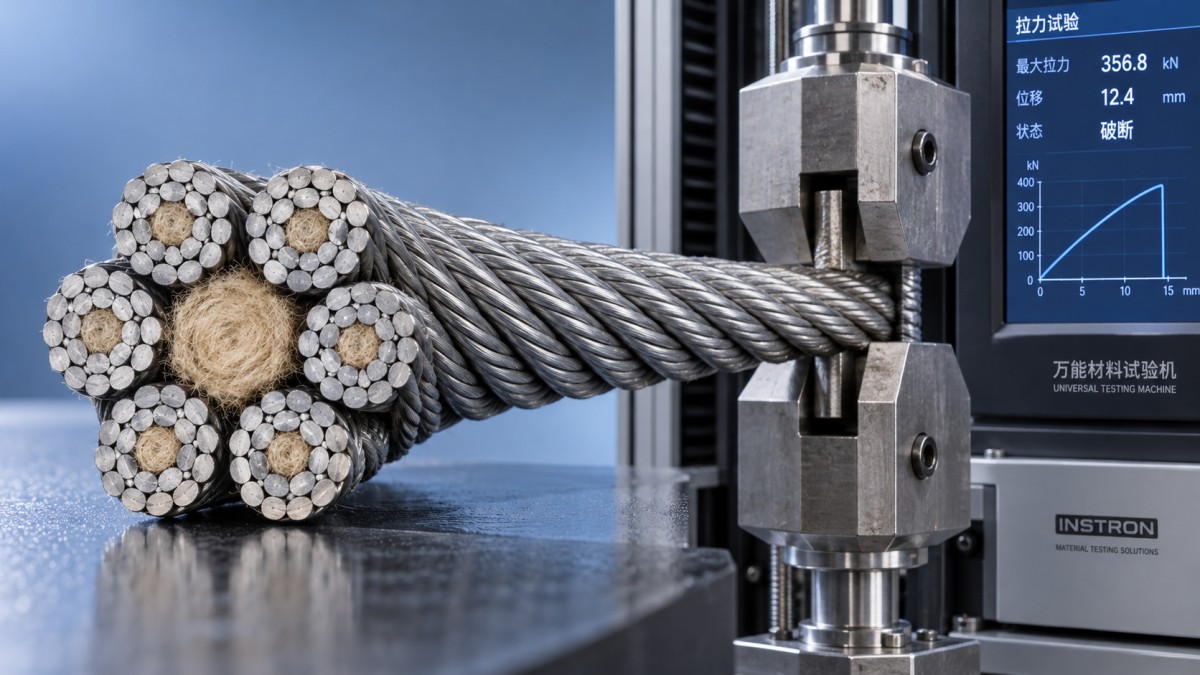
A cross-sectional drawing should show the central rope core, any fiber centers inside the strands, and the arrangement of steel wires. It should also match the construction identified on the inspection certificate. If the drawing and certificate use different designations, resolve that discrepancy before comparing breaking-force values.
“Fiber content” needs a defined measurement
Fiber content can mean the number and location of fiber cores, their material, or a measured proportion by mass or volume. These descriptions are not interchangeable. A percentage without a measurement basis gives little useful information for engineering assessment.
For most selection decisions, the core arrangement and material are more useful than an isolated percentage. Natural and synthetic fibers differ in moisture behavior, temperature tolerance, and compatibility with lubricants. The specification should identify the core material and any relevant operating limits.
If fiber percentage is a contractual requirement, define how it is determined and whether lubricant is included in the measured mass. Otherwise, two reported values may describe different measurement methods rather than different rope constructions.
How fiber affects performance in service
A fiber core supports the surrounding strands and can retain lubricant within the rope. Its compressibility allows the internal geometry to adjust under bending and loading. These properties can help handling, but flexibility alone does not establish suitability for repeated bending over sheaves.
Bending performance also depends on wire size, strand arrangement, sheave diameter, groove profile, load, and lubrication. A rope that feels easy to bend by hand may still be unsuitable for a demanding running-rope application. The equipment specification and rope manufacturer’s application limits should govern that decision.
Crushing resistance deserves particular attention. Compared with a comparable steel-core construction, a fiber-core rope generally provides less rigid internal support. High contact pressure, tight grooves, or multilayer drum winding can distort the rope and displace strands. An adequate breaking-force rating does not remove these risks.
Core condition also affects dimensional stability. Compression and settling can contribute to initial extension and diameter changes under load. Where rope length controls positioning or clearance, distinguish this constructional extension from the elastic extension of the steel wires.
Lubricant retention should not be treated as permanent protection. Water exposure, unsuitable chemicals, heat, or inadequate relubrication can compromise the core and internal lubrication. Galvanizing protects steel surfaces under appropriate conditions, but it does not establish that the fiber is suitable for wet service or that internal corrosion cannot occur.
Reading a breaking-force rating correctly
Minimum breaking force is a specified strength requirement for the rope. It is not the allowable working load. A measured breaking force is the result obtained from a particular destructive test. Keeping these values separate prevents a favorable test result from being used as an unsupported operating limit.
A useful strength document identifies the rope construction, nominal diameter, rope grade, finish, applicable specification, and minimum breaking force. Where testing is reported, it should also identify the sample or production lot and the test method.
The following distinctions help when comparing quotations and certificates:
- Wire tensile strength: a stress value for the wire, expressed in units such as N/mm². It is not the force required to break the finished rope.
- Rope grade: a designation used within the applicable rope specification. It must be interpreted with that specification’s definitions.
- Minimum breaking force: the specified lower strength requirement for the finished rope, usually expressed in kN.
- Measured breaking force: the result from a tested sample, assessed against the specified requirement.
- Working load limit: the permitted load for the defined rope application or assembly, incorporating the applicable design requirements.
A high wire-strength figure cannot compensate automatically for a smaller steel cross-section. Nor should a breaking-force table for a different construction or core type be applied simply because the nominal diameters match.
When a calculation is useful
Some rope specifications express minimum breaking force through a relationship of the form Fmin = K × d² × R / 1000, where Fmin is in kN, d is nominal diameter in mm, R is the applicable rope grade in N/mm², and K is a factor associated with the specified construction.
This relationship is useful only when the governing specification defines the inputs and provides an applicable factor. An assumed K can produce a plausible-looking answer that has no valid basis for the rope being purchased. For an unfamiliar 6x12 construction, request the relevant specification provision or the manufacturer’s documented basis for the rating.
ISO 3108 addresses determination of measured breaking force through tensile testing. ISO 2408 specifies requirements for steel wire ropes within its scope. A reference to either standard should identify its edition and relevance to the supplied construction; a standard number alone does not establish that a particular catalog rating is supported.
From rope strength to a usable assembly rating
For a simple tensile application, dividing minimum breaking force by the applicable design factor is a starting point. The final permissible load may also depend on termination efficiency, bending conditions, dynamic effects, and equipment requirements. The design factor must come from the governing application rules, rather than an arbitrary ratio selected from a catalog.
A sling requires a further assessment. Its rating depends on the completed assembly: rope, ferrules or sockets, eyes, thimbles, hooks, master link, and the permitted loading configuration. Rope breaking force alone cannot establish sling capacity.
For example, the Double Leg Swaged Wire Rope Sling with Safety Hook Galvanized High-Strength offers constructions including 6x19, 6x24, 6x37, 19x7, and 7x19, with steel-core or fiber-core options. These alternatives illustrate why an assembly specification must identify its actual rope construction. Their ratings should not be transferred to 6x12 FC rope.
Two-leg loading adds another variable. In an ideal symmetrical arrangement, leg tension increases as the legs spread farther from vertical. Unequal load distribution can further increase the load on one leg. The assembly’s documented working load and angle limits therefore take precedence over an estimate based on twice a single rope’s capacity.
What should be settled before technical acceptance?
A useful acceptance package connects three things: the physical construction, its strength requirement, and the intended duty. It should establish:
- The complete rope designation and cross-section, including fiber cores within individual strands.
- The core material, wire finish, diameter tolerance, and applicable rope grade.
- The minimum breaking force and its specification or calculation basis, with traceable test documentation where required.
- The operating limits relevant to bending, crushing, temperature, moisture, and lubrication.
- The termination details and assembly rating when the rope forms part of a sling or other finished component.
If a supplier can quote diameter and tensile grade but cannot connect them to the exact construction and minimum breaking force, the specification remains incomplete. Once those details are established, the evaluator can assess the rope against the actual duty: a strength requirement, a bending condition, or a crushing exposure. That is the point at which “6x12 FC” becomes a usable engineering specification.
Navigation
Send Us A Message



Shandong Faster Technology Co., Ltd. is a professional manufacturer of steel wire ropes.
Get in Touch
*We respect your confidentiality and all information are protected.