





5mm Galvanized Wire for Fabrication: Specifying Tensile Strength and Coating
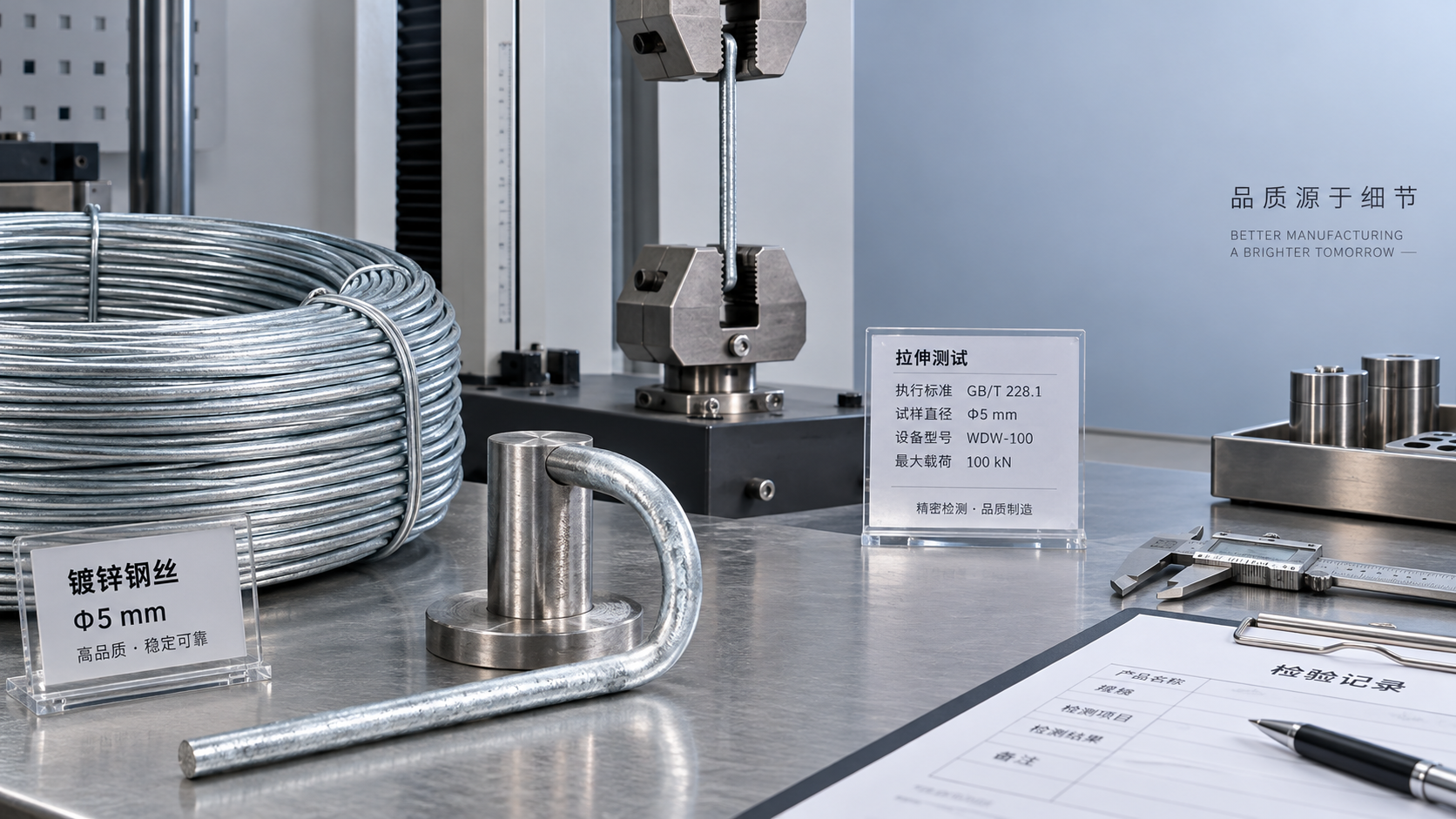
5mm Galvanized Wire for Fabrication: Specifying Tensile Strength and Coating
Specifying galvanized wire 5mm for fabrication requires more than confirming diameter. Tensile strength, ductility, and zinc coating characteristics influence forming performance, corrosion resistance, and service life. The challenge is matching these properties to the application without selecting wire that resists forming or lacks protection for its operating environment. A useful specification connects material properties to the finished component, then defines how those properties will be verified.
Start by establishing whether the requirement is for solid steel wire or steel wire rope. A 5mm solid wire and a 5mm stranded rope are not interchangeable: their metallic cross-sections, flexibility, terminations, and load behavior differ. Diameter alone does not establish suitability for a formed bracket, protective frame, restraint, or lifting assembly.
Specify strength around the fabrication process
There is no universal tensile-strength requirement for 5mm galvanized steel wire. A component with tight bends needs a different balance of strength and ductility from a straight tension member. Steel chemistry, drawing reduction, heat treatment, and the galvanizing sequence can all affect the delivered condition.
For formed parts, specify an agreed tensile-strength range rather than only a minimum. A minimum-only requirement may admit substantially stronger wire that needs greater forming force and produces more springback. Higher tensile strength does not mean higher elastic stiffness; the practical difference often lies in yielding, permanent deformation, and forming behavior.
Pair the strength range with evidence of ductility. Depending on the application, this could include elongation measured with a stated gauge length, a bend test, or a wrapping test. The method matters: results obtained with different specimen conditions or test geometries may not be directly comparable.
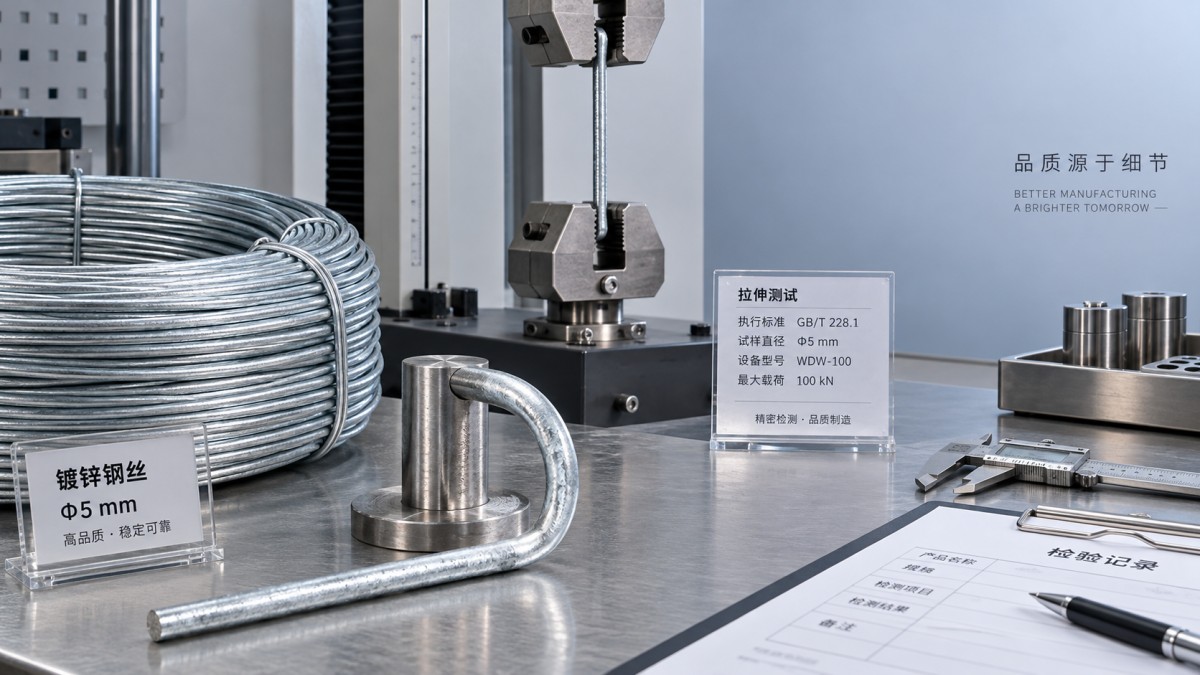
A fabrication trial should reproduce the smallest bend radius, forming direction, and tooling contact found in production. Inspect for steel cracking, excessive springback, and coating damage. Passing a straight-wire tensile test does not prove that the material will survive a tight-radius bend.
Do not convert tensile strength directly into a working-load rating. Bends, welds, connections, cyclic loading, and corrosion can govern the finished assembly. Safety-critical load limits require an appropriate design basis and assembly verification.
Define the zinc coating in measurable terms
“Galvanized” describes a treatment, not a complete acceptance requirement. Ask the supplier to identify the coating process, coating mass, and production sequence. Wire galvanized before final drawing can have different surface and forming characteristics from wire galvanized after drawing.
Hot-dip and electrogalvanized coatings should not be compared by appearance alone. Electrogalvanizing can provide a controlled, relatively smooth finish; hot-dip processing can provide heavier zinc protection. Actual performance depends on the specified coating, its continuity, and the exposure—not simply the process name.
Define coating mass in g/m² or specify an applicable coating class. EN 10244-2 addresses zinc and zinc-alloy coatings on steel wire and can provide a reference framework where appropriate. Confirm the relevant edition, diameter category, coating type, and acceptance requirements rather than citing the standard without those details.
Coating adhesion deserves separate attention. A heavier coating is not automatically better if fabrication causes it to flake away. Agree on a wrapping or bending assessment and distinguish permissible surface changes from unacceptable peeling or exposed steel. Examine the outside of bends and areas contacted by feed rollers or dies.
Outdoor humidity, marine salts, chemical exposure, abrasion, and trapped moisture create different corrosion demands. Coating mass alone cannot establish service life. Salt-spray results may support comparative quality checks, but they should not be presented as a direct prediction of years in service.
Check dimensions where they affect production
State whether “5mm” means the finished coated diameter or another agreed measurement basis. Then define diameter tolerance and ovality. EN 10218-2 provides a reference for steel-wire dimensions and tolerances, subject to the applicable product requirements and contractual agreement.
These details matter when wire passes through guides, enters drilled holes, or is formed against fixed tooling. Measure at multiple positions and orientations using suitable calibrated equipment. An acceptable average diameter can conceal local oversize sections or ovality that interrupt feeding.
Delivery condition also belongs in the specification. Coil dimensions, coil mass, cast, helix, and straightened-length tolerances can affect machine setup and scrap. For welded fabrication, qualify the welding procedure, control zinc-fume exposure, and establish how damaged coating will be restored. An intact incoming coating does not guarantee protection after joining.
Keep wire and rated restraint hardware separate
When a fabricated wire component sits within a transport or marine restraint system, assess the load-bearing hardware separately. Shandong Faster’s G80 Alloy Steel Welded Marine Lashing Link Chain Hot Dip Galvanized with Double Eye Grab Hooks 8mm 10mm represents a different product category: welded alloy-steel chain with matched grab hooks, rather than solid fabrication wire.
Its product information lists 20Mn2 alloy steel and references EN 818-2. Those details should not be transferred into a wire specification or treated as proof that every complete assembly is approved for lifting. Verify application-specific ratings, component compatibility, traceability, and manufacturer approval of the galvanizing process. Lashing suitability does not by itself establish lifting suitability.
Make supplier acceptance repeatable
A supplier evaluation should connect the approved sample to routine deliveries. Request a batch-linked inspection record covering:
- Material identification, delivered condition, and traceable batch references.
- Actual tensile results and the agreed ductility-test method.
- Finished diameter, ovality, coating mass, and adhesion results.
- Sampling frequency, acceptance limits, and treatment of nonconforming material.
- Packaging and storage precautions against moisture and handling damage.
Shandong Faster Technology Co., Ltd. describes integrated wire-drawing, twisting, rope-closing, and inspection capabilities, alongside steel wire rope, customized pressed slings, and chains. Its stated rope range includes 1–20mm galvanized, stainless-steel, and plastic-coated constructions. That manufacturing scope is relevant to integrated sourcing, but a solid 5mm fabrication-wire requirement still needs explicit confirmation of availability, processing route, and test coverage.
Before approving galvanized wire 5mm, send the supplier the component drawing, smallest bend radius, joining method, exposure conditions, and inspection requirements. Evaluate a production-representative trial against those criteria, then retain the approved specification and sample reference. This gives engineering and procurement a clearer decision basis than diameter, coating appearance, or price alone.
Navigation
Send Us A Message



Shandong Faster Technology Co., Ltd. is a professional manufacturer of steel wire ropes.
Get in Touch
*We respect your confidentiality and all information are protected.