





3mm Galvanized Wire for Fencing: What to Specify Before Ordering in Bulk
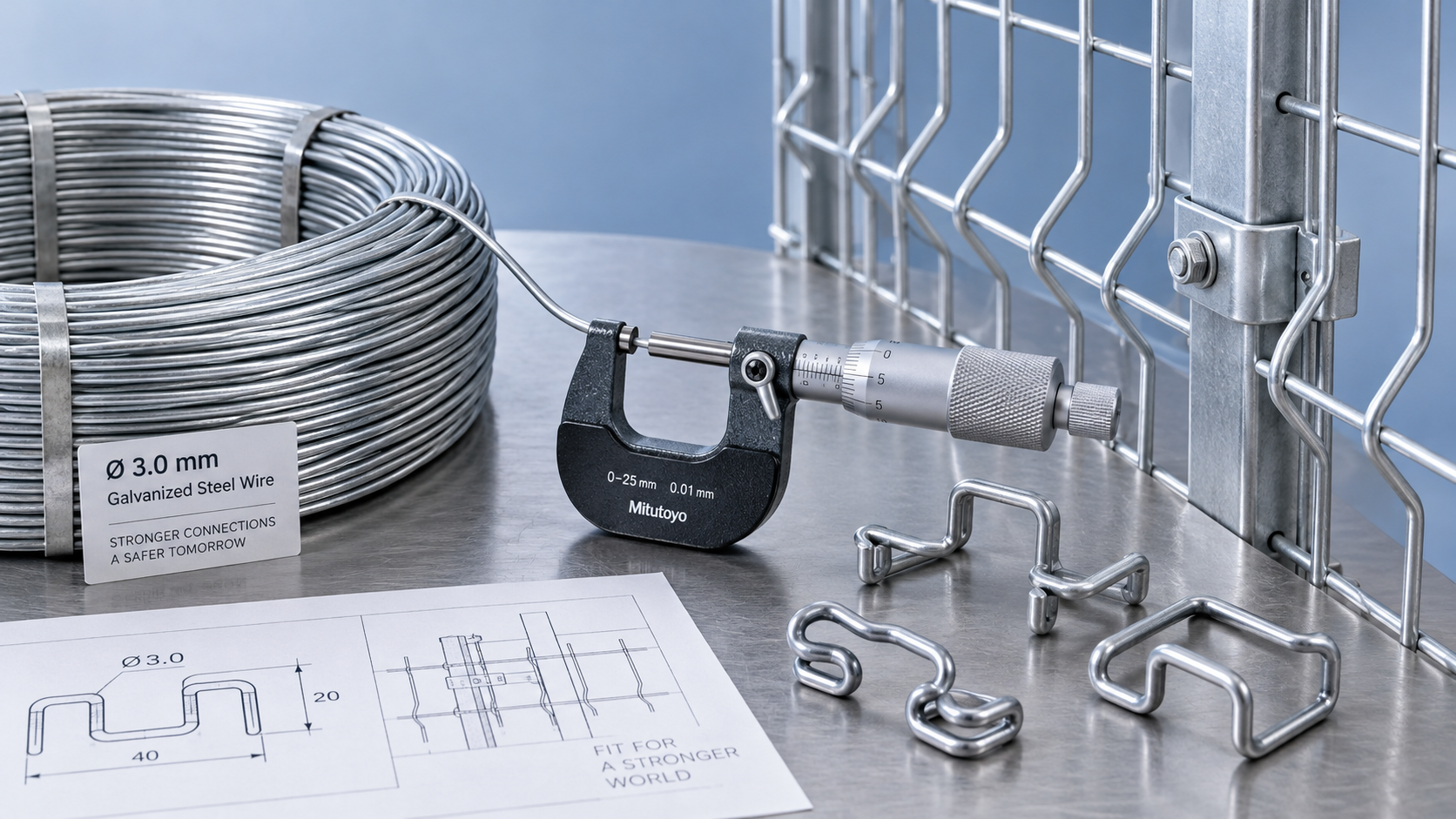
A bulk delivery can meet the description “3mm galvanized wire” and still cause problems on a fencing job: coils may not fit the payout equipment, harder wire may be difficult to tie, or the zinc coating may be unsuitable for the exposure. Before ordering, specify the wire construction, diameter tolerance, coating requirement, mechanical properties, coil format, and inspection evidence—not just diameter and price.
For buyers comparing galvanized wire 3mm quotations, the immediate task is to create one measurable specification that every supplier prices against. Separate essential acceptance requirements from preferences, and confirm the fence design before selecting strength or coating levels. Otherwise, a cheaper quotation may represent less usable length, a different coating, or wire that slows installation.
Start with the fence function, not the supplier’s product label
Clarify whether the wire will serve as a tension line, woven fence component, tie wire, or another part of the assembly. These uses do not necessarily need the same mechanical properties. Wire suitable for maintaining tension over a span may be unnecessarily difficult to bend around a post or form into a secure tie.
Also distinguish single solid galvanized steel wire from stranded wire rope. A nominal 3mm diameter does not make them interchangeable: construction changes flexibility, breaking force, fastening methods, and elongation under load. Put the required construction in the first line of the inquiry.
The fence designer should establish the working tension and compatible posts, anchors, and fittings. Wire tensile strength alone cannot establish the capacity of the assembled fence, particularly where it performs a protective or safety-related function.
Turn “3mm” into an acceptance requirement
State whether 3.00mm refers to the finished galvanized diameter or the steel core before coating. Then agree on upper and lower limits under the selected product standard or purchase specification. An unspecified “normal tolerance” leaves room for suppliers to apply different manufacturing practices.
Request actual measured results rather than a certificate that merely repeats the nominal diameter. Where ovality matters to clamps or forming equipment, specify how measurements in different directions will be assessed. Use the same measurement method for supplier inspection and incoming checks.
Specify zinc protection without relying on appearance
Descriptions such as “heavy galvanized,” “bright finish,” or “outdoor grade” are not sufficient acceptance criteria. Specify the galvanizing process and the minimum zinc coating mass, normally expressed in grams per square metre, with a mutually agreed test method. Coating adhesion matters too, especially when the wire will be bent or wrapped during installation.
Base the coating requirement on exposure: sheltered inland fencing, frequently wet locations, and salt-laden environments present different corrosion risks. Ask suppliers to identify the exact coating class and applicable standard they propose. Do not accept a claimed service life based solely on zinc mass; moisture, contaminants, abrasion, and installation damage also affect durability.
A dull surface is not automatically defective, and a shiny surface does not prove adequate zinc protection. Define acceptable surface condition separately from coating performance. Bare areas, peeling, and substantial corrosion warrant investigation; white corrosion deposits should be evaluated against the agreed criteria rather than accepted or rejected by colour alone.
Check strength and workability together
Higher tensile strength is not always the better purchase. For tensioned fencing, sufficient strength is important, but excessive hardness can make bending, knotting, or termination difficult. For tie applications, ductility may be more useful than maximizing tensile strength.
Ask for the specified tensile range and the supplier’s test results, including units and test method. If minimum breaking force is required, state it separately. Tensile strength and breaking force are related, but they are not interchangeable: breaking force also depends on the actual steel cross-sectional area.
A sample evaluation should reproduce the intended installation operations. Bend the wire around the intended fitting, check the termination, and run it through the payout equipment. Look for cracking, coating flaking, excessive springback, or handling difficulties. This practical trial supplements laboratory inspection; it does not replace the fence design calculation.
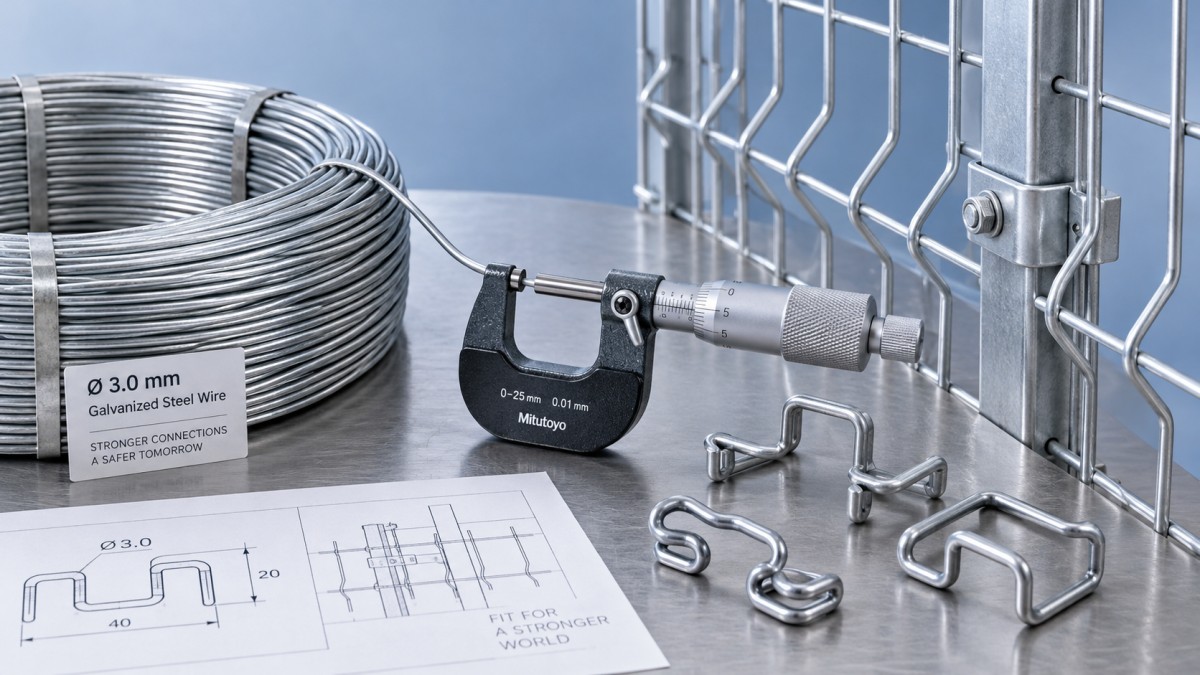
Coil packaging can change the installed cost
A low price per tonne offers little advantage if the crew repeatedly stops to untangle coils or join short lengths. Specify coil inside and outside diameters, maximum handling weight, winding arrangement, and whether a payout frame or reel is required. Agree whether internal joints are permitted and how they must be identified.
- Quantity basis: distinguish net wire weight from gross packed weight, and define any length tolerance.
- Continuous length: match coil length to planned fence runs where unnecessary joints would increase labour.
- Transport protection: agree on wrapping, moisture protection, and measures to prevent coil movement or crushing.
- Traceability: require each coil or reel to show the specification, quantity, and production lot.
For a rough quantity check, bare 3mm solid steel wire weighs approximately 0.0555kg per metre, using a steel density of 7,850kg/m³. Galvanizing and diameter variation affect the actual figure, so this estimate is not a substitute for verified supplied length. When quotations are weight-based, ask suppliers to explain their weight-to-length basis.
Keep balcony cable alternatives out of the fencing comparison
A balcony or window grille inquiry may also include 3mm cable, but that is a different specification. The 7x7 Nylon coated stainless steel 304 316 wire rope use for Invisible Grille is a stranded, nylon-coated stainless steel option offered in sizes including 3.0mm, with stated reel lengths of 500–1000m. It should not be treated as an equivalent substitute for solid galvanized fencing wire.
When that application is relevant, confirm the stainless grade, whether the listed diameter includes the nylon layer, and compatibility with sleeves, tracks, and other fittings. Protective grille performance depends on the complete assembly, anchors, spacing, and any emergency-opening arrangement—not cable diameter alone.
Compare delivered usable cost and release the order by lot
Normalize quotations to the same specification, quantity basis, packaging, delivery terms, and inspection scope. Compare delivered cost per usable metre where possible. Include freight, unloading, packaging disposal, expected joining work, and any agreed testing costs. Keep estimates separate from supplier-confirmed figures.
Before approving bulk production, obtain a representative sample and agree how later deliveries will be checked. Request lot-linked diameter measurements, tensile results, and coating test records. At receipt, check labels and net quantities, inspect packaging and wire condition, and sample coils according to the agreed plan. Hold disputed lots separately until conformity is resolved.
The purchase order should reference the approved specification revision and record the acceptance limits, permitted joints, required documents, and process for handling nonconforming material. Any proposed change to coating, wire grade, or coil format should require written approval before shipment. That prevents a technically different product from arriving under the same “3mm galvanized wire” description.
Navigation
Send Us A Message



Shandong Faster Technology Co., Ltd. is a professional manufacturer of steel wire ropes.
Get in Touch
*We respect your confidentiality and all information are protected.