





10mm Steel Wire Strand for Guyed Structures: Pretension and Anchorage Checks
10mm Steel Wire Strand for Guyed Structures: Pretension and Anchorage Checks
For project managers overseeing guyed towers, masts, and similar structures, selecting steel wire strand 10mm is only the starting point. Reliable performance also depends on correctly specified pretension and verified anchorage capacity. Too little tension can allow excessive movement; too much can overload connections, increase mast compression, and consume foundation capacity before wind loading begins.
The practical question is not simply whether a 10mm cable is strong enough. It is whether the strand, terminations, adjustment hardware, and foundations work together under the approved load cases—and whether the installation team can reproduce those conditions on site.
Resolve the strand specification before calculating tension
“10mm galvanized cable” is not a complete engineering specification. Single-strand constructions and multi-strand wire ropes can share a nominal diameter while differing in metallic area, breaking force, axial stiffness, and elongation during initial loading. Those differences affect both structural response and the adjustment needed after installation.
For permanent guys, the engineer should specify the construction rather than accept a supplier’s closest diameter match. Request the minimum breaking force, coating specification, diameter tolerance, and load–elongation information for the exact product. Clarify whether the material is prestretched or otherwise conditioned; do not assume it from a description such as “high strength.”
This distinction matters when reviewing Shandong Faster’s 19x7 galvanized steel wire rope 4.0-18.0mm Anti rotation steel cable . Its construction comprises 19 seven-wire strands, and its listed range includes 10.0mm. Rotation-resistant rope is relevant to lifting and traction duties, but that does not make it an automatic substitute for structural guy strand. Any substitution needs approval of its stiffness, termination arrangement, corrosion protection, and behavior under sustained loading.
Do not infer a 10mm breaking force from an unlabelled sequence of catalogue values. Obtain a clearly identified specification sheet and traceable test documentation for the selected construction and grade.
Pretension belongs in the structural model, not in a site rule of thumb
There is no universal pretension value for all 10mm guys. A target based only on a percentage of breaking force overlooks mast geometry, guy levels, anchor spacing, equipment weight, and environmental loads. The responsible structural engineer should establish the installation target, allowable tolerance, reference temperature, and measurement conditions.
Consider a mast with several guy levels. Tightening the upper set changes the mast’s position and can alter tensions below it. On a flexible structure, the sequence matters almost as much as the final readings. An installation plan should therefore define staged adjustment and repeated checks of plumbness, rather than instructing crews to finish one guy at a time.
The design also needs to address tension-only behavior. Under lateral loading, some guys gain tension while others unload. Whether reduced tension or slackening is acceptable depends on the approved structural model and serviceability criteria. Adding more pretension “to be safe” is not a reliable fix: it also increases compression in the mast and loading at the anchors.
Temperature changes and constructional settling can shift readings after installation. Specify any follow-up checks in advance, including who may authorize adjustment. Otherwise, a maintenance crew may unintentionally change the engineered balance while trying to make every cable feel equally tight.
Follow the force all the way into the ground
Anchor checks must use the governing design guy force, not just the installation pretension. The load path runs through the termination, turnbuckle, pins or shackles, anchor rod, foundation, and surrounding soil. A strong cable does not compensate for a weak link farther down that path.
For a straight-line force resolution, a guy tension T acting at angle θ above horizontal gives horizontal and upward components of T cos θ and T sin θ at the anchor. This helps explain why changing anchor distance changes the loading direction. It is not a foundation design method: the engineer must also consider the actual geometry, eccentricity, load combinations, and geotechnical conditions.
On a constrained site, moving an anchor inward to clear a road can look like a minor layout adjustment. It changes the guy angle, structural restraint, and foundation demand. Treat that move as a design change, not a field convenience.
- Verify pullout or uplift, sliding, overturning, and structural resistance as applicable to the anchor type.
- Confirm that ground assumptions reflect actual soil, groundwater, and backfill conditions.
- Check hardware alignment so pins, clevises, and turnbuckles are not subjected to unintended bending.
- Where anchor testing is specified, obtain the approved test load, procedure, and acceptance criteria before mobilization.
Termination compatibility is a separate approval
Sockets, swaged fittings, clips, and formed-wire grips are not interchangeable. Each arrangement needs confirmation for the actual strand construction, diameter, coating, and required resistance. Termination efficiency must be included in the assembly check; bare-strand breaking force is not the usable capacity of the finished guy.
If clips are proposed, their suitability, quantity, spacing, orientation, tightening torque, and reinspection requirements must follow the approved fitting instructions. For pressed assemblies, request confirmation of compatibility and the specified inspection or testing records. Also leave sufficient turnbuckle adjustment travel without compromising minimum thread engagement.
Measure installed tension with a method that fits the cable
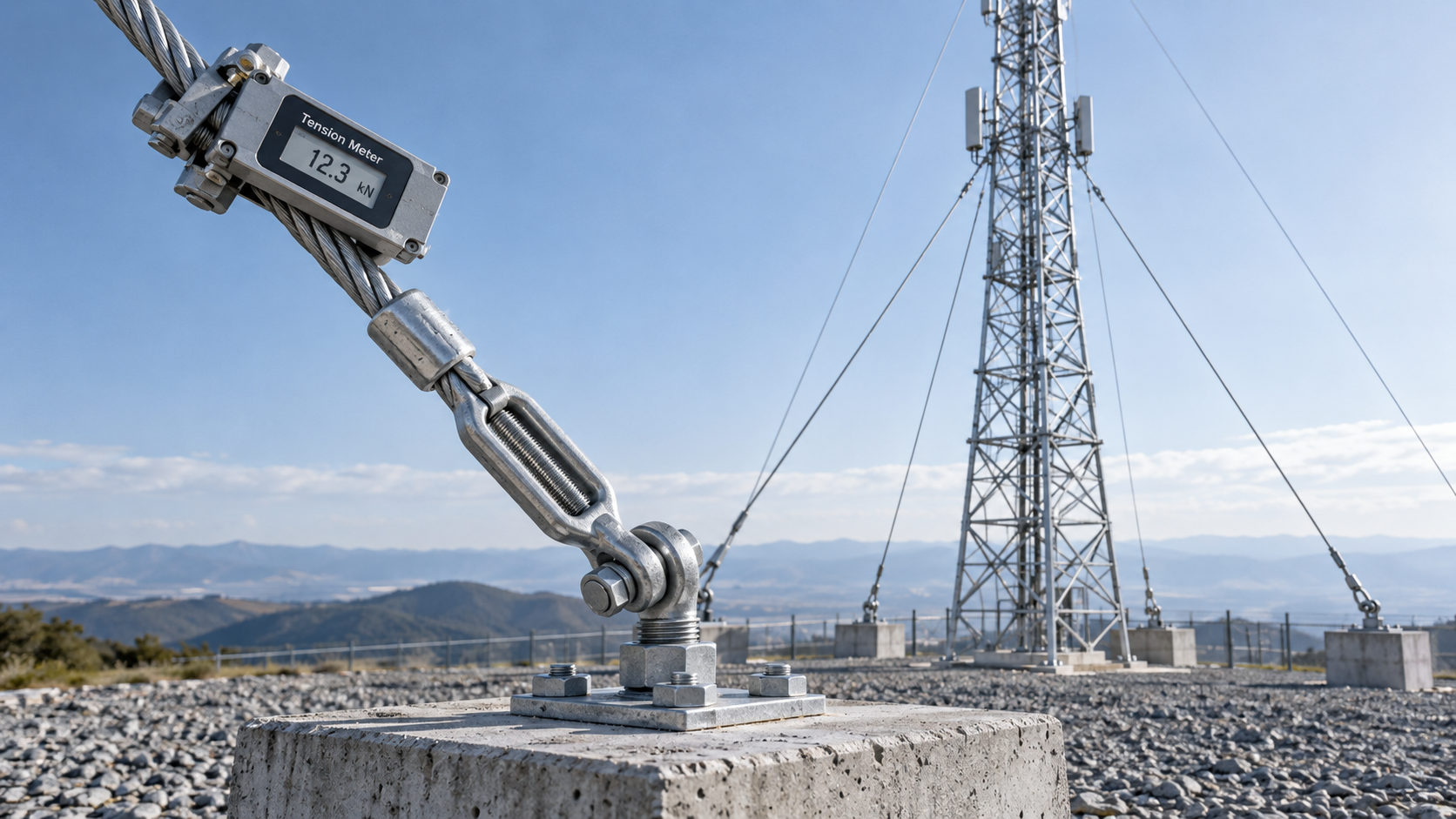
Hand feel and turnbuckle torque are not dependable measures of guy tension. Thread friction alone can make torque misleading. Use an approved measurement method, with calibration applicable to the actual cable construction and diameter.
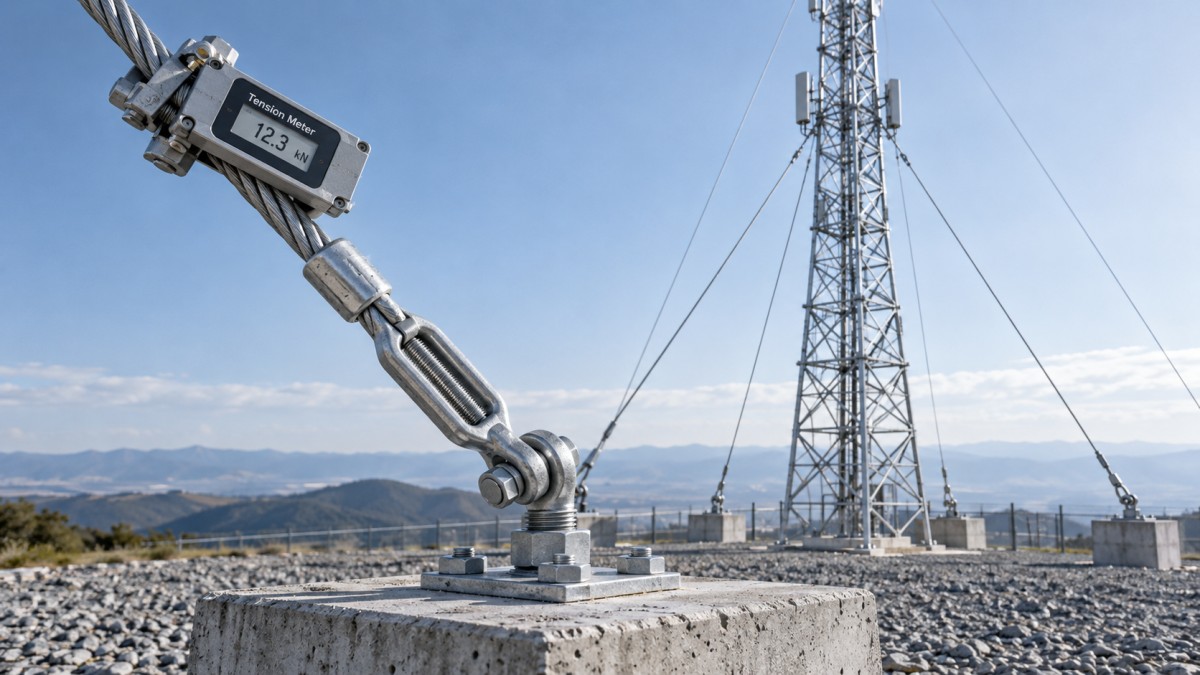
A clamp-on tension meter needs the appropriate calibration relationship. An inline load cell must be incorporated into a suitable load path. Vibration-based methods require known length and mass per unit length, with appropriate treatment of sag and boundary conditions. A generic instrument chart is not evidence that the reading is correct for every 10mm strand.
Take acceptance readings under the conditions defined by the engineer. Record temperature, wind conditions, instrument identification, guy location, tension, and mast alignment. After the adjustment sequence, recheck all guy sets: tightening one can change another. Marking adjustment hardware provides a useful reference for later inspections, but it does not replace measurement.
Make procurement support the handover checks
Shandong Faster Technology Co., Ltd.’s wire drawing, stranding, rope-closing, and inspection capabilities provide a basis for discussing controlled supply and customized assemblies. Its stated 1–20mm single- and multi-strand range offers options, but the purchase order still needs to identify the approved guy construction and acceptance documents. Manufacturing capability and project suitability are different questions.
Before release, align finished lengths, termination details, corrosion protection, batch identification, and inspection requirements with the drawings. Before handover, retain the approved design tensions, foundation acceptance records, as-built anchor positions, termination checks, and final tension readings. If any of these remain unresolved, nominal diameter alone is not a sound basis for accepting the installation.
Navigation
Send Us A Message



Shandong Faster Technology Co., Ltd. is a professional manufacturer of steel wire ropes.
Get in Touch
*We respect your confidentiality and all information are protected.