





Steel Wire Rope Core Types: How FC, WSC, and IWRC Affect Performance
A steel wire rope core supports the outer strands and helps the rope retain its shape under load. Fiber cores (FC) generally favor flexibility, while steel cores provide firmer support against crushing and tolerate heat better. A wire strand core (WSC) uses one steel strand; an independent wire rope core (IWRC) uses a complete, smaller wire rope.
These differences matter when ropes run over sheaves, wind onto drums, or carry sustained tension. However, core type alone cannot establish suitability. Two ropes with the same diameter and core designation can have different breaking forces, bending behavior, and service limits because their overall constructions differ.
What FC, WSC, and IWRC actually describe
The core sits inside the surrounding strands. It provides internal support as those strands experience tension, bending, and sideways pressure. Steel cores also contribute metallic area that carries part of the tensile load.
FC means fiber core. It may contain natural or synthetic fibers. The core provides a relatively compliant center and can hold lubricant, depending on its material and preparation. Natural and synthetic fiber cores should not be treated as interchangeable: moisture response, compression behavior, and temperature limits vary.
WSC means wire strand core. A single strand of steel wires forms the center. In a typical 7×7 construction, for example, six outer strands surround a seventh strand. WSC is commonly encountered in smaller cables, where a compact metallic construction is useful.
IWRC means independent wire rope core. The center is itself a rope made from several strands. This creates a metallic support structure beneath the outer strands. IWRC is widely used where substantial loading, drum pressure, or dimensional stability makes a fiber core unsuitable.
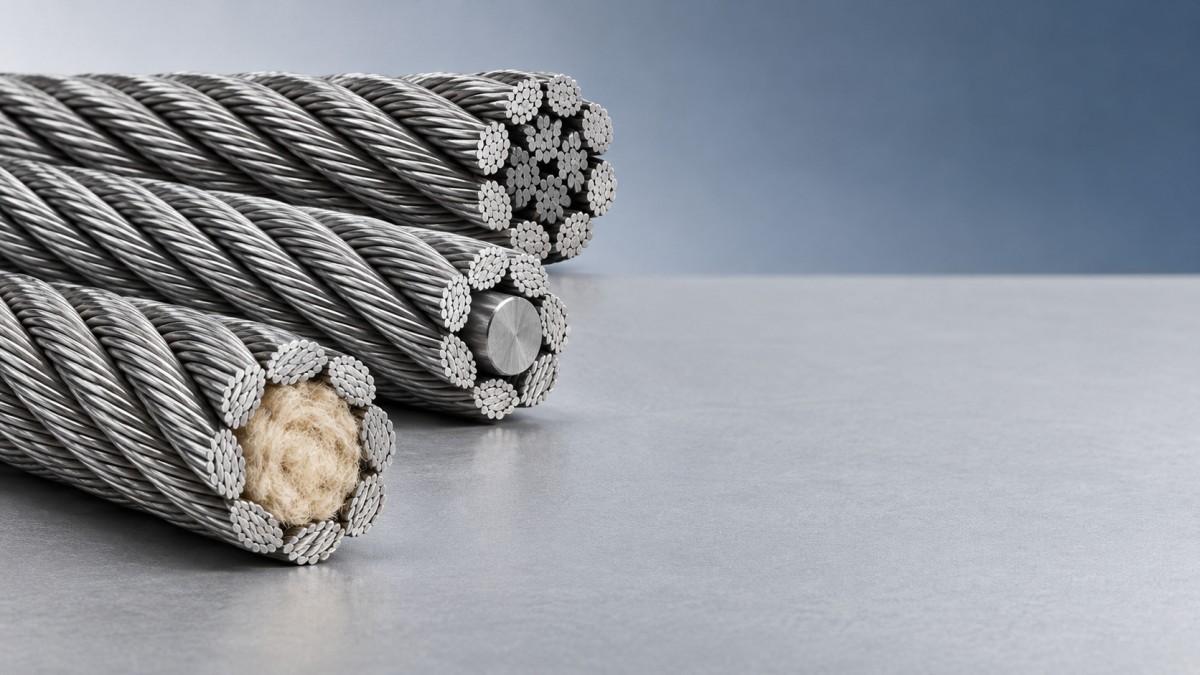
The distinction between WSC and IWRC is structural. Both are steel cores, but a single strand and a complete inner rope have different bending and contact behavior. Their performance must be assessed within the finished rope construction.
Breaking force and working capacity are different checks
For otherwise comparable ropes, a steel core generally increases the amount of load-bearing metal and can provide a higher minimum breaking force than a fiber core. It also helps support the outer strands as tension rises. There is no universal strength increase that applies to every FC-to-IWRC substitution.
The valid comparison uses the same nominal diameter, rope construction, grade, and applicable specification. Comparing an FC rope with one outer-strand arrangement against an IWRC rope with another does not isolate the effect of the core.
Minimum breaking force is not the permissible working load. Working capacity also depends on the required design factor, terminations, loading arrangement, and equipment requirements. For slings, hitch configuration and sling angle further affect capacity. A higher wire tensile strength grade does not, by itself, establish the capacity of a finished assembly.
Changing to IWRC should therefore trigger a compatibility review. Rope mass, stiffness, termination suitability, and behavior in existing grooves may change even when nominal diameter stays the same.
Flexibility does not automatically mean longer fatigue life
A fiber core can make a rope easier to bend and handle, which is useful where compliance matters. Yet handling flexibility and resistance to repeated bending fatigue are different properties.
When a rope passes over a sheave, its wires repeatedly bend and straighten. Wire diameter, strand construction, lubrication, rope tension, and sheave diameter all influence the resulting fatigue. A rope containing more, finer wires generally bends more readily than a comparable construction containing fewer, larger wires, although abrasion and crushing requirements may favor a different design.
The sheave-to-rope diameter ratio, commonly expressed as D/d, remains an essential check. A core change cannot compensate for an unsuitable sheave diameter, worn grooves, poor alignment, or severe reverse bending. A steel-core rope designed for demanding running service may outlast a more compliant rope when its full construction matches the duty.
Likewise, IWRC does not automatically make a rope rotation resistant. Rotation behavior depends on the lay directions and arrangement of the complete rope. Suspended loads and long lifting heights require a separate assessment of torque and rotation characteristics.
Drum pressure and heat can rule out an otherwise suitable core
During multilayer winding, upper rope layers press against lower layers. Crossover points create concentrated contact pressure. If internal support is insufficient, the rope can flatten, strands can shift, and local damage can accelerate.
IWRC is often favored in this situation because it provides firmer internal support. It still needs suitable drum geometry, controlled spooling, and appropriate installation tension. Replacing FC with IWRC will not cure damage caused by poor winding or an unsuitable groove profile.
Heat creates a different selection boundary. A fiber core may soften, dry out, or otherwise deteriorate according to its material, reducing support beneath the outer strands. Steel cores avoid that particular mechanism, but the steel wires, lubricant, coatings, and terminations retain their own temperature limits. Selection should account for the rope’s actual exposure, including localized heating and duration.
In marine and wet environments, corrosion protection requires equal attention. Natural fibers can retain moisture, while synthetic fibers have different absorption characteristics. Steel cores can suffer internal corrosion that is difficult to see from the surface. Galvanizing, suitable lubrication, drainage, and inspection access should be considered together; the core designation alone does not establish corrosion resistance.
A central wire is not the same as a wire strand core
Small products illustrate an important terminology trap. A 1×7 construction consists of one central wire surrounded by six wires. It is a single strand, so its central wire should not be classified as WSC or IWRC. A strand becomes a wire strand core when it serves as the center of a larger rope.
Shandong Faster Technology Co., Ltd.’s 1x7 Galvanized Steel Wire Rope 0.6-3.0mm use For Hanging And Pulling Wire illustrates this distinction. Its specified construction and galvanized finish are relevant to applications such as light suspension, messenger lines, and plant support pulling wires, subject to the required load and termination design.
That construction should not be treated as an equivalent replacement for a flexible running rope simply because both products contain steel wires. Repeated travel over small pulleys requires assessment of bending fatigue and the complete cable design. Zinc coating provides corrosion protection, but does not establish suitability for lifting or continuous bending.
What to put in the specification before selecting a core
Start with the equipment’s rope requirements and the dominant service condition. Multilayer drum pressure points toward stronger internal support. Repeated bending makes strand design and sheave geometry central. Heat can exclude certain fiber materials. For elevator traction service, groove interaction and the specified rope system also govern selection.
A useful procurement specification should include:
- Complete construction: strand arrangement, core type, lay type, and lay direction.
- Mechanical requirements: nominal diameter, tolerance, rope grade, minimum breaking force, and any elongation limits.
- Operating conditions: load range, cycling, sheave and drum geometry, winding layers, temperature, and corrosion exposure.
- Assembly details: terminations, fitting compatibility, and capacity requirements.
- Acceptance documentation: the applicable standard and edition, inspection records, and traceability to the supplied batch.
When comparing standards-based data sheets, keep the construction, grade, and reporting basis consistent. A general certification label cannot replace a rope-specific mechanical specification.
For replacement work, record how the existing rope deteriorated. Flattening suggests a support or spooling problem; repeated bending breaks direct attention toward construction and sheaves; internal corrosion points toward protection and maintenance. Use that evidence alongside the equipment requirements to choose the core and complete rope together.
Navigation
Send Us A Message



Shandong Faster Technology Co., Ltd. is a professional manufacturer of steel wire ropes.
Get in Touch
*We respect your confidentiality and all information are protected.