





Is 1x7 stainless steel wire flexible enough for pulleys?
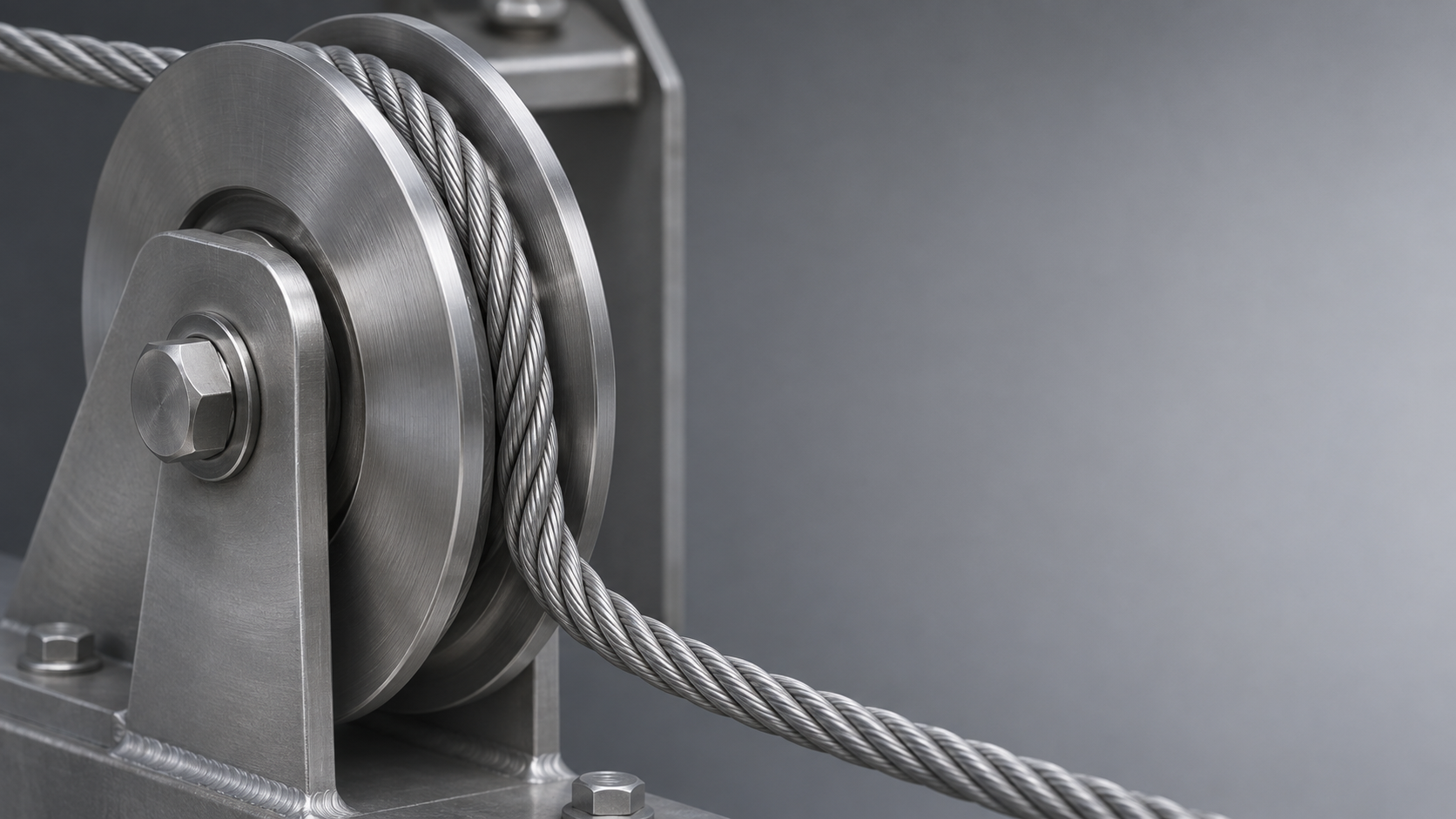
1x7 stainless steel wire can pass over a pulley, but it is generally a poor first choice for repeated bending, particularly around a small sheave. Its relatively stiff single-strand construction is better suited to fixed tension members or mechanisms with infrequent movement. Whether it is acceptable in a particular assembly depends on the sheave diameter, rope diameter, load, bend path and expected number of cycles.
The practical question is not simply whether the wire can be bent around the pulley during installation. It is whether the assembly can tolerate that bend repeatedly, under its working load, for the required service life. A wire that moves smoothly during a trial may still accumulate fatigue damage in service.
Why pulley movement challenges 1x7 construction
A 1x7 strand consists of seven wires laid together. Compared with a multi-strand rope of the same nominal diameter, its individual wires are relatively large. As the strand passes over a sheave, those wires must bend and adjust against one another. Repeated bending can initiate fatigue breaks, especially when the sheave is small or the strand is highly loaded.
Stainless steel provides corrosion resistance appropriate to many environments, but it does not remove the need to assess bending fatigue. Likewise, a strand with sufficient published breaking strength is not automatically suitable for a moving pulley system: strength and fatigue performance answer different questions.
For a fixed bracing line that is routed around a large radius and adjusted only occasionally, 1x7 may be a reasonable candidate. For a control cable that cycles frequently, changes direction over several sheaves or reverses over opposing bends, the case for a more flexible construction becomes much stronger.
Start with the sheave-to-rope diameter ratio
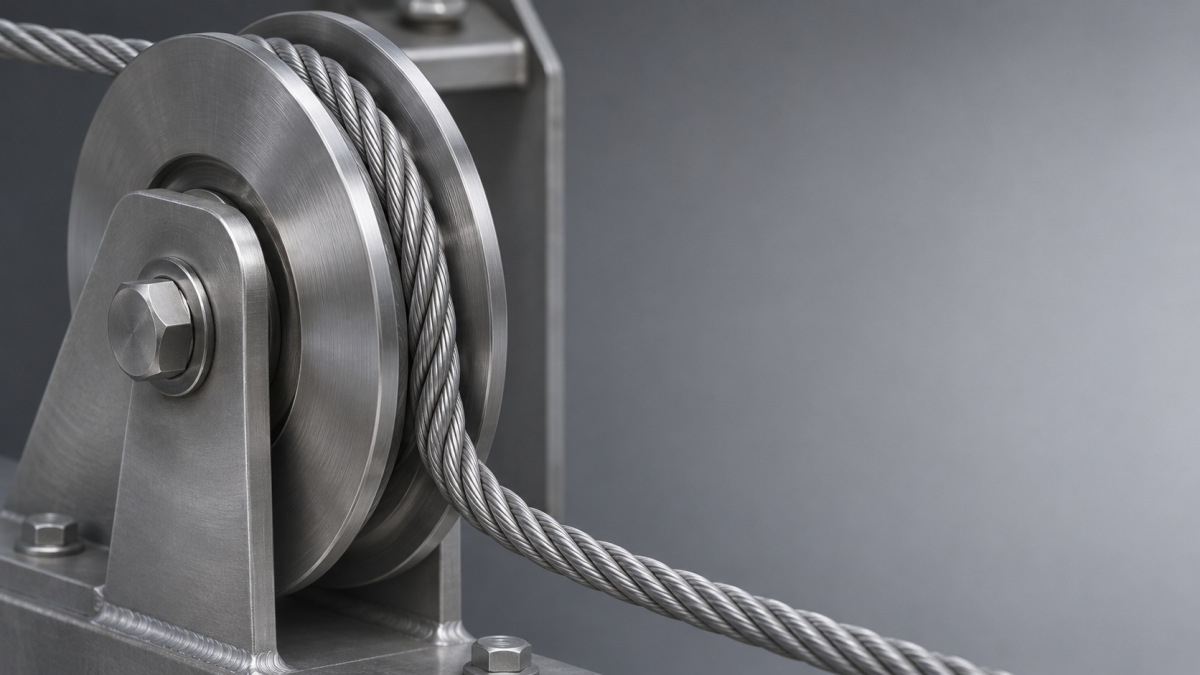
The ratio commonly written as D/d compares the sheave’s pitch diameter, D, with the nominal rope diameter, d. A larger ratio generally reduces the severity of each bend and can improve fatigue life. A smaller ratio increases bending severity. Use the diameter definition specified by the rope or equipment manufacturer when applying its guidance, since measurements at the groove can otherwise be confused with the outside diameter of the sheave.
For example, doubling the rope diameter while keeping the same sheave halves the D/d ratio. The larger rope may offer more breaking strength, but it also has to bend more sharply relative to its size. Replacing a worn cable with a thicker one can therefore create a fatigue problem even when it appears to be a conservative strength upgrade.
There is no single D/d value that makes every 1x7 installation acceptable. A suitable limit depends on the exact strand, loading, cycle duty and equipment design. Obtain a recommendation for the specific construction and application; do not apply a ratio intended for a different rope simply because its diameter is the same.
Also check the whole path. Several sheaves can impose multiple bends during one operating cycle. Reverse bends, in which the rope bends in opposite directions as it travels through the mechanism, can be more demanding than repeated bending in one direction. A single large sheave does not compensate for a smaller, heavily loaded sheave elsewhere in the path.
When should you consider 7x7 or 7x19 instead?
Multi-strand constructions provide more flexibility by distributing the rope’s cross-section among more, smaller wires. For a pulley application, that can make them more suitable than 1x7, although their service life still depends on the complete system.
These are relative comparisons, not interchangeable design approvals. Moving to 7x7 or 7x19 can change breaking strength, elongation, abrasion behavior and compatibility with terminals. The new rope must fit the groove and termination system, and the complete assembly must meet the equipment’s load and safety requirements.
Smaller outer wires can be beneficial for bending, but they may also be more vulnerable to external wear in an abrasive environment. If the cable runs through contamination or contacts fixed edges, specify both fatigue duty and abrasion exposure when comparing alternatives. A more flexible rope is not a substitute for correcting misalignment or an unsuitable groove.
Assess the complete operating cycle
Before approving 1x7, describe what one cycle actually does to the strand. An adjustable tension line moved a few times during setup presents a different duty from a mechanism that travels back and forth throughout each shift. Record the working load range, expected travel, number and direction of bends, and whether the strand remains stationary against a sheave under tension for long periods.
Then review the components that govern contact and movement:
- Groove condition and fit: Check that the groove supports the specified rope diameter without pinching it, and inspect for wear, sharp edges and debris.
- Alignment: Confirm that the rope enters and leaves the sheave without excessive side loading or rubbing against guards and adjacent parts.
- Sheave rotation: A seized or poorly rotating sheave can make the rope slide in the groove, increasing wear.
- Terminations: Use fittings approved for the selected construction and check clearance near end connections, where bending or contact may concentrate damage.
- Environment: Consider corrosion exposure, temperature and contamination alongside the grade and condition of the stainless steel.
Inspection access matters as well. Broken wires may appear near a termination or at a repeatedly bent section, and damage can be difficult to see where the rope rests in a groove. Establish inspection and replacement criteria under the equipment manufacturer’s instructions and applicable requirements; do not wait for a complete strand failure as evidence that the choice was unsuitable.
Keep pulley rope and lifting sling decisions separate
A lifting assembly can contain wire rope without being designed to run over a sheave. For example, a Double Leg Swaged Wire Rope Sling with Safety Hook Galvanized High-Strength is intended for two-point lifting. Its sling configuration and fittings should not be treated as evidence that it is suitable as a moving pulley rope. Conversely, selecting a flexible rope for a sheave does not establish the working load limit or suitability of a finished sling.
For an existing design, the next step is to compare its most demanding sheave and operating cycle with guidance for the exact 1x7 strand. If repeated bending is central to the mechanism and fatigue-life guidance is unavailable, evaluate a suitable multi-strand rope and any necessary changes to the sheaves and terminations before committing to the design.
Navigation
Send Us A Message



Shandong Faster Technology Co., Ltd. is a professional manufacturer of steel wire ropes.
Get in Touch
*We respect your confidentiality and all information are protected.