





3mm Steel Wire Strand for Bracing: Checking Loads, Stretch, and End Fittings
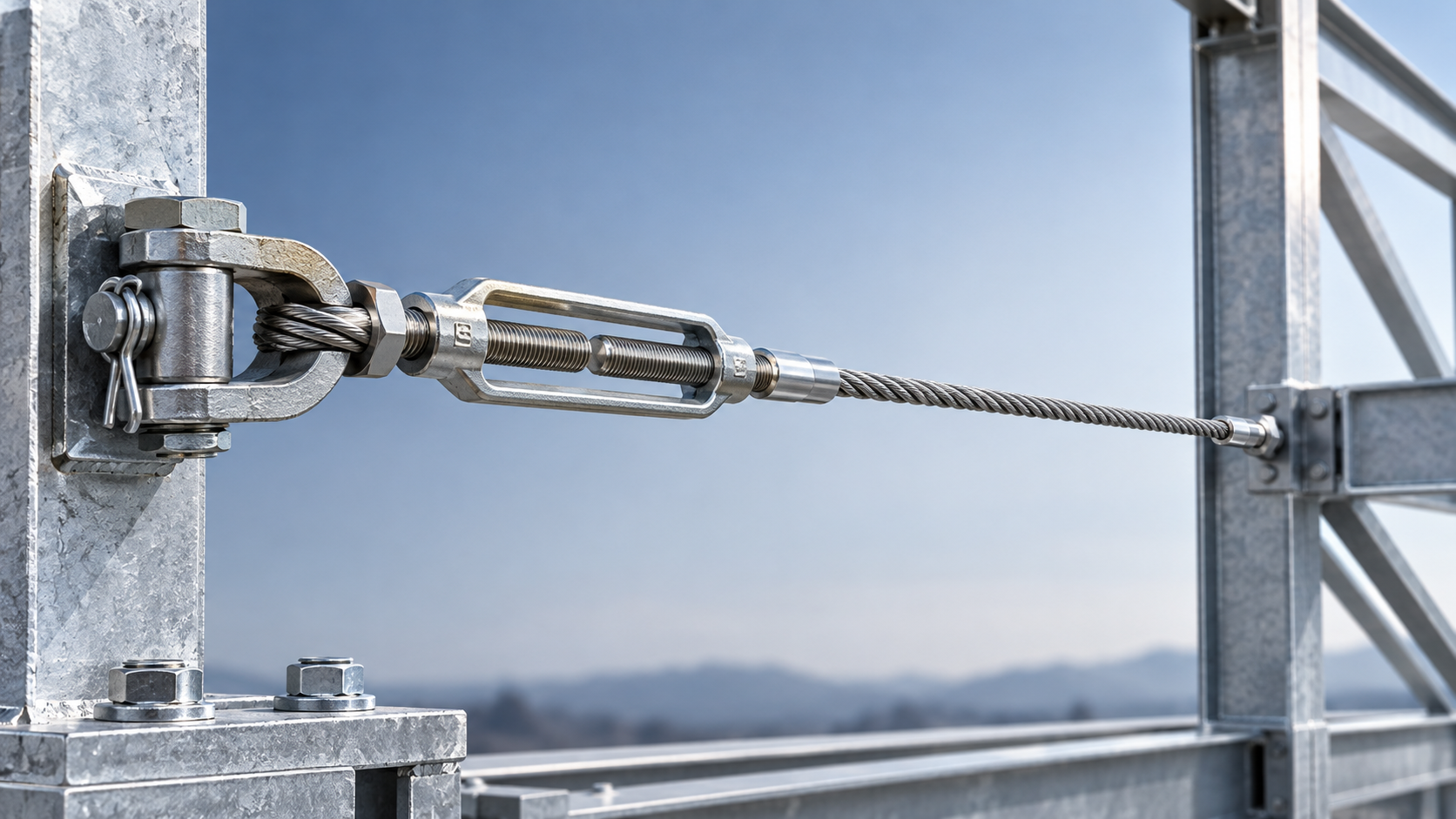
A 3mm steel wire strand can suit light tension bracing when its verified strength, stiffness, end connections, and anchors meet the project requirements. Diameter alone cannot establish suitability. A strand may resist the calculated load yet stretch enough to let a frame move, or its end fitting may limit the capacity before the wire itself becomes critical.
Start with the force the brace must carry and the movement the structure can tolerate. Then assess the complete assembly, including installation tension, turnbuckles, attachment points, and exposure conditions. This gives a more useful selection basis than comparing nominal diameters or advertised breaking loads.
Establish what the brace must do
Steel strand works in tension and provides negligible resistance to compression. In a crossed-brace arrangement, a change in load direction may transfer the main tension force from one diagonal to the other. Do not assume both diagonals share the load equally unless the structural analysis supports that assumption.
Brace angle also affects the required tension. For a simple diagonal resisting a horizontal force, only the horizontal component of strand tension contributes to that resistance. A steeper diagonal therefore needs greater tension to resist the same horizontal force. The connections also receive a vertical force component, which must be included in the support design.
Define the conditions that could govern the selection:
- Wind, equipment movement, vibration, or other forces acting on the braced structure.
- Load reversal and whether a strand can become slack.
- Initial tension required to control slack and movement.
- Maximum acceptable displacement at the supported frame or component.
- Temporary erection conditions before the permanent structure is complete.
Pretension keeps a brace engaged, but it also loads the strand, fittings, and anchors before external forces arrive. Increasing it without calculation can overload connections or distort a light frame. Its interaction with service loads should be included in the structural model.
Compare construction and documented strength
A listing described as “steel wire strand 3mm” may refer to different wire arrangements, materials, and coatings. A single strand and a flexible multistrand wire rope are not interchangeable simply because their outside diameters match. Construction affects stiffness, bending behavior, initial settling, and fitting compatibility.
A relatively stiff strand can be useful for a straight, static brace. A flexible rope may be easier to route or form into an eye, but its elongation and connection requirements can differ. Specify the construction explicitly rather than allowing a supplier to substitute whichever 3mm product is available.
Request the minimum breaking force for the exact construction, wire grade, and material supplied, supported by traceable documentation. Breaking force describes failure resistance; it is not the permitted service load. Wire tensile strength alone is also insufficient to establish the capacity of the finished strand assembly.
Assess capacity using the design method applicable to the structure. Where an allowable-load method uses a design factor, the reduced capacity of the terminated strand must be considered before establishing the allowable load. Where the project uses factored loads and resistance factors, follow that method consistently. Mixing the two approaches can produce misleading results.
Termination efficiency describes how much of the strand’s breaking strength a particular connection retains. It depends on the strand and fitting combination, preparation, and installation. Do not apply a generic efficiency value to every ferrule, clip, or terminal. Separately check turnbuckles, pins, brackets, and anchors: the lowest applicable capacity can govern the assembly.
Check stretch against the movement limit
Strength and stiffness answer different questions. Strength determines whether the assembly can resist the force. Stiffness determines how much it moves while doing so. A long, small-diameter brace can satisfy a strength check while allowing unacceptable frame displacement.
For an initial elastic estimate, strand extension follows the relationship ΔL = FL/(EA), where F is tension, L is the loaded length, E is the effective elastic modulus, and A is the metallic cross-sectional area. Use consistent units and properties appropriate to the strand construction. Treating the nominal outside diameter as a solid steel bar can misrepresent both area and stiffness.
The relationship explains why length matters: at the same force and axial stiffness, a longer strand extends more. However, strand extension does not translate directly into the same amount of frame movement. Brace geometry and connection flexibility also affect displacement.
Installation movement can include wires bedding into position, terminals seating, and clearance being taken up at pins. These effects differ from recoverable elastic stretch. Ask for load–elongation information when movement limits are tight, and specify any required factory pre-stretching or controlled seating procedure.
A turnbuckle provides adjustment, but tightening it cannot eliminate elastic extension under changing loads. If movement governs the design, compare a larger strand, a shorter brace, a revised brace angle, or a rigid bracing member. More pretension is not automatically the best remedy.
End fittings must match the exact strand
Choose the termination system alongside the strand. A fitting marked for a 3mm cable may be designed for a different construction or material. Compatibility must cover the metallic diameter, wire arrangement, fitting material, and intended loading.
Factory-swaged terminals can provide compact connections when the terminal and pressing process are qualified for the specified strand. Ferrule-secured eyes may also be suitable where the strand permits the required bend and the ferrule system is approved. A thimble supports an eye and helps protect its bearing surface, but it does not establish the termination’s load capacity.
Small wire rope clips should not be selected merely because they fit around the strand. Suitability depends on the manufacturer’s permitted constructions, installation procedure, tightening requirements, and published capacity. A generic clamp can introduce slip or local wire damage that a strand-only strength calculation misses.
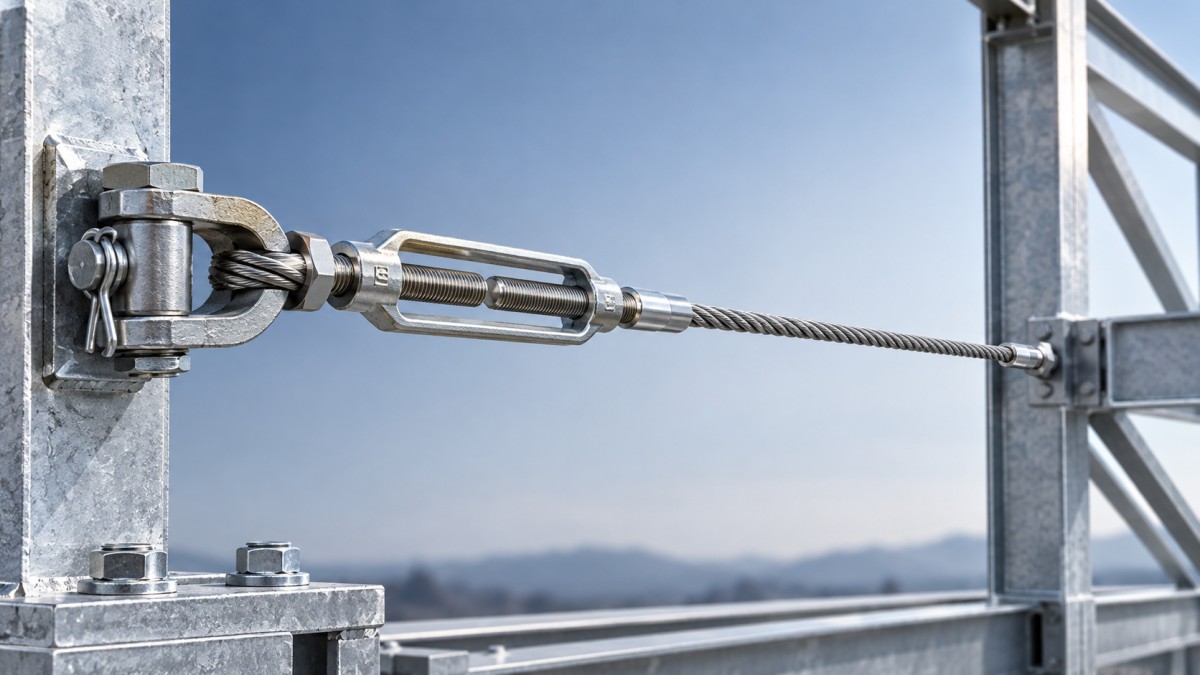
Follow the load path through the completed connection: strand, terminal, pin or shackle, turnbuckle, bracket, and structural anchor. Pins need appropriate bearing surfaces, and fittings should align with the load. Side loading, sharp bends, and terminals forced against bracket edges can undermine an otherwise adequate specification.
Provide enough adjustment travel for installation tolerances and seating while maintaining the required thread engagement. Include a locking method suited to vibration and an inspection point that remains accessible after installation.
Exposure and installation can change the choice
Galvanized and stainless steel options should be assessed against moisture, salts, chemicals, contact metals, and maintenance access. Stainless steel is not automatically suitable for every corrosive environment, and a protective coating does not increase the underlying strand’s structural capacity.
For plastic-coated products, state both the metallic strand diameter and the overall coated diameter. Terminations must follow the approved system’s preparation requirements; gripping a compressible coating can create a slipping connection. Coating can also conceal corrosion or broken wires, so inspection access belongs in the selection decision.
Keep erection lifting separate from permanent bracing. If equipment must be hoisted into position, a purpose-designed assembly such as the 6-22mm Lifting Chain Sling 1 2 3 4 Legs G80 Welded Chain Sling With Hook provides single- or multiple-leg lifting configurations. Selection depends on the marked working load limit, sling angles, attachment points, and load balance. Its lifting role does not establish suitability for replacing a designed strand brace.
Turn the assessment into a purchase specification
A useful enquiry defines the assembly rather than requesting “3mm wire.” Include the following:
- Strand construction, metallic diameter, material, and corrosion protection.
- Required strength documentation and the project’s capacity assessment basis.
- Design tension, installation pretension, brace length, and movement limit.
- Terminal types, validated termination performance, and fitting capacities.
- Finished length reference points, tolerances, and adjustment range.
- Installation, inspection, and traceability requirements.
Shandong Faster Technology Co., Ltd. supplies single- and multistrand steel wire rope in galvanized, stainless steel, and plastic-coated series, with customization capabilities for pressed sling products. These capabilities provide a basis for discussing material and assembly options. The enquiry should identify the required bracing performance and request a compatible, documented strand-and-terminal combination.
Approve the 3mm option only when both capacity and movement checks pass for the complete installed assembly. If either fails, revise the diameter, geometry, connection system, or bracing type before ordering.
Navigation
Send Us A Message



Shandong Faster Technology Co., Ltd. is a professional manufacturer of steel wire ropes.
Get in Touch
*We respect your confidentiality and all information are protected.