





What to check before selecting aircraft cable for control runs
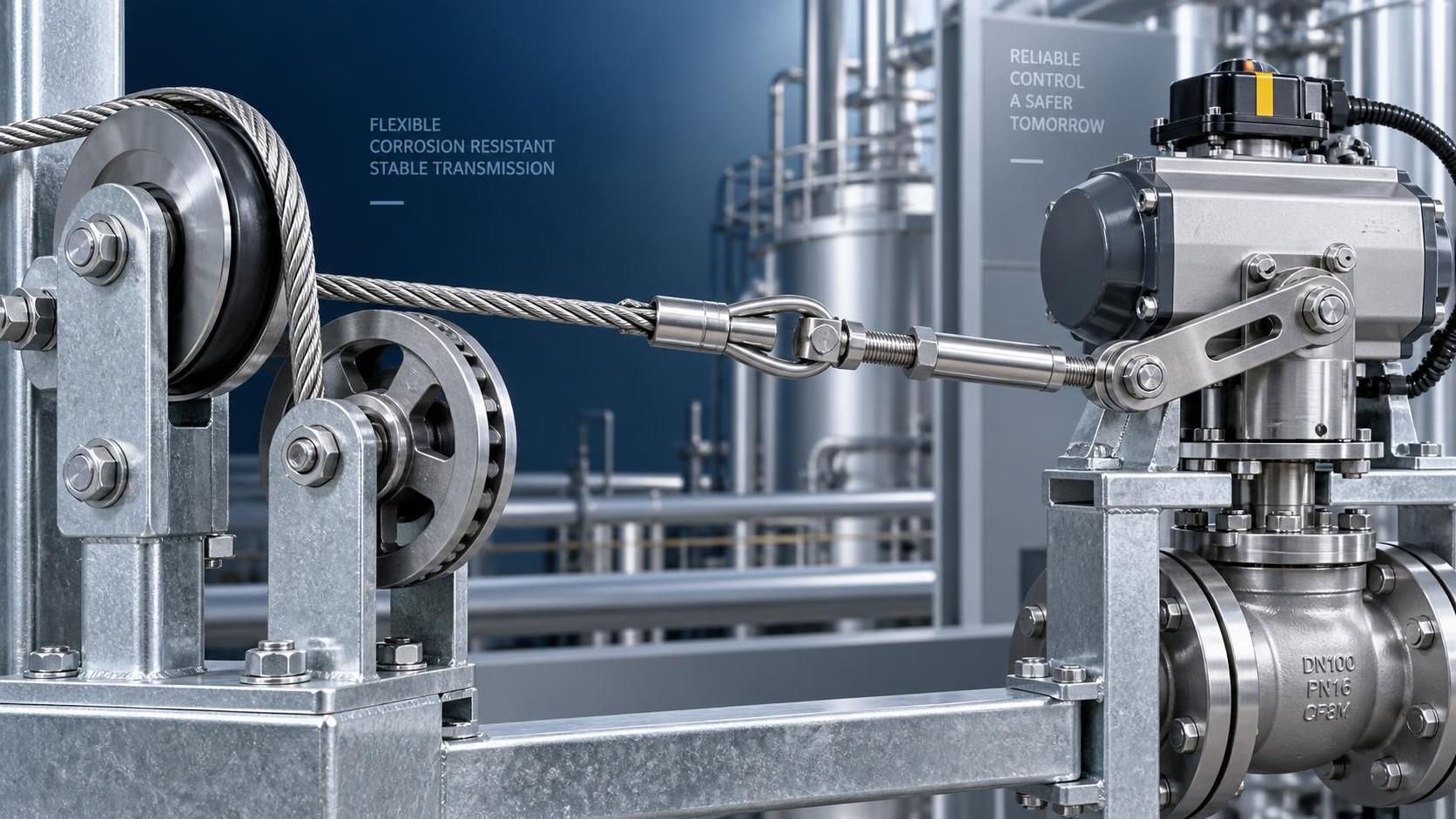
What to Check Before Selecting Aircraft Cable for Control Runs
Selecting aircraft cable for a control run is rarely as simple as choosing a diameter from a catalog. In industrial equipment, the cable may operate a damper, valve, gate, throttle, brake, remote release, conveyor adjustment, or actuator linkage. It may run through several pulleys, pass around tight bends, sit outdoors for years, or move only occasionally but carry meaningful consequences if it sticks or fails.
For procurement teams, the most expensive mistake is often buying a cable that looks adequate on paper but does not match the motion system. A higher breaking load does not automatically mean better control performance. In many control applications, flexibility, fatigue resistance, corrosion protection, and termination quality matter just as much as nominal strength.
Start with the actual duty, not the cable name
“Aircraft cable” is commonly used as a market term for small-diameter stranded steel wire rope. The term alone does not define construction, material, finish, or intended use. Before requesting quotations, map the control path and operating conditions: Is the run straight or routed around sheaves? Does it see repeated cycling? Is the load steady, intermittent, or subject to shock? Is the cable exposed to salt spray, washdown chemicals, dust, or abrasive particles?
A cable used in a manually adjusted ventilation damper faces a different problem from one used in a frequently cycled machine control. The first may be more sensitive to outdoor corrosion and low-maintenance operation. The second may be limited by bending fatigue at pulleys and by smooth travel through guides. Treating both as a simple tensile-strength purchase can lead to premature wire breaks, rough movement, or excessive cable stretch.
It is also worth separating control runs from lifting duties. A cable assembly designed to move or position a mechanism should not be specified as a lifting sling unless its complete assembly, end fittings, working load, and applicable requirements have been evaluated for lifting. This distinction is basic, yet it is often blurred when one supplier is asked to source all wire-rope-related items.
Construction determines how the cable behaves
Cable construction is one of the first technical checks. Fewer, larger outer wires generally provide better abrasion resistance, while constructions with more individual wires tend to be more flexible and better suited to bending over pulleys. For example, a 7x19 construction is often considered where flexibility is a priority in control and motion applications. A 6x19-type construction may offer a different balance between flexibility, surface durability, and cost. The right choice depends on the routing and cycle pattern rather than on a universal ranking.
Core selection changes performance as well. A fiber core can support flexibility and may be appropriate for certain light-duty runs, while a steel core can provide greater support and resistance to crushing in applications with higher compression or more demanding handling conditions. Neither should be selected by habit. Ask whether the cable will be clamped, wound, bent repeatedly, or run through grooved sheaves; these details affect the practical value of the core.
Do not rely on a construction label without confirming the rope’s diameter tolerance, lay direction, lubrication condition, and actual minimum breaking force from the supplier’s documentation. Two cables described with similar shorthand can behave differently if their manufacturing control and wire quality differ.
Check the bending path before finalizing diameter
Diameter is important, but it must work with the pulley and guide geometry. A cable that is too stiff for the available sheave diameter will experience concentrated bending stress. Over time, this commonly shows up as broken outer wires near pulley contact points. A cable that is undersized may be easier to route, but may introduce unwanted elongation, reduced safety margin, or poor engagement in a drum groove.
Procurement specifications should therefore include the smallest sheave or pulley diameter in the route, the number of bends, groove profile where relevant, and whether the cable crosses guides or rub points. If these details are unavailable, a supplier can only provide a generic recommendation. That is not the same as confirming suitability for the installed mechanism.
Pay attention to cable travel length, too. In a long control run, elastic extension and constructional stretch can affect adjustment accuracy. A gate that appears fully closed at the handle may not be fully closed at the far end if the system has excessive cable movement, poorly matched fittings, or inadequate tension adjustment.
Material and surface protection should reflect the environment
Bright steel, galvanized steel, stainless steel, and plastic-coated cable each solve different problems. Bright wire rope can be suitable in controlled indoor environments where corrosion is limited and inspection is easy. Galvanized aircraft cable is widely considered for general outdoor, construction, port, and industrial exposure because the zinc coating provides additional corrosion protection. It is not maintenance-free, especially in aggressive marine or chemical environments.
Stainless steel is often the more appropriate direction where moisture, salt, hygiene requirements, or long-term corrosion risk are dominant concerns. However, grade selection, fitting compatibility, and contact with dissimilar metals still need review. “Stainless” should not be treated as a complete environmental assessment.
Plastic-coated cable can reduce surface abrasion, improve handling, and protect adjacent equipment in some arrangements. The coating changes the effective outside diameter, which matters for guides, clamps, sleeves, and pulley grooves. Where a mechanism depends on precise movement or a tight fit, specify both the bare cable diameter and the finished coated diameter.
Strength is a check point, not the full specification
Breaking load should be verified against the maximum expected load, system safety requirements, dynamic effects, and the reduction associated with terminations. A bare cable’s stated breaking force does not automatically represent the capacity of the finished control assembly. Cable clips, swaged ferrules, threaded terminals, thimbles, and socketed ends can each affect the final result.
This is where procurement documents frequently become incomplete. A purchase order may state “3 mm galvanized cable, 100 metres” but omit the end condition, required proof testing, cut-length tolerance, coil or reel packaging, and traceability needs. Those omissions move risk downstream to assembly and installation teams.
For recurring industrial requirements, ask suppliers to identify the wire tensile-strength range and available diameter range rather than assuming all stock is equivalent. Shandong Faster Technology, for example, produces single- and multi-strand steel wire ropes from 1 mm to 20 mm, with galvanized, stainless steel, and plastic-coated options. Its stated tensile-strength range of 1570–2160 N/mm² illustrates why material and rope-grade details should be included in a meaningful technical comparison.
Specify terminations as carefully as the cable
Many field failures begin at the end fitting, not in the cable span. A control cable may need a threaded stud, eye, fork, stop sleeve, hook, thimble, or a custom swaged terminal. The fitting must fit the connection point and allow the intended direction of pull without side loading. If adjustment is required, define where it occurs and how much adjustment travel is needed.
For light rigging and hoisting requirements, assemblies such as an 8mm galvanized steel wire rope Sling soft eye 3tons Eye to Eye for Rigging & Hoisting may be relevant where eye-to-eye connections and handling flexibility are needed. That type of sling should be evaluated as a dedicated rigging product, however, rather than being casually substituted into a moving control run. The operating mode, inspection criteria, and safety considerations are not the same.
Use supplier capability as part of the risk assessment
When cable is needed repeatedly across equipment lines, supplier consistency becomes a practical issue. Ask how raw material, wire drawing, stranding, rope closing, and final inspection are controlled. A manufacturer with process visibility can usually respond more effectively when a project requires a non-standard length, coating, termination, or packaging method.
This is particularly relevant for buyers serving lifting, ports, mining, marine, construction, or elevator-related sectors, where a cable order may sit alongside sling and chain requirements. An integrated rope-sling-chain supplier can simplify sourcing, but each product category still needs its own performance criteria. One-stop supply should reduce coordination work, not dilute the specification.
A practical pre-purchase checklist
- Define the control function, maximum load, travel length, movement frequency, and possible shock loading.
- Record cable routing, minimum pulley diameter, number of bends, guide points, and potential abrasion locations.
- Select construction and core based on flexibility, fatigue exposure, crush resistance, and expected service life.
- Match galvanized, stainless, bright, or coated finishes to the real environment rather than the lowest initial price.
- Specify bare diameter, finished diameter where coated, breaking-force requirement, length tolerance, and packaging.
- Document end fittings, adjustment method, installation orientation, and any assembly testing or inspection records required.
The best aircraft cable choice is the one that moves smoothly through the installed system, withstands its environment, and can be inspected and replaced without surprises. If the cable route or loading is unclear, resolve that before comparing prices. A precise inquiry usually produces better technical offers—and avoids buying a cable that is strong enough, but wrong for the job.
Navigation
Send Us A Message



Shandong Faster Technology Co., Ltd. is a professional manufacturer of steel wire ropes.
Get in Touch
*We respect your confidentiality and all information are protected.